


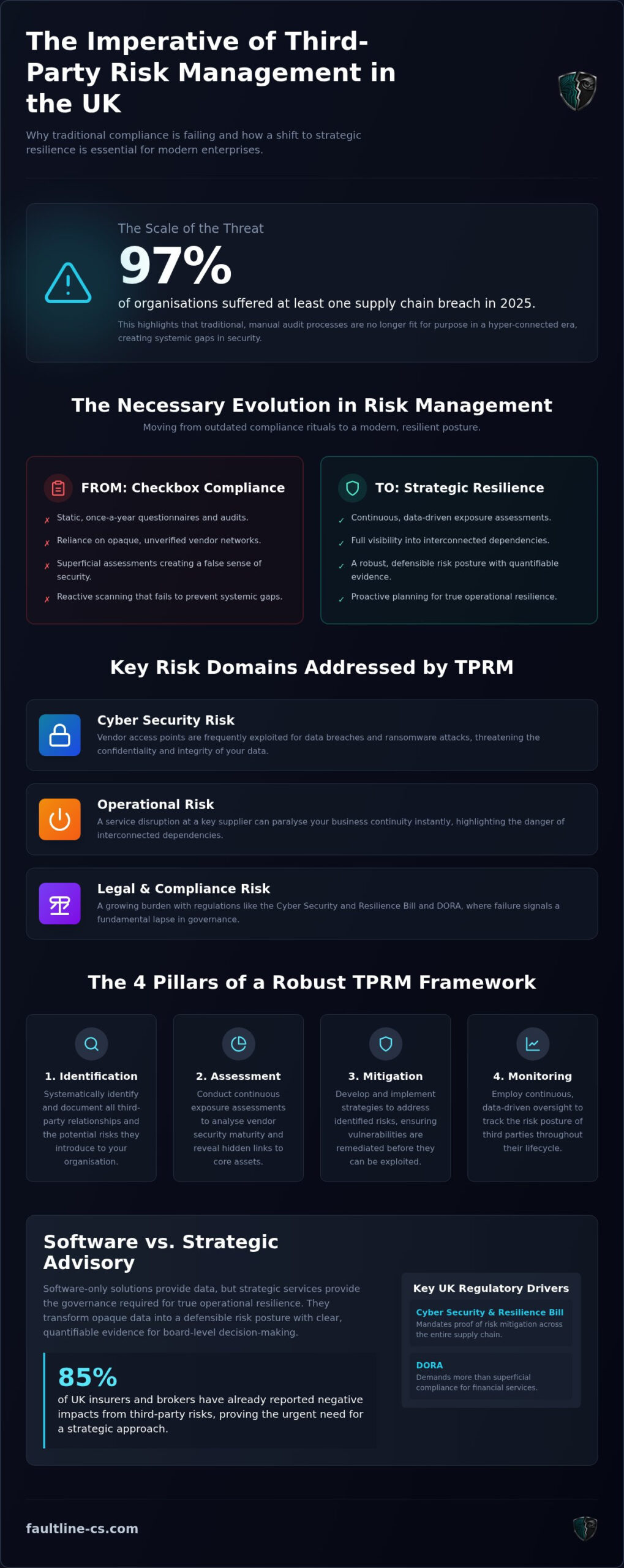
Ninety-seven per cent of organisations suffered at least one supply chain breach in 2025. This staggering figure suggests that traditional, manual audit processes are no longer fit for purpose in an era of hyper-connectivity. For many UK directors, the reliance on opaque vendor networks represents a systemic gap that technical fixes alone cannot bridge. Engaging professional third party risk management services UK has become a necessity for those who recognise that operational resilience is now a mandate, not an option.
You’re likely aware that the regulatory landscape is shifting, with the Cyber Security and Resilience Bill and DORA demanding more than just superficial compliance. We understand the difficulty of quantifying these hidden vulnerabilities to a board that requires evidence over assumptions. This guide provides a strategic roadmap for transitioning from basic checkbox exercises to a robust, defensible risk posture. We will examine how to gain full visibility into your supply chain, automate inefficient audits, and ensure your organisation remains resilient against the inevitable disruptions of the modern market.
Key Takeaways
- Learn why traditional checkbox compliance is insufficient and how continuous exposure assessments reveal hidden systemic gaps within your vendor network.
- Understand the limitations of software-only solutions and how strategic third party risk management services UK provide the governance required for true operational resilience.
- Navigate the evolving UK regulatory landscape, including the Cyber Security and Resilience Bill and DORA, by shifting from reactive scanning to proactive planning.
- Discover how to transform opaque supply chain data into a defensible risk posture that provides clear, quantifiable evidence for board-level decision-making.
What are Third Party Risk Management Services in the UK?
Compliance is not security. For the modern enterprise, the reliance on external partners has transformed from a tactical advantage into a strategic vulnerability. Third Party Risk Management (TPRM) is the systematic process of identifying, assessing, and mitigating the risks that enter your organisation via your supply chain. In the United Kingdom, where critical national infrastructure and financial services are increasingly interconnected, these services have evolved. They no longer rely on static, once-a-year questionnaires. Instead, effective third party risk management services UK providers offer continuous, data-driven oversight that ensures enterprise resilience in an unpredictable market.
At its core, Third-party management serves as a safeguard for the operational logic of the business. It encompasses the entire supplier lifecycle, from initial due diligence to offboarding. By moving beyond a simple “tick-box” approach, UK leadership can gain the visibility required to protect reputational integrity and financial stability. This is particularly vital as 85% of UK insurers and brokers have already reported negative impacts from third-party risks, according to industry research. A robust TPRM programme acts as a pragmatic sentinel, ensuring that external partnerships strengthen rather than weaken your defensible posture.
The Expanding Scope of the UK Supply Chain
The traditional corporate perimeter has dissolved. In a cloud-first business environment, your data and operations are often managed by entities you don’t directly control. This shift from simple vendor management to complex supply chain resilience is a response to the systemic risks inherent in modern outsourcing. When a single software provider or logistics partner fails, the ripple effect can paralyse an entire sector. Recognising these interconnected dependencies is the first step toward securing the modern supply chain against hidden vulnerabilities.
Key Risk Domains Addressed by TPRM Services
Modern risk management must address several critical fronts simultaneously. Cyber security remains a primary concern, as vendor access points are frequently exploited for data breaches and ransomware attacks. However, operational risk is equally significant; a service disruption at a key supplier can halt your business continuity instantly. Finally, the legal and compliance burden is growing. With the introduction of the Cyber Security and Resilience Bill and the implementation of DORA, UK firms face strict mandates to prove they have identified and mitigated risks across their entire third-party ecosystem. Failing to meet these standards results in more than just fines; it signals a fundamental failure in governance.
The Components of a Robust TPRM Framework
Static assessments are a liability. A framework that treats third-party risk as a one-time onboarding hurdle fails to account for the fluid nature of modern supply chains. To be effective, third party risk management services UK must be integrated into the very fabric of corporate governance. This requires a transition from isolated technical checks to a holistic system built on four critical pillars: Identification, Assessment, Mitigation, and Monitoring. This structure ensures that every external relationship is evaluated not just for its digital footprint, but for its impact on your overall operational logic.
A sophisticated programme prioritises visibility. It utilises exposure assessments to reveal hidden links between suppliers and your core assets, ensuring that no vulnerability remains unmapped. This level of insight is essential for aligning with international standards, such as the G7 third-party cyber risk framework, which advocates for a principle-based approach to managing external threats. By embedding GRC consulting into this framework, leadership can ensure that risk management isn’t just a compliance exercise but a driver of strategic resilience. For organisations looking to bridge the gap between technical data and board-level strategy, a tailored Supplier & Third-Party Risk Analysis provides the necessary clarity.
Supplier Due Diligence and Onboarding
Standard questionnaires are insufficient for high-risk vendors. They provide a self-reported snapshot that often ignores the physical and operational realities of a business. A robust onboarding process must incorporate physical security audits and an analysis of the vendor’s internal logic. By setting a baseline for security maturity using data-driven readiness frameworks, you can identify systemic gaps before a contract is even signed. This proactive stance prevents the introduction of weak links into your ecosystem.
Continuous Monitoring and Threat Detection
The transition from annual audits to real-time oversight is non-negotiable. Managed Security Service Providers (MSSPs) play a vital role here, providing the security operations centre (SOC) capabilities required to track supplier-related threats as they emerge. By leveraging SIEM solutions, organisations can identify anomalous behaviour amongst third-party accounts, detecting potential compromises before they escalate into full-scale breaches. Continuous monitoring transforms your risk posture from a reactive “hope for the best” strategy into a defensible, evidence-based operation.
Software vs. Strategic Advisory: Choosing the Right Approach
Automation is not a strategy. Many UK organisations fall into the “Silo Trap” by procuring expensive software platforms and assuming the risk is managed. Whilst these tools excel at processing vast quantities of data, they often lack the contextual insight required to identify systemic operational gaps. A software dashboard might present a sea of green lights, but it rarely accounts for the human behaviour and operational logic that drive true security. Professional third party risk management services UK provide the gravitas required to interpret these metrics, offering a strategic wake-up call that software alone cannot deliver.
The distinction lies between raw data and actionable evidence. An algorithm can scan a supplier’s external perimeter, but it cannot assess the maturity of their internal governance or the resilience of their recovery plans. Strategic advisory services act as a pragmatic sentinel, bridging the gap between technical scans and board-level decision-making. This human-led approach ensures that risk management remains focused on business outcomes rather than just technical fixes. It provides the clarity needed to understand not just what the risks are, but how they specifically threaten your organisation’s unique operational flow.
The Limitations of Automated Risk Scoring
A “Green” score in a vendor portal can mask critical vulnerabilities. These scores are frequently based on self-reported supplier data or superficial outside-in scans that fail to verify the actual effectiveness of controls. Relying on these metrics without independent verification is a dangerous gamble. Professional realism identifies the risks that algorithms overlook, such as a supplier’s lack of a tested exit strategy or poor internal security culture. Without this deeper investigation, your organisation remains exposed to hidden vulnerabilities that no automated tool will ever flag.
The Value of Specialist GRC Consulting
Effective risk management must align with your organisation’s specific risk appetite. Specialist Governance, Risk & Compliance (GRC) Consulting ensures that third-party oversight is integrated into your broader corporate objectives. This involves developing bespoke remediation plans that suppliers can actually execute, rather than issuing generic demands that go ignored. By focusing on strategic alignment, consultants help you build a resilient ecosystem where every partnership is measured against its contribution to your long-term stability and regulatory standing. This tailored approach transforms risk management from a burden into a defensible strategic asset.
Navigating the UK Regulatory Landscape: NIS2 and DORA
Compliance has entered a new phase of individual accountability. The UK’s Cyber Security and Resilience Bill, introduced in November 2025, aligns domestic standards with the EU’s NIS2 Directive, placing direct responsibility for supply chain security on senior leadership. Simultaneously, the Digital Operational Resilience Act (DORA), which reached its implementation deadline on 17 January 2025, mandates that financial firms maintain rigorous oversight of their ICT providers. These regulations are not mere suggestions; they are legal frameworks with significant consequences for non-compliance. UK directors are now personally accountable for security governance failures that stem from unmitigated vulnerabilities within their third-party networks.
Managing this complexity requires a shift from reactive security to proactive governance. Many organisations are leveraging professional third party risk management services UK to ensure their frameworks meet these stringent standards. These services provide the necessary visibility to navigate a landscape where the UK’s Critical Third Parties (CTP) regime, operational as of 13 July 2026, grants regulators direct oversight of designated service providers. By grounding your risk posture in evidence rather than assumptions, you can ensure that your organisation remains both compliant and resilient.
Steps to Achieving Regulatory Alignment
Achieving compliance requires a methodical deconstruction of your current posture. It begins with a comprehensive gap analysis against the specific requirements of NIS2 and DORA. Once the gaps are identified, you must categorise your suppliers based on their criticality to your essential services. This prioritisation allows for a more efficient allocation of resources. Contracts should then be updated to include mandatory incident reporting and clear audit rights. Finally, implementing a continuous cyber readiness assessment programme ensures that compliance is maintained in real-time, rather than just during periodic reviews.
Supply Chain Due Diligence as a Competitive Advantage
Resilience is a market differentiator. A robust approach to supply chain due diligence UK standards facilitates smoother mergers and acquisitions (M&A) by providing prospective buyers with evidence of a secure, well-governed ecosystem. It also builds deep trust with clients who increasingly demand proof of resilience before entering into long-term partnerships. Utilising the FaultLine Cyber Readiness Assessment, powered by IntelSensus, allows organisations to prove their maturity with data-driven insights. By viewing compliance as a strategic asset, you move beyond mere survival to a position of market leadership.
FaultLine: Your Strategic Guide to Third-Party Resilience
FaultLine Cyber & Security Ltd delivers a sober, evidence-based approach to third-party risk. We recognise that the modern supply chain is not merely a technical network but a complex web of human behaviour and operational logic. By moving beyond superficial vulnerability scans, our third party risk management services UK provide senior leadership with the clarity required to build long-term resilience. We value transparency and logic, ensuring that your security posture is built on a foundation of verifiable evidence rather than optimistic assumptions.
Our methodology is centred on the FaultLine Cyber Readiness Assessment, powered by IntelSensus. This framework allows us to evaluate the maturity of your ecosystem with data-driven precision, identifying systemic gaps that traditional audits frequently overlook. We don’t act as a distant service provider. We function as a knowledgeable partner, offering a clear-eyed perspective on the reality of your external dependencies. This pragmatic approach ensures that your organisation moves from a state of hidden vulnerability to one of demonstrable, defensible strength.
Beyond Technical Fixes: Our Operational Logic
Security is as much about human behaviour as it is about technical systems. We uncover hidden risks by deconstructing operational workflows and understanding how third parties interact with your core assets. This comprehensive oversight is reinforced by the integration of SOC and SIEM monitoring, providing real-time detection of threats originating from vendor access points. Our assessments serve as a strategic wake-up call, highlighting overlooked vulnerabilities before they can be exploited. By understanding the logic behind your operations, we provide insights that algorithms alone cannot reach.
Next Steps for Securing Your Ecosystem
Securing your modern supply chain begins with visibility. Initiating a FaultLine Exposure Assessment allows you to identify your most critical operational gaps and prioritise remediation efforts effectively. From there, our Governance, Risk & Compliance (GRC) Consulting provides a structured roadmap for achieving alignment with the Cyber Security and Resilience Bill and DORA. We move seamlessly from identifying systemic problems to outlining a structured path forward, maintaining a sense of momentum that is both professional and thorough. This steady hand ensures that your risk governance is aligned with your broader business outcomes.
Enquire about our Supplier Risk Analysis services to transform your third-party governance from a checkbox exercise into a defensible strategic asset.
Building a Defensible Future for the UK Supply Chain
Operational integrity is no longer a peripheral concern; it’s a strategic mandate. As the regulatory landscape shifts toward personal accountability for UK directors, the transition from superficial technical scanning to robust governance has become essential. True resilience requires a shift in perspective, moving from a reliance on opaque vendor networks to a state of full visibility where every dependency is measured and mitigated. By integrating continuous monitoring with comprehensive physical and digital exposure analysis, organisations can ensure they remain secure against systemic disruptions.
Professional third party risk management services UK provide the necessary clarity to navigate these complexities with confidence. FaultLine delivers the specialist GRC and operational resilience expertise required to transform raw data into a defensible risk posture. Our IntelSensus-powered Cyber Readiness Assessments provide the evidence-based insights needed to satisfy both regulators and the board. Secure your supply chain with FaultLine’s specialist TPRM services. Taking this first step ensures your organisation remains a steady hand in an increasingly complex global market.
Frequently Asked Questions
What is the primary goal of third-party risk management services in the UK?
The primary goal is to secure the operational logic of an organisation by identifying and controlling risks introduced by external partnerships. It moves beyond simple technical checks to ensure that the entire supply chain supports long-term resilience. This process protects financial stability and reputational integrity by providing visibility into hidden vulnerabilities that could disrupt core business functions.
How does NIS2 affect third-party risk management for UK businesses?
NIS2, and its UK equivalent via the Cyber Security and Resilience Bill, places personal accountability on leadership for supply chain security. Organisations must implement rigorous risk management measures and incident reporting protocols for their suppliers. This shift ensures that third-party vulnerabilities are no longer treated as isolated technical issues but as central components of corporate governance.
What is the difference between vendor risk management and TPRM?
Vendor risk management typically focuses on the procurement cycle and individual contract compliance. TPRM is a more comprehensive, strategic approach that evaluates the entire ecosystem. It considers the systemic impact of all external relationships, including the risks posed by your vendors’ own suppliers, ensuring that no part of the chain remains opaque.
Can TPRM services help with DORA compliance?
Professional third party risk management services UK are specifically designed to meet the stringent demands of DORA. These services provide the framework for the mandatory oversight of ICT third-party service providers. By utilising data-driven assessments, firms can demonstrate the high level of digital operational resilience required by UK and EU financial regulators.
Why is a questionnaire-only approach to supplier risk considered a failure?
Questionnaires provide a self-reported snapshot that often lacks objective evidence. They cannot verify the actual maturity of a supplier’s internal controls or their ability to recover from a disruption. Relying solely on these documents creates a false sense of security, masking critical operational gaps that only an independent, evidence-based assessment can reveal.
How often should a UK organisation audit its high-risk suppliers?
High-risk suppliers should be subject to continuous monitoring rather than annual reviews. Whilst a formal deep-dive assessment is advisable every 12 to 18 months, real-time oversight is necessary to track emerging threats. This ensures that any decline in a supplier’s security posture is identified and addressed before it impacts your own operations.
What role does an MSSP play in managing third-party cyber risk?
An MSSP provides the security operations centre (SOC) capabilities required to monitor third-party access in real-time. By integrating SIEM solutions, they can detect anomalous behaviour amongst external accounts that might indicate a compromise. This technical layer of defence is a vital component of a resilient third party risk management services UK strategy.
How do you measure the ROI of third-party risk management consulting?
ROI is demonstrated by the mitigation of potential losses from operational downtime and regulatory fines. It’s also found in the increased efficiency of the procurement process and the ability to provide clients with a defensible, secure posture. Effective consulting turns risk management into a competitive advantage during mergers, acquisitions, and major contract bids.
Leave a Reply