


Your supply chain is no longer a peripheral operational concern; it is your most significant unmapped liability. For many UK boards, the complexity of opaque supplier networks remains a hidden vulnerability that could lead to catastrophic reputational damage or heavy financial penalties. As of July 2026, the stakes have escalated with proposed amendments to the Modern Slavery Act introducing fines of up to £1 million or 1% of turnover. Mastering supply chain due diligence UK standards is no longer about simple compliance. It’s about ensuring your organisation’s survival in a landscape where transparency is the new currency of trust.
You likely feel the pressure of conflicting requirements, from the rigorous NHS procurement rules to the new mandatory deforestation due diligence for firms exceeding a £1 million turnover. We understand that security is as much about operational logic as it is about human behaviour and technical systems. This article provides a definitive roadmap to navigate these evolving regulations, helping you transform a perceived compliance burden into a robust strategic advantage. We’ll explore the transition from transparency to mandatory action, ensuring your governance framework provides the visibility required to mitigate systemic gaps and secure long-term resilience.
Key Takeaways
- Recognise why 2026 marks a definitive shift from passive transparency to mandatory accountability and the potential for significant financial penalties.
- Understand the necessity of a multi-dimensional scrutiny model that integrates cyber, physical, and operational risks to uncover hidden systemic vulnerabilities.
- Learn how to implement a future-proof framework for supply chain due diligence UK by tiering suppliers based on their critical impact on your operational resilience.
- Challenge the illusion of regulatory safety by moving beyond static annual audits toward continuous exposure assessments and evidence-based governance.
- Discover how to transform compliance requirements into a strategic advantage that builds board-level confidence in your organisation’s long-term stability.
The Shifting Landscape of Supply Chain Due Diligence in the UK
Your supplier network is no longer a separate entity; it’s a direct extension of your corporate risk profile. At its core, supply chain due diligence is the systematic identification and mitigation of third-party risks. It’s the process of ensuring that every link in your operational chain is as resilient as the core of your business. 2026 represents a critical juncture for UK regulatory scrutiny. Boards can no longer plead ignorance regarding the failings of their partners. The cost of negligence has transitioned from theoretical reputational damage to concrete legal and financial liability.
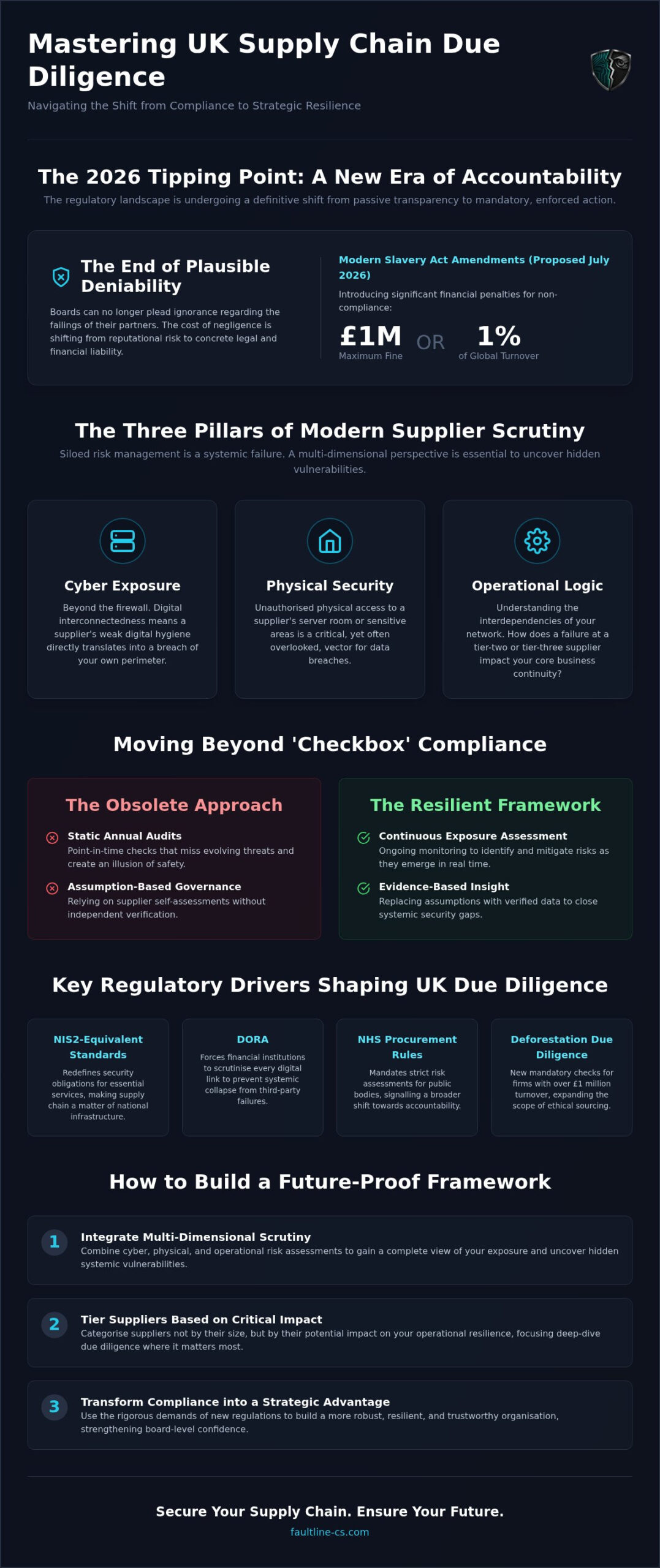
The evolution from ‘know your supplier’ to ‘know your supplier’s security posture’ is complete. Simply verifying a business’s registration or tax status is insufficient. Modern supply chain due diligence UK requirements demand that you understand the integrity of a partner’s internal controls and digital hygiene. Establishing a robust due diligence framework is now a prerequisite for any organisation seeking to avoid systemic failure. Directors now face a landscape where oversight is a personal mandate, with proposed amendments to the Modern Slavery Act in June 2026 introducing fines of up to £1 million or 1% of total turnover for non-compliance.
The Regulatory Drivers: NIS2, DORA, and the Modern Slavery Act
The UK’s regulatory environment is tightening with clinical precision. NIS2-equivalent standards have redefined obligations for essential services, making supply chain security a matter of national infrastructure. Meanwhile, the Digital Operational Resilience Act (DORA) forces financial institutions to scrutinise every digital link, ensuring that a failure at a third-party software provider doesn’t trigger a systemic collapse. Whilst the Modern Slavery Act 2015 established a foundation for labour transparency, the 2026 landscape demands active, evidence-based intervention. Recent NHS procurement regulations, effective from May 2026, already mandate strict risk assessments for public bodies, signalling a broader shift toward mandatory accountability across all sectors.
The Move Towards Operational Resilience
Business continuity plans that stop at your own front door are obsolete. True resilience requires depth. This shift moves organisations away from annual, “tick-box” audits toward continuous security monitoring and managed detection. In this context, operational logic means understanding the interdependencies of your entire network. If a tier-two supplier fails, how does that impact your delivery? We focus on visibility and insight, replacing assumptions with evidence to close the systemic gaps that annual audits often ignore. Security is not a static state; it’s a continuous process of exposure assessment and strategic alignment.
The Three Pillars of Modern Supplier Scrutiny: Cyber, Physical, and Operational
Siloed risk management is a systemic failure waiting to happen. Many UK organisations treat cyber security as an IT issue and physical security as a facilities concern, yet in a modern supply chain, these boundaries don’t exist. If an unauthorised individual gains physical access to a supplier’s server room, your digital perimeter is effectively breached. Effective supply chain due diligence UK requires a multi-dimensional perspective that maps the interdependencies between your partners and your core business functions. Without this visibility, you’re merely managing fragments of a larger, more dangerous puzzle.
Identifying the weakest link in your ecosystem demands a comprehensive exposure assessment. It’s not enough to know who your suppliers are; you must understand how their vulnerabilities translate into your risks. As industry bodies advocate for more robust mandatory due diligence laws, the expectation for directors to demonstrate oversight of these converged risks has never been higher. Relying on isolated data points creates an operational illusion of safety that won’t survive a real-world crisis.
Cyber Exposure: Beyond the Firewall
Digital interconnectedness has turned supplier access levels into primary attack vectors. Over-privileged accounts often provide third parties with far more reach into your internal systems than their role requires, creating a silent path for lateral movement during a breach. Managed services, such as 24/7 SOC and SIEM monitoring, are essential for detecting these anomalous digital interactions in real time. In this context, cyber exposure is the aggregate risk profile created by the digital dependencies and shared access permissions between an organisation and its third-party partners. Understanding this profile is the first step toward reclaiming control over your digital estate through a targeted supplier and third-party risk analysis.
Physical and Operational Security Gaps
Physical security remains an overlooked vulnerability in the UK’s corporate landscape. A supplier’s lack of robust site access controls or poor hardware disposal policies can lead directly to data exfiltration or operational sabotage. Beyond physical entry, you must evaluate their business continuity plans with clinical realism. Can they survive a systemic shock, such as a regional power failure or a major transport strike? Operational resilience isn’t about having a plan on paper; it’s about ensuring your suppliers are as prepared for a crisis as you are. We focus on identifying these hidden systemic gaps, moving beyond the superficiality of software-only risk assessments to provide a grounded, evidence-based view of reality.
Beyond Checkbox Compliance: Why Regulatory ‘Safe’ is an Operational Illusion
Compliance is often mistaken for security. It is a common boardroom fallacy that a supplier’s ISO 27001 certification or a signed code of conduct equates to operational resilience. In reality, these are merely badges of intent. A business can be perfectly aligned with current legislation and still be utterly vulnerable to a tier-three supplier failure. Contracts don’t stop ransomware, and a signed indemnity clause won’t restore your reputation after a systemic data breach. Relying on annual questionnaires is like checking the weather once a year and assuming the forecast remains valid for the next twelve months.
Effective supply chain due diligence UK strategies must move beyond the legal department’s filing cabinet. Whilst the UK Government Guidance on Supply Chain Due Diligence provides a necessary baseline for labour and tax compliance, it does not account for the technical and operational interdependencies of 2026. Directors must demand evidence-based validation over self-reported data. If you aren’t verifying the security posture of your partners through active scrutiny, you aren’t managing risk; you’re simply documenting its existence.
The GRC Gap: Why Frameworks Fail in Practice
Governance, Risk, and Compliance (GRC) frameworks fail when they are treated as paperwork exercises rather than operational mandates. The gap between a policy on a server and the actual behaviour of employees within your supply chain is where most vulnerabilities reside. Strategic alignment is vital. Your IT, Legal, and Procurement teams must operate as a single unit rather than in silos. When procurement prioritises cost over a supplier’s security maturity, they are effectively purchasing a future liability that the IT team will eventually have to manage. Security governance must reflect the messy reality of human behaviour, not the sterile perfection of a spreadsheet.
Evidence Over Assumptions: The Case for Exposure Assessments
Moving from a culture of trust to one of verification is a strategic necessity. Data-driven readiness assessments provide the clarity that static audits lack, offering what we describe as a controlled wake-up call for leadership. These assessments reveal uncomfortable truths about hidden vulnerabilities before they can be exploited. By quantifying third-party risk through technical evidence, you can present a clear-eyed perspective to the board. This approach transforms abstract technical concerns into tangible business outcomes, allowing for a more logical allocation of resources toward the areas of highest systemic risk. Engaging specialist third party risk management services UK organisations trust provides the structured methodology needed to move from assumptions to defensible, evidence-led conclusions.
Constructing a Resilient Supply Chain Due Diligence Framework
A framework is not a document to be filed; it’s a living operational process. Most organisations fail because they treat due diligence as a hurdle to be cleared during onboarding. True resilience requires the integration of scrutiny into the entire supplier lifecycle. To build a future-proof supply chain due diligence UK strategy, you must move beyond the basic “Check, Act, Review” cycles suggested by generic guidance. You need a methodical deconstruction of your third-party ecosystem that prioritises evidence over assumptions.
Organising your network by risk tier allows you to focus your most intensive resources where they matter most. It’s an exercise in strategic prioritisation. By embedding continuous monitoring into your governance model, you ensure that your security posture remains robust long after the initial contract is signed. This methodical approach moves your organisation from a reactive state of “firefighting” to a proactive position of controlled oversight.
Step 1: Supplier Mapping and Risk Tiering
Resource allocation must be dictated by risk, not volume. You cannot scrutinise every supplier with the same intensity, so you must identify the critical third parties that pose a systemic risk to your operations. Categorise your partners into tiers based on their level of data access, physical proximity to your assets, and their operational criticality. A dynamic risk map of your entire UK supply chain allows the board to see exactly where a single point of failure could trigger a wider collapse. This visibility ensures that high-impact suppliers receive the deepest level of technical and operational validation.
Step 2: Implementing Continuous Monitoring
The transition from annual audits to continuous monitoring is the hallmark of a mature security posture. Static assessments are only valid for the moment they are completed. To maintain oversight of high-risk supplier connections, a 24/7 SOC is essential. By utilising SIEM solutions to detect anomalous behaviour amongst third-party accounts, you can identify threats before they escalate into full-scale incidents. Continuous monitoring dramatically reduces the dwell time of a supply chain breach by identifying unauthorised lateral movement the moment it occurs. This proactive stance is a core component of our Operational Resilience Services, providing the steady hand needed to manage complex digital dependencies.
Step 3: Incident Response and Operational Resilience
Resilience is tested in the hours following a compromise, not during the planning phase. You must establish collaborative incident response protocols with your key suppliers. This includes defining clear communication channels and shared responsibilities for when a third party is breached. Joint tabletop exercises and simulations are vital for uncovering the friction points that occur during a crisis. Testing your response in a controlled environment ensures that when a real-world shock occurs, your organisation and its partners can act with clinical precision rather than panicked confusion.
Fortifying Your Ecosystem: Strategic Governance and Exposure Assessments
Resilience is not a byproduct of chance; it is the result of deliberate strategic alignment. In an increasingly complex regulatory environment, FaultLine serves as the steady hand for senior leadership, providing the clarity required to manage opaque and often volatile supplier networks. Effective supply chain due diligence UK requires more than just a passing acquaintance with the law. It demands a governance framework that is firmly rooted in operational reality. Our specialist GRC consulting ensures that your organisation meets the rigorous demands of NIS2 and DORA alignment whilst maintaining the agility needed to respond to emerging threats.
The transition from reactive firefighting to proactive threat management represents a fundamental shift in corporate philosophy. It requires moving away from the “fire and forget” mentality of annual audits and toward a model of continuous oversight. By identifying systemic gaps before they are exploited, we help you transform compliance from a recurring burden into a competitive advantage. This approach provides the board with the confidence that supply chain resilience is a measurable, managed outcome rather than a hopeful assumption. We focus on business outcomes, ensuring that your security investments are logically aligned with your strategic goals.
The FaultLine Approach: Evidence-Based Resilience
Current audit methods often fail because they rely on the supplier’s own perception of their security posture. Our exposure assessments remove this subjectivity by uncovering the hidden gaps that self-reported data inevitably misses. The FaultLine Cyber Readiness Assessment, powered by IntelSensus, provides a data-driven framework for evaluating security maturity with clinical precision. This process bridges the gap between the boardroom and the server room, translating technical vulnerabilities into the high-level language of risk management and corporate governance. It provides a controlled wake-up call that allows leadership to address weaknesses before they result in a catastrophic failure, ensuring that your operational logic is as sound as your technical systems.
Next Steps for Senior Leadership
Securing your ecosystem begins with asking the right questions of your technical leadership. Directors must demand visibility into the potential “dwell time” of breaches originating within their third-party network. To improve your posture immediately, start by categorising your suppliers by their impact on your core business functions rather than their contract value. Once your risk tiers are established, move beyond static questionnaires and implement a regime of continuous technical validation. If you are ready to move from assumptions to evidence, the most logical first step is to Book a FaultLine Cyber Readiness Assessment today. This is the only way to ensure your organisation remains a resilient sentinel in an era of systemic vulnerability.
Securing Your Operational Future through Strategic Resilience
Static compliance is a relic of a less interconnected era. To thrive in 2026, UK directors must embrace a model of continuous verification that prioritises evidence over assumptions. True supply chain due diligence UK standards require a multi-dimensional approach that integrates cyber, physical, and operational security into a single, cohesive framework. By moving toward continuous monitoring and tier-based risk management, you close the systemic gaps that leave your organisation vulnerable to third-party failures.
FaultLine acts as a strategic guide in this complex environment. Our specialist GRC consulting and managed SOC and SIEM services transform regulatory burdens into operational advantages. By utilising the FaultLine Cyber Readiness Assessment, powered by IntelSensus, you gain the visibility required to make informed, board-level decisions about your ecosystem’s maturity. Don’t wait for a crisis to reveal your hidden liabilities. Secure your supply chain with a strategic Exposure Assessment from FaultLine and take control of your operational logic today to ensure a more resilient tomorrow.
Frequently Asked Questions
What is the primary regulation for supply chain due diligence in the UK?
The UK does not have a single overarching piece of legislation for all sectors, instead relying on a composite of the Modern Slavery Act 2015 and sector-specific mandates like the Data Protection Act 2018. For 2026, the proposed amendments to the Modern Slavery Act represent the most significant shift, introducing financial penalties of up to £1 million for organisations that fail to meet transparency and reporting requirements. This creates a mandatory requirement for boards to demonstrate active, evidence-based oversight of their labour supply chains.
How often should I audit my high-risk suppliers for cyber security?
Annual audits are no longer sufficient for high-risk partners who maintain direct access to your internal systems or handle critical data. High-risk suppliers require quarterly technical reviews or, ideally, continuous monitoring through managed SOC and SIEM services to detect threats as they emerge. This shift ensures that your supply chain due diligence UK strategy reflects the real-time nature of digital threats rather than relying on a static, historical snapshot of a supplier’s security posture.
Can I be held legally liable for a supplier’s cyber breach?
Legal liability is a direct consequence of failing to exercise adequate oversight, particularly under the Data Protection Act 2018 and sector-specific mandates like DORA. If a supplier’s failure results in the compromise of personal data you control, the Information Commissioner’s Office (ICO) will scrutinise your due diligence process. Directors face personal accountability and significant regulatory fines if they cannot prove that reasonable, evidence-led steps were taken to verify the supplier’s internal security controls.
What is the difference between third-party risk management and supply chain due diligence?
Supply chain due diligence is the targeted investigative process used to identify and assess risks before and during a partnership, whereas third-party risk management is the ongoing operational framework for governing those risks. Due diligence provides the evidence-based foundation for your strategy by revealing hidden vulnerabilities. Risk management ensures that the insights gained during the due diligence phase are continuously applied to maintain long-term operational resilience across the entire supplier lifecycle. Understanding how professional third party risk management services UK providers structure this ongoing governance can help directors distinguish between a one-time assessment and a sustainable, continuous oversight programme.
How do NIS2 and DORA affect UK supply chain requirements in 2026?
These regulations mandate that organisations in essential services and financial sectors take active responsibility for the security of their entire digital ecosystem. By 2026, DORA requires financial firms to conduct deep-dive assessments of their ICT third-party service providers to ensure systemic stability. NIS2-equivalent standards in the UK place similar pressure on critical infrastructure, forcing a transition from voluntary best practice to mandatory, evidence-led compliance that focuses on the interdependency of the network.
What are the hidden physical security risks in a digital supply chain?
Physical security risks often manifest as unauthorised access to a supplier’s server rooms or poor disposal policies for decommissioned hardware containing sensitive data. If a partner’s site security is lax, an intruder can gain direct access to the physical devices that connect to your digital network. This convergence of physical and cyber risk is frequently overlooked by leadership, creating a systemic gap that annual, software-based audits fail to detect or mitigate effectively.
Is ISO 27001 enough to satisfy UK supply chain due diligence requirements?
ISO 27001 is an important baseline for information security management, but it is not a guarantee of operational resilience or legal compliance in every sector. The certification proves that a supplier has a management system in place, but it doesn’t validate the real-world effectiveness of their technical controls. Robust supply chain due diligence UK requires technical exposure assessments to verify that a supplier’s actual security behaviour matches their documented policies and meets current regulatory expectations.
How can I monitor supplier security without damaging the business relationship?
Framing security monitoring as a collaborative effort toward mutual resilience prevents the process from feeling like an adversarial audit. You should establish clear transparency requirements within your contracts from the outset, positioning these technical checks as a shared business outcome rather than a lack of trust. When both parties understand that a breach at either end of the chain is a mutual failure, continuous monitoring becomes a logical component of a high-value partnership.

Article by
Alex J Morgan
Alex Morgan is a content and web specialist supporting FaultLine Cyber & Security Ltd, with years of experience and teaching in web development, content creation, organic SEO, PPC and SMM since 2009.
Leave a Reply