


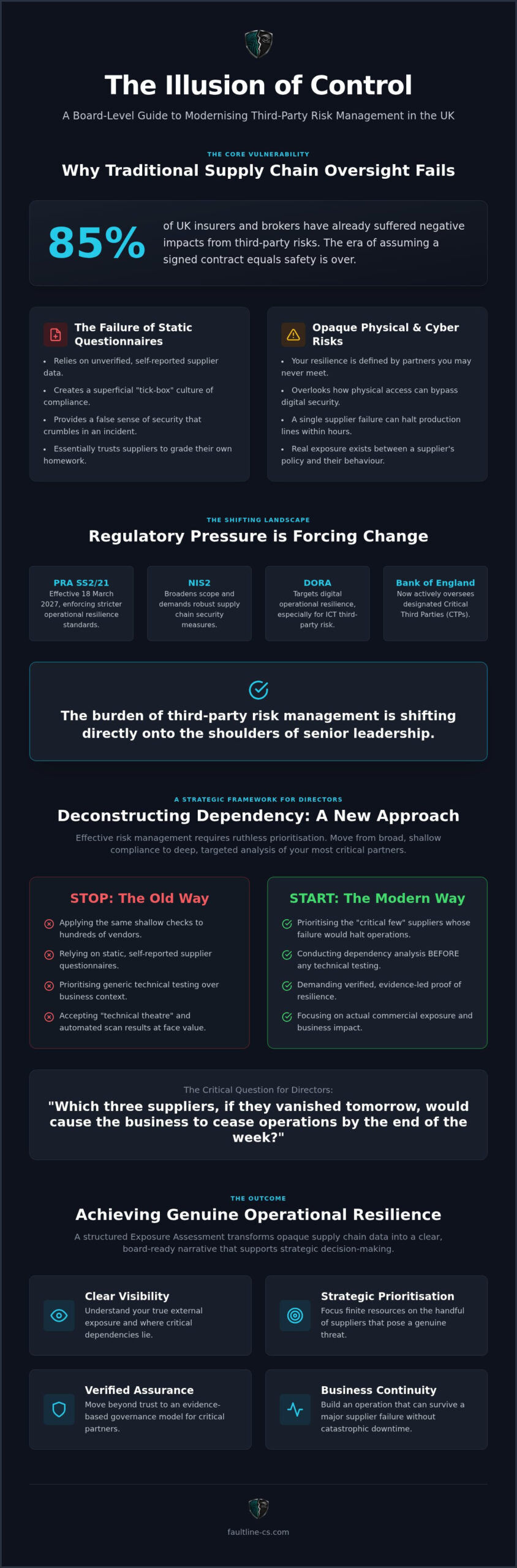
Your operational resilience is no longer defined by what happens within your four walls, but by the security posture of companies you may never meet. Most boards operate under a dangerous illusion of control, assuming that a signed contract or a completed spreadsheet equals safety. The reality is that 85% of UK insurers and brokers have already suffered negative impacts from third-party risks. With the Bank of England now overseeing designated Critical Third Parties and the PRA SS2/21 requirements becoming effective on 18 March 2027, the era of passive oversight is over.
It’s understandable to feel the weight of opaque supply chain dependencies and the mounting regulatory pressure from NIS2 and DORA. You need a resilient operation that can survive a major supplier failure without catastrophic downtime. This article provides a strategic roadmap to modernise your third-party risk management UK. You will learn how to identify hidden vulnerabilities within your supply chain and move beyond technical theatre to achieve genuine operational resilience. We will explore how to gain clear visibility of your external exposure and align your governance with the latest UK and EU standards to ensure your business remains functional regardless of external shocks.
Key Takeaways
- Recognise why traditional static questionnaires fail to protect your business and how they often become nothing more than a superficial tick-box exercise for suppliers.
- Identify the critical few suppliers whose failure would halt your operations by prioritising dependency analysis over generic technical testing.
- Understand how the evolving regulatory landscape, including NIS2 and DORA, shifts the burden of third-party risk management UK directly onto the shoulders of senior leadership.
- Learn to look past technical theatre and automated scanning to find advisors who provide a clear-eyed perspective on your actual commercial exposure.
- Discover how a structured Exposure Assessment can transform opaque supply chain data into a board-ready narrative that supports strategic resilience.
The UK Supply Chain Vulnerability: Why Traditional Risk Management Fails
Supply chain security is the weakest link in corporate governance. Traditional third-party risk management focuses on the wrong indicators. It prioritises administrative compliance over operational reality. For UK firms in logistics and manufacturing, these interconnected dependencies create a surface area for failure that most boards haven’t fully mapped. When a single component supplier or haulage partner fails, the ripple effect can halt production lines within hours. This isn’t just a technical problem; it’s a fundamental threat to business continuity.
Real exposure exists in the space between a supplier’s self-assessment and their actual daily behaviour. A secure network is worthless if a physical delivery partner has unchecked access to your loading bay or shared server rooms. Effective third-party risk management UK requires moving beyond trust and towards verified evidence. It’s about understanding the commercial impact of a supplier’s downtime on your own bottom line.
To gain a deeper perspective on the strategic importance of this discipline, watch this discussion on risk management frameworks:
The Failure of Static Questionnaires
Trusting a supplier to grade their own homework is a fundamental strategic error. Static questionnaires are snapshots of a moment that likely never existed. They suffer from an inherent “honesty gap” where suppliers, eager to secure or retain a contract, provide the answers they think you want to hear. This self-reported data is often outdated before the ink is dry. Without evidence-led verification, these documents provide a false sense of security that crumbles during a real-world incident. Directors must demand more than simple assertions; they need proof of resilience. Understanding how to audit supplier security with a structured, evidence-led approach is the only way to move beyond these superficial self-assessments and gain a realistic picture of your exposure.
The Intersection of Physical and Cyber Dependency
Directors frequently overlook how physical vulnerabilities translate into digital disasters. A breach doesn’t always start with a phishing email. It can begin with shared infrastructure, co-located data centres, or unmonitored access points used by maintenance contractors. This “hidden exposure” is where systemic gaps reside. If your supplier’s physical security is compromised, your digital perimeter is effectively bypassed. Understanding this crossover is essential for building a truly resilient operation that can survive a partner’s failure. Our services focus on bridging this gap through rigorous analysis of these overlooked intersections.
Deconstructing Dependency: A Strategic Framework for UK Directors
Complexity is the enemy of resilience. Most boards approach third-party risk management UK as a volume game, attempting to apply the same shallow checks to hundreds of vendors. This diluted focus is a strategic error. Effective risk management requires a ruthless prioritisation of the “critical few” suppliers whose failure would immediately stop your production or service delivery. Dependency analysis must always precede technical testing; you cannot secure what you haven’t mapped. Directors must ask which three suppliers, if they vanished tomorrow, would cause the business to cease operations by the end of the week. Building a structured third party risk management framework is the most effective way to move from reactive oversight to a proactive, evidence-led approach that genuinely protects your operations.
The UK government has recognised this dangerous concentration of risk through new safeguards for major technology providers, targeting entities that pose systemic threats to the national infrastructure. For a director, the logic is identical. You must identify which partners hold the keys to your operational continuity. A deep, targeted analysis of five high-impact partners provides more protection than a broad, automated review of five hundred low-risk ones. It’s about deconstructing the operational trust assumptions your organisation makes every morning when the systems boot up. To achieve this, leadership should focus on three specific areas:
- Revenue Impact: Quantify the exact cost of downtime per hour for each critical partner.
- Sub-processor Visibility: Identify who your suppliers rely on to deliver their service to you.
- Alternative Readiness: Determine if a “warm standby” or alternative supplier actually exists for your most vital functions.
Mapping Your Critical Attack Paths
Attackers rarely strike the front door of a well-defended enterprise. They look for the “stepping stone”, a minor supplier with legitimate access but inferior security. These critical attack paths turn a small vendor’s vulnerability into your systemic failure. By mapping these routes, you can identify where a breach at a peripheral partner, such as a facilities management firm or a niche software provider, becomes an existential threat to your core data or manufacturing assets. It’s about seeing the business through the eyes of an adversary who prioritises the path of least resistance.
Operational Trust vs. Verified Security
Longevity is not a proxy for security. The assumption that a partner is safe simply because they’ve been on the books for a decade is a dangerous fallacy. This “implied trust” ignores the reality that your partners’ own supply chains and technical environments are in constant flux. Moving to a “verify then trust” model requires evidence-led assurance that evolves alongside the threat landscape. If you’re unsure where your most significant dependencies lie, you can speak with our team to begin a structured analysis of your external exposure.
Navigating the UK Regulatory Landscape: NIS2, DORA, and Beyond
Regulation is no longer a peripheral concern for the compliance team. It’s a direct boardroom responsibility. New frameworks like NIS2 and DORA are fundamentally altering how UK firms must approach their external dependencies. This shift isn’t limited to the City; manufacturing, logistics, and critical infrastructure sectors are now firmly within the regulatory crosshairs. Directors can no longer delegate the safety of their supply chain to technical teams and hope for the best. Accountability has become personal.
The landscape of third-party risk management UK is evolving to address systemic vulnerabilities that have long been ignored. Compliance is no longer about satisfying an auditor once a year. It’s about demonstrating continuous, evidence-led resilience. For leadership, this means moving beyond a “best efforts” approach to a structured regime of oversight that treats supplier failure as a certainty rather than a possibility.
NIS2 and the Impact on UK Infrastructure
The NIS2 Directive has expanded the definition of essential and important entities, bringing a vast array of UK firms into scope. If your business serves EU markets or operates within critical UK sectors like energy, transport, or water, you’re likely impacted. The directive mandates rigorous supply chain security policies, including supplier selection criteria and cybersecurity evaluations. Crucially, it introduces a “board accountability” factor. Leadership can now be held personally liable for systemic failures in risk management. Aligning your strategy with the NCSC supply chain security guidance is a necessary first step to meeting these heightened expectations.
DORA and Operational Resilience in Finance
The Digital Operational Resilience Act (DORA) has set a high bar for the financial sector since it came into effect in January 2025. It mandates that third-party risk management be a core operational requirement. The UK has mirrored this urgency with its own regime for Critical Third Parties (CTPs). As of July 2026, the Bank of England and the FCA have begun active oversight of designated CTPs, including major cloud providers. This focus on concentration risk highlights why robust supply chain due diligence UK is essential. You must understand not just your direct suppliers, but the critical infrastructure they depend on to keep your services running. With the PRA SS2/21 requirements becoming fully effective on 18 March 2027, the window for addressing these gaps is closing.
The “flow-down” effect of these regulations means that even small suppliers now face pressure to meet enterprise-grade standards. If a niche partner cannot prove their resilience, they become a liability that your business cannot afford to carry. This creates a more resilient ecosystem, but it requires directors to take an active role in vetting the entire supply chain. Senior leaders who want to understand how to structure their response to these demands should review the operational resilience framework UK regulators now expect as a core component of corporate governance. It’s about ensuring your business remains functional regardless of the regulatory or technical shocks that hit your partners.
Selecting a Third-Party Risk Partner: A Framework for Senior Leadership
Software is a tool, not a strategy. Many organisations fall into the trap of “technical theatre”, where automated scanning results are presented as comprehensive risk management. Whilst 64% of organisations now use dedicated TPRM software platforms, a mere dashboard of red and green lights cannot account for the nuance of human behaviour or physical operational gaps. A partner who only provides automated data is leaving you to do the hard work of interpretation. True third-party risk management UK requires a human-led approach that identifies what those red lights actually mean for your production line or service delivery. It’s about answering the “so what?” for directors who need to understand commercial exposure, not just technical scores.
Senior leadership needs a partner who provides a holistic view. This means looking beyond the digital perimeter to include physical security and operational logic. You shouldn’t settle for a distant service provider who treats your business as a generic data point. Instead, seek a strategic guide who prioritises “Pilot 0 thinking”. This mindset delivers immediate, actionable insights before you commit to heavy tool investment or long-term software contracts. It’s about finding the gaps that automated tools overlook, such as how a supplier’s staff turnover or physical site access could jeopardise your resilience. Evidence-led analysis should always outweigh assumptions, especially when 12% of organisations still rely on spreadsheets to manage hundreds of vendors.
The Difference Between Tools and Insights
Automated tools are efficient at finding known vulnerabilities, but they’re blind to context. A high-risk score on a minor vendor might be irrelevant, whilst a low-risk score on a critical partner could hide a systemic dependency that threatens your entire operation. Human-led analysis is what bridges this gap. It turns raw data into a narrative that a board can actually use to make decisions. When evaluating potential partners, ask to see examples of bespoke risk reporting. If the results look like a generic export from a software suite, they aren’t providing the level of insight required to protect a complex UK supply chain. You need a partner who can interpret the “honesty gap” in supplier reporting and provide a realistic view of your exposure. For organisations considering how continuous monitoring fits into this picture, understanding what a managed security service provider UK can offer beyond automated dashboards is an important part of evaluating your defensive options.
Evaluating the Advisor’s Commercial Acumen
An advisor must speak the language of business risk, not just IT security. If they can’t translate a technical finding into a commercial decision matrix, they aren’t a strategic partner. They need to understand the specific pressures of your industry, whether that’s the just-in-time requirements of manufacturing or the strict uptime demands of logistics. You should look for third party risk management services UK that align with national standards and demonstrate a deep understanding of local operational sectors. A partner with commercial acumen will focus on how a supplier’s failure impacts your revenue, ensuring that risk management supports business outcomes rather than just ticking a compliance box.
Closing the Exposure Gap: The FaultLine Approach to Supplier Assurance
Real-world incidents don’t occur in a vacuum. They happen in the exposure gap, the space where assumed security measures meet the messy reality of operational behaviour. Whilst large consultancies often propose multi-year, high-cost engagements that many UK mid-market firms find too slow and expensive, FaultLine Cyber & Security Ltd prioritises immediate clarity. We focus on the intersection of cyber, physical, and operational vulnerabilities to reveal the hidden risks that automated tools routinely miss. Effective third-party risk management UK is about identifying the realistic attack paths an adversary would actually take, rather than just ticking boxes on a compliance list.
The objective is operational resilience. Your business must remain functional regardless of the external shocks that hit your supply chain. We don’t act as a distant service provider but as a strategic guide, helping you move from a state of uncertainty to one of grounded expertise. By deconstructing complex systemic issues into categorised insights, we provide a steady hand for directors who need to navigate these high-stakes environments with confidence.
The Fixed-Price Exposure Assessment
Clarity shouldn’t be a luxury reserved for firms with seven-figure budgets. Our Exposure Assessment is a targeted, entry-level service designed for senior leaders who need answers quickly. For a fixed price of £5,000, we analyse up to five of your most critical suppliers to identify where your organisation is truly vulnerable. This isn’t a never-ending audit or a piece of technical theatre. It’s a practical starting point that delivers a board-level report in plain English. We strip away the unnecessary fluff to focus on the core message: what are the risks, and what is the strategic path forward? This deliverable provides a board-ready narrative that explains your external visibility without requiring technical expertise from the reader.
Building Long-Term Resilience
Securing the “critical few” is only the first step in a broader strategy. FaultLine supports ongoing governance, risk, and compliance (GRC) efforts, ensuring your operations align with standards like ISO 27001 and the latest UK regulatory requirements. For organisations seeking a deeper level of validation, we offer the FaultLine Cyber Readiness Assessment, powered by IntelSensus. This service provides a comprehensive deconstruction of your internal and external security posture, using evidence over assumptions to build a resilient operation. We encourage a proactive stance that treats security as a fundamental component of business logic. To begin identifying the vulnerabilities within your own supply chain, you should contact our team for a consultation.
Securing Your Operational Future
Operational resilience is no longer an optional project for the IT department; it’s a core survival requirement for the board. We’ve seen that static questionnaires and automated scans provide a dangerous illusion of safety. True third-party risk management UK requires a shift toward evidence-led verification and a ruthless focus on the dependencies that keep your production lines moving. With regulatory deadlines approaching and the cost of vendor breaches rising, the window for addressing these hidden vulnerabilities is closing.
Leadership in the UK operational sectors must now prioritise strategic alignment over superficial audits. Gaining clear visibility of your external exposure is the only way to satisfy new board-level accountability requirements. By choosing a specialist advisor with deep roots in manufacturing and logistics, you ensure that your risk reporting is grounded in operational logic. Our fixed-price entry service at £5,000 provides the evidence-led insights you need to make informed commercial decisions without the need for high-cost engagements. It delivers board-level, plain-English reporting that focuses on business outcomes rather than technical theatre.
Taking a proactive stance today ensures your business remains functional regardless of the shocks that hit your partners. You can build a resilient operation that survives supplier failure and meets every regulatory expectation with confidence.
Frequently Asked Questions
What is the most common third-party risk for UK businesses?
Supply chain compromise remains the most frequent vector for operational disruption. Attackers typically exploit a smaller, less secure partner to gain a “stepping stone” into a larger target’s network. This turns a minor vendor’s vulnerability into your systemic failure, often bypassing your primary defences through legitimate access points.
How does NIS2 affect UK companies that are not based in the EU?
NIS2 impacts any UK firm that provides essential services within the EU or acts as a critical supplier to EU-regulated entities. The directive mandates specific security measures and incident reporting requirements that flow down through the supply chain. UK directors must ensure compliance to maintain their market access and avoid personal liability for systemic failures.
Can a third-party risk assessment help with cyber insurance renewals?
Insurers now require robust third-party risk management UK as a standard condition for policy underwriting. Demonstrating a structured process to monitor your “critical few” suppliers provides the evidence-led assurance that carriers need to quantify their exposure. This transparency can help secure better terms and ensure your coverage remains valid during an incident.
How often should we audit our most critical suppliers?
Critical suppliers require continuous oversight rather than annual snapshots. Whilst a formal review every twelve months is a common baseline, high-impact partners should be monitored for operational changes or security incidents in real time. Static audits are often outdated before they are completed, leaving you blind to emerging vulnerabilities. Working with a managed security service provider UK can help bridge this gap by providing the continuous monitoring capability that periodic internal reviews cannot replicate.
What is the difference between a supplier questionnaire and an exposure assessment?
A questionnaire is a self-reported assertion, whilst an exposure assessment is a verified analysis of reality. Questionnaires rely on a supplier’s own interpretation of their security, which often leads to an “honesty gap”. An exposure assessment identifies the actual attack paths and vulnerabilities that exist in the supplier’s operational behaviour. Directors who want to understand the full scope of what a rigorous process involves should review our guidance on how to audit supplier security effectively, moving beyond self-reported data to verified, evidence-led findings.
Is third-party risk management mandatory for UK manufacturing firms?
Regulatory pressure and commercial contracts are making these practices effectively mandatory for the manufacturing sector. Many firms fall under the “important entities” category of NIS2 or serve as vital links in critical national infrastructure. Proving your operational resilience is becoming a prerequisite for winning and retaining major enterprise contracts.
How do we manage risk without damaging our relationship with key suppliers?
Transparency and shared goals are the foundation of healthy supplier relationships. Position your risk management efforts as a mutual commitment to operational uptime rather than an interrogation based on a lack of trust. Most professional suppliers welcome a structured approach that helps them identify and mitigate their own vulnerabilities.
What are the first steps a board should take to address supply chain risk?
Identify your critical dependencies immediately. A board should move beyond technical assumptions and commission a targeted third-party risk management UK review of the vendors whose failure would halt production. This provides the clarity needed to align your corporate governance with the practical reality of your external exposure.

Article by
Alex J Morgan
Alex Morgan writes and develops content for FaultLine Cyber & Security Ltd. Alex has worked across web development, organic SEO, digital marketing and content creation since 2009, with a particular focus on making complex subjects clear, useful and easy to navigate.
Leave a Reply