


Your server room is locked, but the external contractor who serviced the cooling units last week still holds an active, unmonitored key card. This is not a failure of your hardware; it’s a systemic gap in your operational logic that a physical security vulnerability assessment is designed to expose. Most directors recognise the frustration of approving significant capital expenditure on security technology only to find it offers little resistance against sophisticated, real-world breaches. You’re likely facing mounting pressure from the 24-month implementation period of Martyn’s Law, which received Royal Assent in April 2025, alongside the rigorous governance demands of NIS2.
We understand that security is as much about human behaviour as it is about technical systems. This guide explains how to identify the hidden entry points that compromise your cyber defences and operational resilience. You’ll discover how to move beyond expensive technical theatre and towards a strategy rooted in evidence rather than assumptions. We will outline a clear path to managing supplier access and aligning your physical site security with your broader corporate governance, ensuring your investment protects your production lines and your commercial reputation.
Key Takeaways
- Recognise why modern security must shift from simple asset protection to a broader focus on total operational resilience and business continuity.
- Understand the physical-to-cyber bridge where unauthorised site access allows intruders to bypass digital defences and compromise your network.
- Implement a strategic framework for your physical security vulnerability assessment to uncover hidden gaps in your perimeter and internal zones.
- Prepare for the upcoming enforcement of Martyn’s Law by aligning your physical security measures with the latest UK governance and compliance standards.
- Replace expensive technical theatre with a pragmatic Exposure Assessment that focuses on realistic attack paths and commercial risk.
What is a physical security vulnerability assessment in a modern business context?
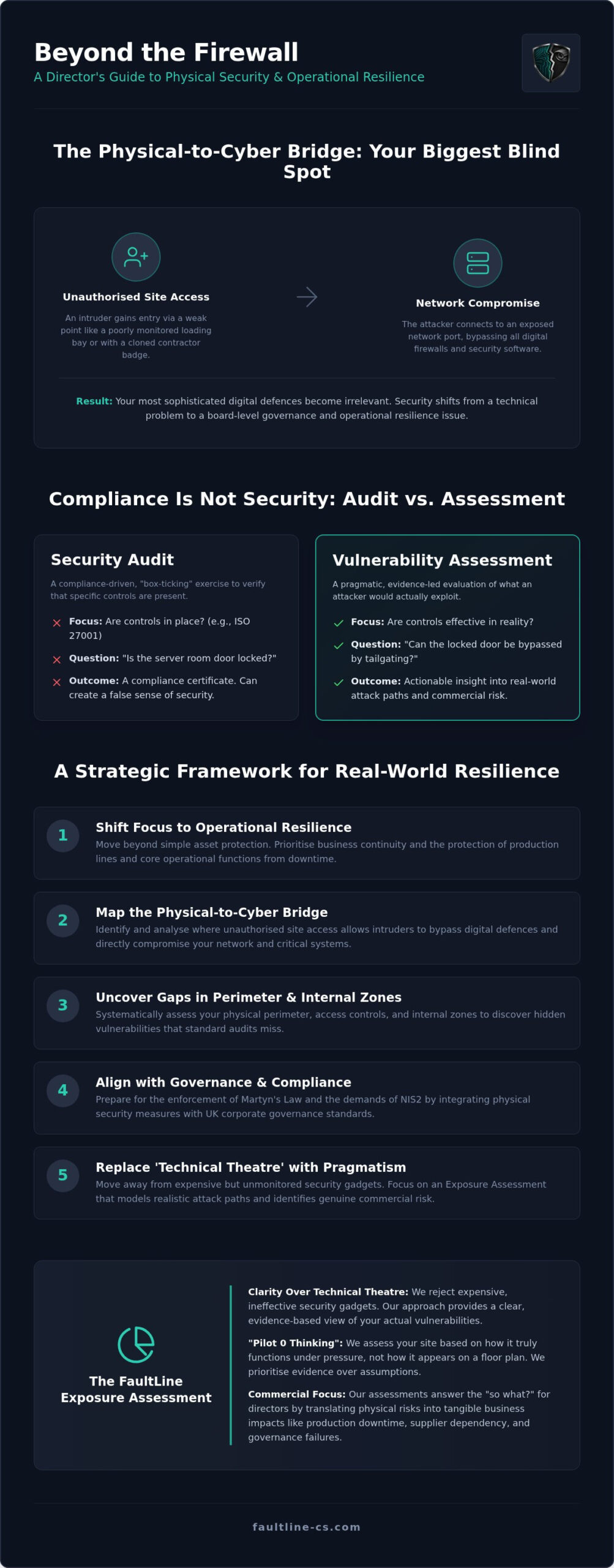
Physical security is no longer just about stopping the opportunistic thief. For a modern director, a physical security vulnerability assessment is a systematic evaluation of how your physical assets, people, and access controls either protect or expose your operational core. This process has shifted from traditional theft prevention to a focus on total operational resilience. It’s a strategic necessity because the “Exposure Gap” where physical and cyber risks overlap is now the primary entry point for sophisticated threats. If an intruder can gain physical access to a network port or a server room, your digital firewalls become irrelevant. This makes security a board-level governance issue rather than a task relegated to facilities management.
To understand how these physical risks translate into operational exposure, watch this overview of security management:
The difference between a security audit and a vulnerability assessment
Compliance does not equal security. A security audit is a box-ticking exercise designed to verify that specific controls, such as those required by ISO 27001:2022, are in place. In contrast, a physical security vulnerability assessment identifies the actual gaps that an attacker would exploit. It focuses on the “so what?” factor for operational leaders by modelling realistic attack paths. Whilst an audit might confirm a door is locked, an assessment will reveal if that door can be bypassed by someone with a cloned contractor badge or through a poorly monitored loading bay. This distinction is vital for manufacturing and logistics leaders who need to protect production lines from downtime rather than just satisfying a regulator.
Why traditional security measures often create a false sense of safety
Visible security hardware is often a comfort blanket for the board. We call this “technical theatre,” where expensive cameras and sensors are installed but rarely monitored or maintained. These systems create an illusion of safety whilst leaving systemic gaps wide open. Traditional measures often fail because they ignore human behaviour; for example, staff often prop open fire exits for convenience or allow “tailgating” through secure turnstiles. At FaultLine, we apply “Pilot 0 thinking” to see the real state of play. This approach prioritises evidence over assumptions, ensuring that your Exposure Assessment reveals how your site actually functions under pressure, not just how it looks on a floor plan.
The physical-to-cyber bridge: Why your site access is a digital risk
Digital defences are often bypassed by a single pair of boots on the ground. When an intruder gains physical entry to your facility, they don’t need to crack your encryption or exploit a complex software bug; they simply need to find an exposed network jack or an unlocked terminal. Your business exposure to cyber threats starts at the perimeter, not the firewall. If a server room is left unsecured or a network port in a public lobby remains active, the strongest digital perimeter can be circumnavigated in seconds. A comprehensive physical security vulnerability assessment must therefore account for how physical access facilitates digital breaches.
This risk is not merely theoretical. Microsoft reported in 2026 that phishing remains a dominant initial access method, often serving as the precursor to physical security tests where attackers use harvested credentials to gain site entry. Once an attacker has bridged the gap into your physical environment, they can access air-gapped systems or plant hardware that bypasses remote monitoring. By following established protocols like CISA’s SAFE assessment framework, organisations can begin to map these physical entry points to their digital consequences, ensuring that site security is viewed as a critical component of the IT stack.
Unsecured hardware and the risk of “shadow” devices
Physical access provides a direct path to your data through rogue hardware. An attacker can plant a “shadow” device, such as a rogue access point or a compact USB keylogger, that creates a persistent backdoor into your network. This also puts your physical backups at risk; if an unauthorised person can walk out with a drive, your encryption is the only remaining hurdle between them and your intellectual property. The physical-to-cyber bridge is the most overlooked vector in modern manufacturing environments. Conducting a physical security vulnerability assessment is the only reliable way to identify these silent listeners before they are activated.
The human element: Tailgating and operational trust
Polite office culture is a significant security liability. Most employees are conditioned to hold doors open for others, a behaviour known as tailgating that bypasses even the most expensive badge readers. In logistics and manufacturing hubs, the risk is compounded by the high volume of contractors and suppliers moving through the site daily. Shared access cards amongst staff or unmonitored visitor badges create gaps in your audit trail that attackers exploit with ease. Effective security requires testing these operational trust assumptions through evidence-led observation rather than relying on the presence of hardware alone. If you are unsure whether your current site controls can withstand a determined intruder, it may be time to discuss your specific operational risks with a specialist who understands the crossover between physical and digital threats.
Conducting a physical security assessment: A 5-step strategic framework
Effective security is not a product you buy; it is a process you govern. A physical security vulnerability assessment provides the evidence needed to move from assumptions to reality through a structured, five-step framework. This methodical approach ensures that your investment is directed towards actual risks rather than visible but ineffective deterrents.
- Step 1: Define the crown jewels. Identify the specific zones where a breach would halt production or expose sensitive intellectual property.
- Step 2: Map the perimeter. Evaluate external visibility signals and physical boundaries to see how your site appears to a motivated observer.
- Step 3: Evaluate supplier pathways. Analyse how third parties, from maintenance crews to delivery drivers, gain and maintain access to your critical zones.
- Step 4: Test crossover points. Examine the hardware security at the bridge between your physical site and your digital network.
- Step 5: Translate to exposure. Distil the findings into a board-level report that prioritises commercial risk over technical minutiae.
Identifying your “crown jewels” in manufacturing and logistics
Production lines and research labs are the primary targets for those seeking to disrupt your operations or steal proprietary processes. A physical breach in these areas does not just result in the loss of hardware; it creates catastrophic downtime that ripples through your entire supply chain. By identifying these critical operational zones early, you can align your security strategy with the core principles of an operational resilience framework UK. This ensures that your most valuable assets receive the highest level of protection, moving beyond a one-size-fits-all approach to site security.
Analysing supplier and third-party dependency
Your security is only as strong as the most junior contractor with a key card. Directors must audit supplier security to understand the risks posed by cleaning crews, maintenance contractors, and delivery drivers who move through secure zones daily. These external parties often represent a significant gap in identity management, as their credentials may not be revoked as strictly as those of permanent staff. Managing this exposure requires a clear-eyed look at how external parties are vetted and how their movement is monitored on-site. A robust physical security vulnerability assessment will reveal if your current supplier access policies are being followed in practice or if they have been bypassed by operational convenience.
Regulatory resilience: Martyn’s Law and UK compliance standards
Compliance is rapidly shifting from a voluntary best-practice framework to a mandatory legal requirement for UK directors. The introduction of the Terrorism (Protection of Premises) Act 2025, commonly known as Martyn’s Law, represents a fundamental change in how organisations must govern their physical spaces. Following its Royal Assent in April 2025, businesses are currently within a 24-month implementation period, with full enforcement expected by Spring 2027. A physical security vulnerability assessment is no longer just a defensive tool; it is the primary evidence base required to demonstrate that your board has fulfilled its statutory duty to protect both staff and the public.
Beyond new legislation, physical security remains a cornerstone of established digital standards. As of September 2026, all organisations seeking or maintaining ISO/IEC 27001:2022 certification must comply with updated controls, including specific requirements for physical security monitoring. Similarly, the April 2026 updates to the Cyber Essentials scheme have increased the pressure on firms to prove that their controls are effective in practice rather than just on paper. Evidence-led reporting is now a prerequisite for insurance readiness, as underwriters increasingly demand proof of “Pilot 0 thinking” before providing coverage for operational downtime or physical breaches.
Preparing for Martyn’s Law: A compliance roadmap
The new legislation introduces a tiered system based on premises capacity. The Standard Tier applies to locations with a capacity of 200 to 799 people, focusing on staff awareness and response planning. However, the Enhanced Tier for sites with a capacity of 800 or more requires a detailed physical security vulnerability assessment and the implementation of “reasonably practicable” measures. Directors must ensure that staff training and incident response plans are not merely generic documents but are tailored to the specific vulnerabilities of their site. Failing to provide this evidence to the Security Industry Authority (SIA) once enforcement begins could lead to significant regulatory penalties and personal liability for leadership.
Aligning physical security with GRC framework implementation UK
Strategic risk management requires physical vulnerabilities to be integrated directly into the corporate risk register. It is a mistake to treat site security as a separate silo from your broader governance, risk, and compliance (GRC) efforts. The board holds ultimate accountability for public safety and operational trust, meaning that physical risks must be visible at the highest level of decision-making. By aligning site security with your GRC framework, you ensure that security spend is prioritised based on actual commercial exposure rather than assumptions. This alignment fosters a culture of operational resilience where physical and digital defences work in tandem to protect the organisation’s long-term viability.
The FaultLine Exposure Assessment: Clarity over technical theatre
Traditional security reports often drown directors in technical jargon that fails to answer the “so what?” of commercial risk. At FaultLine, we replace this technical theatre with a strategic Exposure Assessment that provides a unified view of your cyber, physical, and supplier vulnerabilities. This process does not result in a simple list of flaws; it produces a realistic attack-path narrative. We demonstrate exactly how an intruder could move from your loading bay to your server room, or how a compromised contractor could disrupt your production line. By mapping these pathways, we provide senior decision-makers with the clarity needed to align security spend with business outcomes. The reporting is formatted specifically for the board, prioritising business impacts like production risk and supplier dependency over technical severity scores.
Why we prioritise evidence over assumptions
Our approach is built on “Pilot 0 thinking,” a philosophy that identifies where real incidents begin rather than where hardware specifications end. We don’t assume your policies are being followed; we observe the evidence of how your site actually operates under daily pressure. To ensure commercial transparency and ease of procurement, we offer our initial physical security vulnerability assessment as a fixed-price service at £5,000. This model allows directors to commission a controlled wake-up call for their leadership teams without the uncertainty of spiralling consultancy costs. It provides a baseline of truth that reveals the systemic gaps hidden behind your visible defences, ensuring that future investments are based on data rather than optimism.
Next steps for UK manufacturing and logistics leaders
Identifying a vulnerability is only the first step toward long-term operational resilience. Once the assessment is complete, the focus shifts to closing the exposure gap through a managed security service provider UK model that integrates physical and digital monitoring into a single pane of glass. This long-term strategy ensures that your security posture evolves alongside emerging threats and regulatory shifts like Martyn’s Law. For leaders in the manufacturing and logistics sectors, the goal is a state of play where security supports production rather than hindering it. If you are ready to move beyond assumptions and secure your operational core, the next step is to establish a clear, evidence-led baseline of your current risk.
Securing your operational core through strategic resilience
Security isn’t a peripheral concern for the facilities department; it’s a fundamental pillar of corporate governance. The convergence of physical and digital risks means your site perimeter is now the front line of your cyber defence. By conducting a thorough physical security vulnerability assessment, you replace the comfort of technical theatre with the clarity of evidence. This transition is critical as the UK moves toward the full enforcement of Martyn’s Law in 2027. Directors who prioritise operational resilience today will find themselves better positioned to manage supplier dependencies and regulatory scrutiny.
Our approach provides a controlled wake-up call for leadership through integrated cyber-physical risk analysis. We move beyond checking boxes to reveal the actual attack paths that threaten your production and reputation. Establishing this baseline of truth ensures your security investment is commercially sound and strategically aligned with board-level, jargon-free reporting. We offer fixed-price transparency to help you manage your budget whilst securing your future.
Taking this step provides the transparency needed to protect your organisation’s long-term viability. We’re ready to help you build a more resilient future.
Frequently Asked Questions
What is the primary goal of a physical security vulnerability assessment?
The primary goal is to identify the systemic gaps where physical access, human behaviour, and digital systems overlap. It’s about protecting your operational core from downtime rather than just preventing theft. For logistics hubs in Newtownabbey or manufacturing plants in Ballymena, this means uncovering how an intruder could bypass visible hardware to disrupt production. It ensures that security spend is prioritised based on real exposure rather than assumptions.
How often should a UK business conduct a physical security assessment?
A UK business should conduct an assessment annually or whenever significant operational changes occur. This includes moving to a new site in Belfast or Derry, changing major suppliers, or installing new building management systems. Regular reviews are essential to maintain compliance with evolving standards like ISO 27001:2022. Staying ahead of these changes helps directors in Lisburn and Craigavon ensure their resilience strategies remain effective against modern threats.
What is the difference between a physical security assessment and a penetration test?
A physical security vulnerability assessment is a strategic review of your site’s logic and operational gaps, whereas a penetration test is a technical attempt to exploit software. FaultLine focuses on the strategic exposure picture, mapping how people and physical access facilitate breaches. We don’t perform penetration tests ourselves; instead, we collaborate with accredited specialists when deep technical probing is required to validate the findings of our broader assessment.
Does my business need a physical security assessment for ISO 27001 compliance?
Yes, a physical security assessment is now a critical component of ISO 27001:2022 compliance. Since the transition deadline passed in October 2025, all organisations must meet the updated controls, which specifically include physical security monitoring. For firms in Newry or Bangor, this means demonstrating that physical access to information processing facilities is monitored and managed to prevent unauthorised entry or damage to critical assets.
How much does a professional physical security vulnerability assessment cost in the UK?
FaultLine offers an initial physical security vulnerability assessment as a fixed-price service for £5,000 to provide commercial transparency for UK directors. This entry-level service identifies the crossover between physical and cyber risks without the uncertainty of escalating consultancy fees. Whilst other providers may offer varied rates based on site complexity, our fixed-price model ensures that leadership teams in Carrickfergus or Antrim can establish a clear baseline of their risk.
Can a physical security breach lead to a cyber insurance claim rejection?
A physical security breach can certainly lead to a claim rejection if an insurer determines that “reasonable care” was not taken. If a digital breach originates from a physical failure, such as tailgating into a server room at a Belfast facility, insurers may argue that basic controls were neglected. Maintaining evidence of regular assessments helps directors prove that they have identified and mitigated foreseeable risks to their operational resilience.
What are the most common physical security vulnerabilities in manufacturing sites?
Common vulnerabilities in manufacturing include unmonitored loading bays, shared access cards amongst contractors, and exposed network ports in public-facing zones. In large logistics operations across Craigavon and Newtownabbey, the high volume of third-party staff often leads to “shadow” access pathways that are rarely audited. These gaps allow intruders to plant rogue hardware or bypass digital firewalls, making it essential to test the operational trust assumptions of your staff.
How does Martyn’s Law affect my requirements for a security assessment?
Martyn’s Law mandates that businesses with public-facing premises implement formal risk assessments and staff training. Following Royal Assent in April 2025, firms have until Spring 2027 to comply with the new requirements. For directors in Derry or Lisburn, a professional assessment provides the documented evidence needed to satisfy the Security Industry Authority (SIA). It ensures your organisation is prepared for the standard or enhanced tier requirements before enforcement begins.

Article by
Alex J Morgan
Alex Morgan writes and develops content for FaultLine Cyber & Security Ltd. Alex has worked across web development, organic SEO, digital marketing and content creation since 2009, with a particular focus on making complex subjects clear, useful and easy to navigate.
Leave a Reply