


Technical theatre is not a strategy for resilience. Most GRC frameworks serve as expensive performances that provide a sense of compliance without actually reducing commercial risk. It’s a common frustration for directors who find themselves caught between the pressure of the UK’s emerging Cyber Security and Resilience Bill and the high cost of implementation. You likely recognise that simply chasing certifications like ISO 27001:2022 doesn’t necessarily protect your production lines or secure your supply chain. A successful GRC framework implementation UK requires a shift in perspective, moving away from siloed security functions toward a model that treats resilience as a core commercial priority.
We understand the exhaustion that comes with managing a landscape where over 600,000 UK businesses reported breaches in the last year. This guide offers a pragmatic roadmap to align your organisation with current standards whilst reducing third party exposure. You’ll gain a clear understanding of how to achieve board level visibility of your real commercial exposure, ensuring your investment delivers more than just a paper exercise. We will explore a structured approach to governance, rooted in Pilot 0 thinking, that replaces technical jargon with evidence led strategy and operational logic.
Key Takeaways
- Avoid the trap of technical theatre by establishing governance and operational logic before investing in expensive software tools.
- Identify the most effective standards for your organisation, including the transition to ISO 27001:2022 and Cyber Essentials Plus for supply chain trust.
- Understand why a strategic GRC framework implementation UK must focus on closing visibility gaps between cyber, physical, and supplier dependencies.
- Initiate your journey with a fixed price Exposure Assessment to reveal real commercial risk and define a clear scope for your programme.
- Adopt a 12 stage roadmap that builds resilience over time, ensuring your security investment aligns with board level commercial objectives.
Beyond the Checkbox: Why GRC Framework Implementation in the UK Often Fails
Governance is not a software purchase. It’s the strategic alignment of governance, risk management, and compliance to ensure operational trust. Too often, GRC framework implementation UK becomes an expensive performance rather than a functional protection. This technical theatre occurs when organisations buy complex tools before establishing the underlying logic of how they manage risk. The result is a dashboard full of green lights that fails to stop a production line from grinding to a halt when a supplier is compromised.
The cost of this oversight is measured in more than just wasted software subscriptions. Real resilience exists at the intersection of cyber, physical, and supplier dependencies. If your security functions don’t talk to each other, you have an exposure gap that no tool can bridge. Failure to address this leads to tangible commercial impacts: extended downtime, loss of supplier trust, and the looming threat of regulatory fines. In the current landscape, ignoring these systemic gaps is a gamble that boards can no longer afford to take.
To better understand the fundamental components of a robust strategy, watch this video:
The Illusion of Compliance
Holding a certificate doesn’t guarantee your business will survive a disruption. In manufacturing and logistics, risk is often siloed. IT manages the firewalls whilst operations manages the warehouse, yet a breach in one often halts the other. Standard audits frequently miss these systemic gaps. You might pass an audit but still harbour vulnerabilities that lead to production risk and severe financial penalties. Under UK GDPR, serious infringements can cost your business up to £17.5 million or 4% of worldwide annual turnover, making the “checkbox” approach a dangerous liability.
Moving to Pilot 0 Thinking
We advocate for Pilot 0 thinking, which prioritises evidence over assumptions. This approach requires directors to lead the GRC conversation rather than delegating it entirely to technical departments. When leadership takes the lead, the focus shifts from technical theatre to real commercial exposure. It’s about asking “so what?” for every identified risk to understand how it affects production and delivery. This mindset ensures that resources are directed toward the vulnerabilities that actually matter to the business.
Visibility is the goal. Board-level decision-making relies on plain English reporting that translates technical threats into business impacts. By focusing on these outcomes through professional GRC consulting, you ensure your investment builds long-term resilience rather than a temporary sense of security. This structured approach moves the organisation from reactive firefighting to a position of controlled, strategic readiness.
Selecting the Right GRC Framework for Your UK Organisation
Choosing a framework is not a matter of collecting badges. It’s a strategic decision that dictates how your organisation survives disruption. For most UK directors, the choice centres on ISO/IEC 27001 and Cyber Essentials Plus. ISO/IEC 27001:2022 remains the gold standard for Information Security Management Systems (ISMS). Following the October 2025 transition deadline, all current certifications must now align with the 2022 version. Whilst Cyber Essentials Plus provides a vital technical baseline for UK supply chains, it lacks the governance depth required for a comprehensive GRC framework implementation UK.
The regulatory landscape is shifting from voluntary best practice to mandatory resilience. The UK’s Cyber Security and Resilience Bill, which mirrors the principles of the EU’s NIS2 directive, is expected to receive Royal Assent later in 2026. This legislation specifically targets managed service providers and supply chain vulnerabilities. For manufacturing and logistics leaders, this means that visibility into third-party risk is no longer a “nice to have” but a legal requirement for operational continuity.
Framework Comparison for Senior Leadership
ISO 27001 and Cyber Essentials Plus serve different purposes. Cyber Essentials Plus is a technical audit that proves your basic defences work, often a prerequisite for UK government contracts. ISO 27001 is a broader management system that addresses human behaviour, physical security, and process logic. In sectors like engineering and logistics, we recommend a 12-month staged approach to ISO alignment. This allows the business to absorb changes without halting production, moving from initial ISO 27001 gap assessment to full certification in a controlled, commercially viable manner.
Addressing UK Regulatory Pressures
Financial supply chains face additional scrutiny under the Digital Operational Resilience Act (DORA). This regulation demands rigorous third-party risk management, ensuring that a failure at a software provider doesn’t collapse a financial service. Boards should consult our DORA Third-Party Risk Management: Strategic UK Guide to understand how these obligations impact their supplier dependencies.
Physical security is also entering the governance fold. The Terrorism (Protection of Premises) Act 2025, known as Martyn’s Law, received Royal Assent in April 2025. Whilst it is not yet fully in force, the government’s 24-month implementation period suggests a commencement date in Spring 2027. This Act requires businesses to integrate physical safety assessments into their broader risk governance. If you’re unsure how these overlapping regulations affect your current posture, you can speak with our consultants for a clear-eyed assessment of your commercial exposure.
The True Cost of Implementation: Tooling versus Governance
Software doesn’t create security; it merely manages the records of it. For many UK boards, the initial instinct is to purchase a GRC platform to solve compliance. This is a fundamental error. A successful GRC framework implementation UK requires established processes and human accountability before any automation occurs. Without governance, software simply creates a faster way to generate reports that nobody understands and that fail to reflect actual operational risk. Tooling is the final layer of a resilient organisation, not the foundation.
The real investment lies in clarity. We recommend starting with a fixed price £5,000 Exposure Assessment. This Pilot 0 phase identifies where your commercial exposure actually sits, whether that’s in a single point of failure in your supply chain or a gap in your physical access controls. By spending £5,000 to define the scope, you avoid wasting six figure sums on tools that are too complex for your current maturity level. It’s a pragmatic step that ensures your budget is directed toward vulnerabilities that actually threaten your production lines.
Tailoring matters. Generic policy templates are a shortcut to audit failure. Auditors look for evidence that your policies are lived, not just filed. Bespoke policy creation ensures that your rules reflect your actual production environment and logistics workflows. The hidden costs of GRC are often found here: in the staff hours required for training, the cultural shift toward security awareness, and the sustained effort needed to engage suppliers in your resilience goals. These human elements are what build operational trust, something no software license can provide.
Avoiding the Software Trap
Evaluating GRC solutions requires a skeptical eye for technical hype. Many vendors promise AI driven continuous monitoring but fail to explain who will manage the alerts or what happens when the logic fails. Prioritise operational trust over automated dashboards that look impressive but offer little insight. Your goal is visibility that leads to meaningful action. Explore our FaultLine Services to see how we prioritise governance logic over technical theatre.
The Value of GRC Consulting
A partnership model provides the gravitas needed to move GRC from an IT task to a board priority. Generic consultancies often deliver thick reports that gather dust. Effective consulting translates complex resilience issues into commercially relevant decisions that directors can act upon. For a deeper look at how to communicate these risks to leadership, read our Board-level Cyber Risk Reporting: UK Directors’ Guide 2026. This ensures your GRC investment delivers tangible business outcomes rather than just a certificate on the wall.
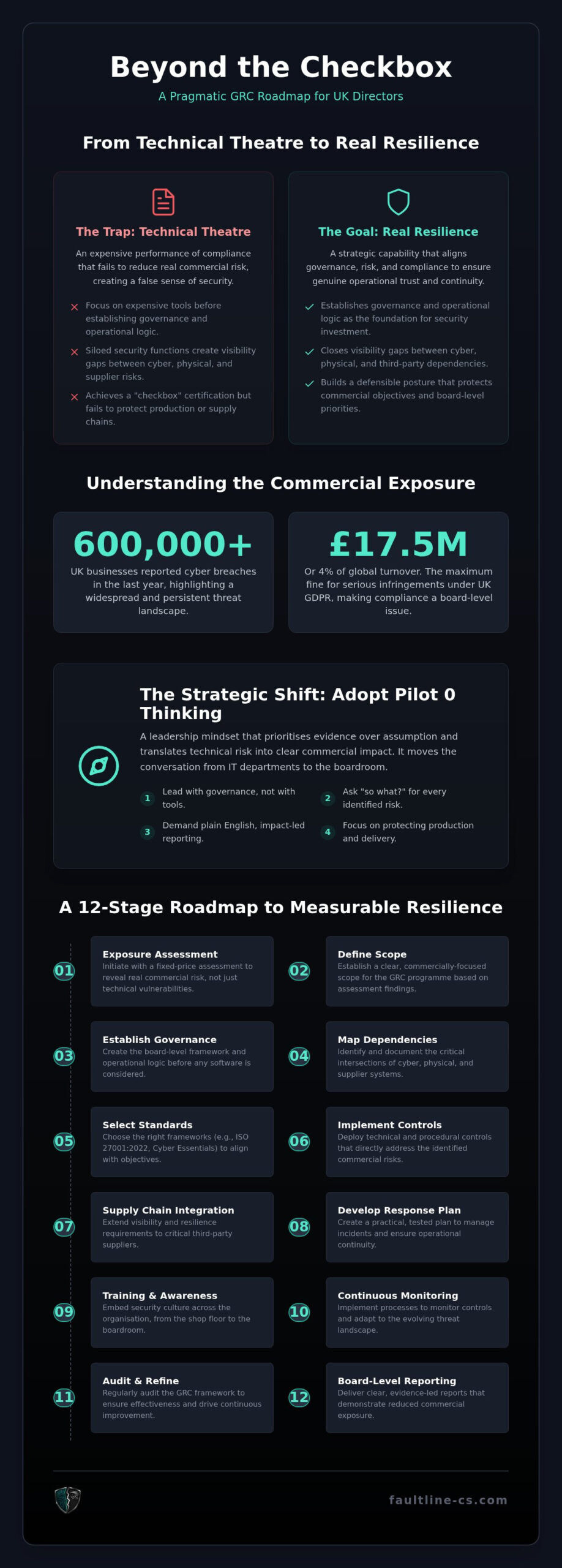
A Staged Roadmap for UK GRC Framework Implementation
Implementation is not a sprint. It’s a methodical deconstruction of systemic vulnerabilities that prioritises operational continuity over technical checkboxes. For a successful GRC framework implementation UK, the process must follow a logical progression that builds trust through evidence. Attempting to deploy controls without a clear understanding of your commercial exposure leads to wasted spend and overlooked gaps. A staged roadmap ensures that every pound spent aligns with a specific business outcome.
Stage 1: The Exposure Assessment. This is the Pilot 0 phase. For a fixed price of £5,000, we identify immediate gaps in your current posture. It’s a diagnostic exercise designed to reveal where your business is most vulnerable before you commit to a full programme. Stage 2: Defining Scope and Asset Management. Visibility must extend across both cyber and physical domains. We map the intersection of your digital systems, production lines, and physical access points to ensure nothing is left in the dark. Stage 3: The Risk Register. We build a register that speaks the language of the board. It translates technical threats into commercial impacts, such as production downtime or supplier failure, allowing for informed decision-making. Stage 4: Implementing Core Controls. This stage involves deploying bespoke policies and conducting deep-dive supplier reviews. Stage 5: Internal Audit. A mid-point test audit is conducted to catch weak evidence early, ensuring you’re fully prepared for final certification or regulatory scrutiny. Before committing to a full programme, conducting a structured ISO 27001 gap assessment at this stage ensures your controls are mapped against real vulnerabilities rather than assumptions.
Managing Third-Party and Supplier Risk
Your resilience is only as strong as your least secure supplier. Managing this requires more than a simple questionnaire. It involves conducting deep-dive reviews of supplier dependencies and mapping the access pathways they hold into your systems. Many organisations operate on dangerous contractual assumptions that fail during a real incident. To understand how to navigate these complexities, read our guide on Modernising Third-Party Risk Management for UK Directors.
Operational Resilience and Incident Preparedness
True resilience goes beyond traditional business continuity. It’s about maintaining core functions whilst under stress. This requires testing your incident response plans against realistic attack narratives that reflect the current threat landscape in the UK. We move beyond theoretical exercises to ensure your team understands the operational logic required to recover from a disruption. For a strategic perspective on this transition, consult our UK Operational Resilience: Strategic Guide for Directors.
Securing the Future: FaultLine’s Outcome-Focused GRC Approach
Resilience is a long term commercial commitment. It cannot be achieved through sporadic technical fixes or the accumulation of disparate software tools. At FaultLine, we view GRC as a strategic discipline that integrates people, suppliers, and systems into a single, cohesive governance structure. Our approach prioritises outcomes over activity, ensuring that every step taken strengthens your operational logic and reduces your commercial exposure. A successful GRC framework implementation UK requires a partner that values evidence over assumptions and moves beyond the superficiality of technical theatre.
We deliver this through a 12 stage outcome focused ISO 27001 programme. This structured path is designed to manage commercial pressure by breaking down complex requirements into manageable, logical phases. By spreading the implementation over 12 months, we allow your organisation to absorb changes naturally without disrupting core production. We focus on the intersection of your physical and digital domains, ensuring that your governance model is as robust on the factory floor as it is in the data centre. When deep technical remediation is required, we partner with specialists to ensure your controls are not just compliant, but effective.
Board-Level Clarity
Directors require insight, not data. Many GRC programmes fail because they overwhelm leadership with technical jargon that obscures real risk. We provide board level plain English reporting that translates complex vulnerabilities into commercially relevant narratives. This clarity allows senior leadership to act with confidence, making informed decisions about resource allocation and risk appetite. Our accountability structures ensure that governance is a shared responsibility, supported by reporting formats that highlight systemic gaps rather than just individual incidents. This approach helps you avoid wasted spend on irrelevant tools, focusing your budget on the areas that deliver the highest return on resilience.
Getting Started with an Exposure Assessment
Clarity begins with our flagship Exposure Assessment. For a fixed price of £5,000, we provide a comprehensive diagnostic of your current posture. This is the Pilot 0 phase of any meaningful GRC journey. You will receive a board level exposure report that outlines realistic attack paths and identifies where your production risk and supplier dependencies overlap. It is a pragmatic, evidence led starting point that defines the scope of your future programme without the need for long term initial commitments. By identifying your real commercial exposure today, you can build a more resilient organisation for tomorrow.
Book your UK GRC Exposure Assessment today
Building a Foundation for Operational Resilience
Effective governance is not a box-ticking exercise or a simple software purchase. It is the strategic alignment of your organisation’s governance with the reality of its commercial exposure. By moving away from technical theatre and focusing on the intersection of cyber, physical, and supplier risks, you ensure that compliance translates into actual protection for your production lines and logistics networks.
A successful GRC framework implementation UK starts with visibility. It requires a clear-eyed understanding of where your vulnerabilities sit before you commit to large-scale programmes or expensive tooling. This transition from reactive firefighting to proactive governance is essential for maintaining trust in an increasingly regulated landscape where certificates alone are no longer enough.
Based in Belfast and serving the whole UK, our specialist GRC consulting provides directors with board-level reporting in plain English. We offer a fixed-price £5,000 entry service to help you identify your Pilot 0 starting point without the noise of technical hype. Resilience is achievable when you prioritise evidence over assumptions and operational logic over technical theatre.
The path to a more secure future is built on transparency and pragmatic leadership. Taking this first step ensures your investment delivers long-term stability and commercial confidence.
Frequently Asked Questions
What is the difference between GRC and simple compliance?
GRC is a strategic management system whilst compliance is a specific, often binary, requirement to meet a standard. Compliance focuses on meeting external rules at a single point in time. GRC creates a continuous governance structure that aligns risk management with your commercial objectives. It ensures that security decisions are based on business logic rather than just ticking boxes to satisfy an auditor. This approach provides a holistic view of operational resilience.
How long does it typically take to implement a GRC framework in the UK?
A full GRC framework implementation UK typically takes between six and eighteen months depending on the maturity of your existing processes. We recommend a staged approach to manage this transition without disrupting production. It starts with an initial assessment to define the scope, followed by several months of process design and control implementation. Attempting to rush this timeline often leads to superficial compliance that fails to address real systemic vulnerabilities.
Is ISO 27001 mandatory for UK manufacturing and logistics firms?
ISO 27001 is not a legal requirement for all UK manufacturing and logistics firms, but it is increasingly becoming a mandatory condition in commercial contracts. Many large scale suppliers and government bodies require this certification to ensure the security of their supply chains. Even without a direct mandate, the framework provides the necessary evidence of due diligence required under the UK’s Cyber Security and Resilience Bill and other emerging regulations.
What are the common pitfalls of GRC implementation for SMEs?
SMEs often fall into the trap of purchasing GRC software before they have established their governance logic. This results in expensive tools that remain underutilised. Other common pitfalls include relying on generic policy templates that don’t reflect actual operational workflows and treating implementation as a purely technical task for the IT department. Without board level leadership and a focus on human behaviour, the framework will fail to provide meaningful protection against commercial disruption.
How much does GRC consulting cost for a UK business?
Costs vary significantly based on the complexity of your operations and the level of support required. Whilst some consultancies charge high daily rates for open ended projects, we prioritise transparency through fixed price entry points. For instance, an initial diagnostic phase provides a clear roadmap and cost certainty before moving into a full implementation programme. This allows directors to budget effectively and ensure that the investment remains proportionate to the identified commercial risks.
Can GRC frameworks help with cyber insurance renewals?
Yes, GRC frameworks are instrumental during cyber insurance renewals. Insurers now demand more than just technical controls like firewalls; they require evidence of robust governance and risk management. A structured framework demonstrates that your organisation has a formal process for identifying and mitigating threats. This documented evidence of maturity can lead to more favourable terms and lower premiums by reducing the insurer’s perception of your commercial exposure and potential for downtime.
What is the role of the board in GRC framework implementation?
The board’s role is to define the organisation’s risk appetite and ensure that resilience is treated as a core business priority. Directors don’t need technical expertise, but they must provide the mandate and resources for the programme to succeed. This involves regular reviews of risk reports, holding operational leaders accountable for security outcomes, and ensuring that GRC remains aligned with the long term commercial strategy rather than being siloed in a single department.
How does physical security fit into a cyber-focused GRC framework?
Physical security is a critical component of a converged GRC framework. A breach of physical access can lead directly to a cyber incident, such as the theft of hardware or unauthorised access to local networks. Integrating physical security ensures that your governance covers every vector of risk. This convergence is also necessary for compliance with Martyn’s Law, which requires formal risk assessments and preparedness plans for physical premises to ensure public safety and operational continuity.

Article by
Alex J Morgan
Alex Morgan writes and develops content for FaultLine Cyber & Security Ltd. Alex has worked across web development, organic SEO, digital marketing and content creation since 2009, with a particular focus on making complex subjects clear, useful and easy to navigate.
Leave a Reply