


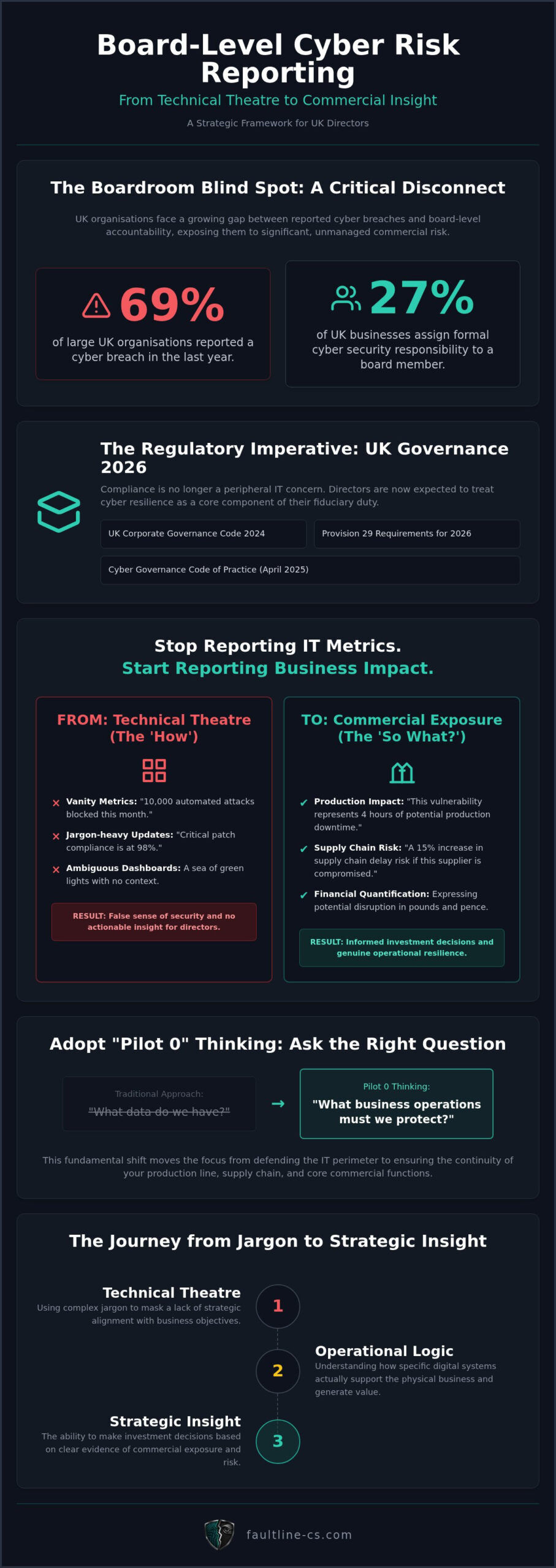
Only 27 per cent of UK businesses currently assign formal responsibility for cyber security to a board member, despite 69 per cent of large organisations reporting a breach in the last year. This disconnect suggests that many directors are still operating with a significant blind spot. Effective board level cyber risk reporting is not a technical update; it is a strategic assessment of production and supply chain vulnerability. If your current reporting focuses on technical theatre rather than commercial exposure, you are likely overlooking the systemic gaps that threaten your operational resilience.
Information overload is the enemy of effective governance. You likely find yourself buried under IT metrics that offer little help in navigating the UK Corporate Governance Code 2024. We understand that the pressure to meet Provision 29 requirements for 2026 creates a need for clarity over complexity. This guide provides a framework to translate technical data into actionable commercial insights that directors can actually use. We will explore how to align security spend with business risk, ensuring your governance provides a steady hand whilst satisfying the latest regulatory demands.
Key Takeaways
- Stop treating cyber as an IT issue and start managing it as a production risk. Learn how to bridge the communication gap between technical security teams and operational leaders.
- Understand the specific requirements of Provision 29 and the Cyber Security and Resilience Bill for 2026. This ensures your governance framework remains compliant with evolving UK standards.
- Shift from vanity metrics to financial quantification of risk. Discover how to express potential downtime and supply chain disruption in pounds and pence to drive better investment decisions.
- Implement a structured framework for board level cyber risk reporting that prioritises clarity. Use the Pilot 0 approach to provide concise, actionable insights that satisfy both directors and regulators.
- Move beyond passive reporting by integrating Exposure Assessments into your governance cycle. This identifies hidden vulnerabilities in your supply chain and operational logic before they lead to systemic failure.
Beyond the Dashboard: Why Boards Misunderstand Cyber Exposure
Most board reports are a flurry of green lights and technical jargon that obscure rather than reveal reality. This is not governance; it is technical theatre. True board level cyber risk reporting functions as a strategic communication tool, designed to translate digital vulnerabilities into the language of commercial consequence. Without this translation, directors are left with a false sense of security. They often assume that a lack of reported incidents equates to a lack of risk, when in reality, it may simply mean the organisation is blind to the vulnerabilities that matter most to the bottom line.
To better understand how to structure these communications and move away from ineffective dashboards, watch this step-by-step playbook:
At FaultLine, we advocate for Pilot 0 thinking. This approach challenges the assumption that existing IT dashboards are the correct starting point for a board discussion. Instead of asking “what data do we have?”, Pilot 0 asks “what business decisions must we protect?”. It shifts the focus from defending the perimeter to ensuring the continuity of the production line. It is a pragmatic sentinel’s view that values evidence over assumptions, stripping away the noise of daily operations to focus on systemic gaps.
The Knowledge Gap vs The Technical Gap
The primary obstacle to effective oversight is rarely a lack of technical skill within the IT team. It is a communication failure. Technical metrics often fail to trigger strategic decisions because they lack context within the broader Enterprise Risk Management (ERM) framework. Security operations deal with the “how”, whilst security governance must deal with the “so what?”. When boards are blinded by jargon, they cannot exercise the informed challenge required by modern UK standards. To bridge this gap, leadership must distinguish between three key areas:
- Technical Theatre: Using complex jargon to mask a lack of strategic alignment.
- Operational Logic: Understanding how specific digital systems actually support the physical business.
- Strategic Insight: The ability to make investment decisions based on evidence of commercial exposure.
Shifting from IT Metrics to Business Impact
Reporting that 10,000 automated attacks were blocked this month provides zero commercial value. It is a vanity metric that describes the environment, not the effectiveness of your strategy. A director cannot act on that number. A more useful report translates a “critical patch” into “four hours of potential production downtime” or “a 15 per cent increase in supply chain delay risk”. We define commercial exposure as the intersection of risk and impact. It is the precise measure of how a digital failure translates into a physical or financial halt. By focusing on business continuity rather than just digital defence, leadership can better align security spend with actual operational needs. This shift ensures the board isn’t just buying tools, but is instead investing in resilience. You can find more on how we structure our Exposure Assessments and GRC consulting to bridge this gap on our services page.
The Regulatory Landscape for UK Governance in 2026
Compliance is no longer a peripheral IT concern. The introduction of the Cyber Governance Code of Practice in April 2025 marked a decisive shift toward board-level accountability. Directors are now expected to treat cyber resilience as a core component of their fiduciary duty. This requires a transition from passive oversight to active, evidence-led board level cyber risk reporting. For organisations in manufacturing and logistics, the stakes are particularly high as digital failures now translate directly into physical production halts and supply chain collapse.
Provision 29 and Material Internal Controls
Under the UK Corporate Governance Code 2024, specifically Provision 29, the board must monitor the company’s risk management and internal control systems. For 2026 reporting cycles, this includes a formal declaration on the effectiveness of these controls. You cannot declare what you cannot prove. Relying on anecdotal evidence from IT leads is a governance failure. Instead, boards need a structured flow of data that validates:
- The resilience of critical production lines against digital disruption.
- Supplier dependencies and hidden third-party vulnerabilities.
- The actual effectiveness of incident response protocols through evidence-led testing.
Continuous monitoring isn’t just a technical preference; it’s the only way to satisfy audit requirements without a last-minute scramble. If your current reporting doesn’t provide this level of granular evidence, your annual declaration remains a significant legal and professional risk.
DORA and NIS2: A New Standard for Resilience
Whilst DORA and NIS2 are EU-led, their impact on UK manufacturing and logistics is systemic. If you operate within European supply chains or provide essential services, these standards dictate your operational reality. The focus has shifted decisively from “protect” to “recover”. Regulators now assume a breach will occur. They are more interested in how quickly your production can resume and how well you manage your dependencies. This requires a deeper understanding of DORA third-party risk management and how it interacts with your broader governance. Managed resilience is now a prerequisite for market access.
Personal accountability is the final piece of the puzzle. The Cyber Security and Resilience Bill, introduced to Parliament in late 2025, strengthens the mandate for directors to oversee ICT risk management. Failure to demonstrate due diligence can lead to significant financial penalties and reputational damage. If you’re unsure if your current data meets these 2026 standards, you might consider speaking with our GRC consultants to review your reporting framework. Effective board level cyber risk reporting ensures that compliance is a byproduct of good management, not a frantic reaction to a looming deadline.
Defining Metrics That Drive Strategic Decisions
Data alone is not an insight. Too often, directors are presented with vanity metrics, such as the number of emails blocked or patches applied, that fail to answer the fundamental question of business survival. Effective board level cyber risk reporting requires a shift toward indicators that trigger strategic action. Researchers at MIT have highlighted this necessity through their Board Level Balanced Scorecard for Cyber Resilience, which prioritises outcomes over activities. For a manufacturing leader, a 99 per cent patch rate is irrelevant if the remaining 1 per cent leaves the main assembly line vulnerable to a three-day halt.
Quantifying Financial Exposure and Ransomware Risk
Directors must stop viewing risk through the lens of probability and start seeing it through the lens of impact. In a production environment, the only metric that truly matters is the cost of downtime. If a ransomware attack encrypts your logistics scheduling system, what is the hourly cost in lost revenue, wasted labour, and contractual penalties? By expressing exposure in pounds and pence, you move cyber from a technical cost centre to a primary business risk. This methodology is explored further in our Cyber Threats: A Strategic Guide for UK Directors, which details how to map attack paths to financial loss. Moving from probability to impact ensures your risk register reflects reality rather than guesswork.
Assessing Supplier and Third-Party Dependency
Your most significant vulnerability often resides outside your own network. In manufacturing and logistics, cyber risk frequently crosses over into physical security. A supplier with remote access to your climate control systems or production machinery represents a systemic gap that a traditional firewall cannot close. Reporting must include the security posture of critical partners, particularly those with trusted access to your operational technology. We discuss how to restructure these relationships in our guide on modernising third-party risk management for UK directors. Without this visibility, your board is essentially outsourcing its risk management to the weakest link in the chain. Integrating these physical security crossover points into your board level cyber risk reporting provides the clarity needed to protect the entire value chain.
A Practical Template for Board-Level Cyber Reporting
Most board packs are too thick and too technical. They often bury critical risks under a mountain of IT performance data that fails to inform strategic decision-making. Effective board level cyber risk reporting requires a radical simplification that prioritises commercial reality over technical activity. We recommend a four-part structure that strips away the noise, allowing directors to focus on the systemic gaps that actually threaten the organisation’s survival. This is the practical application of Pilot 0 thinking: assuming nothing and building a narrative based on evidence rather than assumptions.
Part 1: The Executive Summary of Exposure
This section is the cornerstone of the Pilot 0 approach and should be the first thing a director reads. It must identify the three most significant threats to business continuity, such as a specific production line failure or a critical logistics partner outage. You should avoid technical jargon like “cross-site scripting” or “SQL injection” and focus entirely on commercial outcomes. State the current risk posture clearly against the agreed board appetite. If the risk exceeds the appetite, the summary must explain the potential financial impact and why existing controls are currently insufficient to bridge the gap.
Part 2: Operational and Supplier Resilience
For manufacturing and logistics leaders, the digital world is inseparable from the physical factory floor. This section reports on the “gap” where cyber and physical security overlap, such as remote access to industrial control systems or warehouse management software. It must include an update on critical supplier risk assessments, highlighting any third-party dependencies that have changed since the last report. For logistics leaders, this includes monitoring shifts in the external threat landscape that could disrupt just-in-time delivery schedules or compromise the integrity of the supply chain.
The final two components of the template focus on Incident Preparedness and Management Actions Taken. Preparedness reporting must move beyond “we have a plan” to “we have tested our recovery time for the assembly line and it is currently six hours”. Documenting management actions creates the necessary audit trail for Provision 29. It proves that the board isn’t just receiving data but is actively directing the organisation’s response to commercial exposure. This evidence-led approach ensures that when the audit committee asks “so what?”, the answer is already documented in the minutes.
Integrating Exposure Assessments into Governance
Static reports are a liability. If your board level cyber risk reporting only looks backward at historical incidents, it fails to provide the foresight required by Provision 29 of the UK Corporate Governance Code. Effective governance requires a transition from passive observation to active risk management. By integrating a FaultLine Exposure Assessment into your quarterly cycle, you gain a forward-looking view of where your commercial interests are most vulnerable. This isn’t about chasing every possible threat. It’s about identifying the specific attack paths that lead to production downtime or supply chain collapse. It is a methodical approach that replaces assumptions with evidence, embodying the Pilot 0 principle of starting from a position of zero unverified trust.
From Reporting to Active Risk Management
High-quality data allows you to justify security investment or divestment from tools that provide no commercial value. Directors need realistic attack-path narratives that explain how a breach in a sub-contractor’s network could halt your assembly line. This level of detail transforms a vague technical concern into a concrete business decision. For those requiring specialist FaultLine Services for GRC support or Operational Resilience, we provide the frameworks that turn these narratives into board-level accountability. This accountability ensures that the “so what?” of every security metric is clearly understood by those holding the budget and the legal responsibility. It moves the organisation away from technical theatre and toward a state of professional realism.
Identifying the Gap Where Exposure Lives
Exposure doesn’t live in a silo. It exists in the overlap between your digital systems, your physical assets, and your supplier dependencies. FaultLine connects these dots, providing board-ready, plain English reporting formats that strip away the technical theatre often found in IT-led presentations. We recommend a fixed-price Exposure Assessment as the most efficient way to establish your baseline for 2026. This provides the evidence required for regulatory declarations whilst ensuring your security spend is strictly aligned with business risk. It moves the conversation from “are we safe?” to “are we resilient?”. This distinction is critical in a landscape where the Cyber Security and Resilience Bill now demands proof of due diligence and a clear understanding of supplier dependencies.
Clarity is the ultimate defensive measure. Directors who continue to rely on opaque IT dashboards are choosing to operate with a blind spot that regulators and shareholders will no longer tolerate. It’s time to move beyond the dashboard and start managing cyber risk with the same commercial rigour as any other operational vulnerability. Seek the evidence, challenge the assumptions, and secure your resilience. The steady hand of a strategic guide is often the difference between a minor incident and a systemic failure.
Securing the Future of UK Boardroom Governance
The era of technical theatre in the boardroom is ending. Directors can no longer rely on green dashboards that fail to explain commercial exposure in plain English. Effective board level cyber risk reporting demands a shift toward professional realism, where every metric answers the “so what?” for operational resilience. By focusing on the intersection of digital vulnerabilities and physical production, leadership can satisfy the rigorous demands of Provision 29 whilst protecting the bottom line.
FaultLine provides the clarity needed to navigate this complex regulatory landscape. Our expert GRC consulting and fixed-price Pilot 0 thinking ensure your governance is built on evidence rather than assumptions. We deliver board-level, plain-English reporting as standard, stripping away the jargon to focus on strategic alignment and the protection of your supply chain. This methodical approach ensures that your security spend is an investment in business continuity, not just a reactive cost.
Moving from passive oversight to active risk management is the most effective way to build long-term resilience. With a structured framework and a focus on commercial impact, your board can lead with confidence in 2026 and beyond. We are here to act as your strategic guide in a complex world.
Frequently Asked Questions
What is the most important metric for a board-level cyber risk report?
The most critical metric is the quantified financial impact of an operational halt. Instead of reporting on technical vulnerabilities, focus on the cost of downtime per hour for your primary production lines. This allows the board to make informed decisions about investment based on actual commercial exposure rather than abstract technical threats that lack business context.
How often should a board receive a cyber risk report?
Formal board level cyber risk reporting should typically occur quarterly to align with the standard corporate governance cycle. However, this must be supplemented by exception-based reporting if a significant change in the threat landscape or a material gap in internal controls is identified. This ensures that the board maintains continuous oversight without being overwhelmed by daily operational noise.
Does Provision 29 of the UK Corporate Governance Code require technical data?
No, Provision 29 focuses on the effectiveness of risk management and internal control systems rather than raw technical data. Directors are required to provide a formal declaration that these systems are robust. To do this, they need evidence-led insights that prove controls are working as intended, particularly regarding material risks that could threaten the company’s future resilience.
Can we rely on cyber insurance instead of detailed board reporting?
Cyber insurance is a risk transfer mechanism, not a substitute for governance. Whilst it can mitigate some financial losses, it cannot restore lost production capacity, repair a damaged reputation, or satisfy the legal requirements of the Cyber Security and Resilience Bill. Relying solely on insurance leaves the organisation vulnerable to the systemic gaps that policies often exclude or fail to cover.
How do I report on supplier risk if I do not have access to their systems?
Reporting on supplier risk involves assessing your dependency on their services rather than auditing their internal networks. You should focus on the commercial consequences if a specific partner fails. This is achieved by mapping critical dependencies and using contractual right to audit clauses or independent third-party assessments to validate their resilience and recovery capabilities.
What is the difference between a technical audit and a board-level exposure assessment?
A technical audit is a checklist-based exercise that confirms the presence of specific security tools or compliance standards. In contrast, a board-level exposure assessment focuses on realistic attack paths and their business consequences. It identifies how a failure in one area can cascade through the organisation, providing the strategic clarity needed for effective risk management and investment.
Who should be responsible for presenting the cyber risk report to the board?
Responsibility should lie with a board member who has formal oversight of cyber security, though only 27 per cent of UK businesses currently have this in place. In the absence of a dedicated director, the report should be presented by a leader capable of translating technical issues into commercial risks, such as the COO or a commercially-minded senior risk officer.
How can I ensure my board report is compliant with DORA and NIS2?
Compliance with DORA and NIS2 requires shifting your reporting focus from simple protection to recovery and resilience. Your reports must demonstrate a clear understanding of your ICT dependencies and provide evidence that your organisation can maintain essential functions during a disruption. This evidence-led approach ensures that your board level cyber risk reporting satisfies both UK and EU regulatory expectations.

Article by
Alex J Morgan
Alex Morgan writes and develops content for FaultLine Cyber & Security Ltd. Alex has worked across web development, organic SEO, digital marketing and content creation since 2009, with a particular focus on making complex subjects clear, useful and easy to navigate.
Leave a Reply