


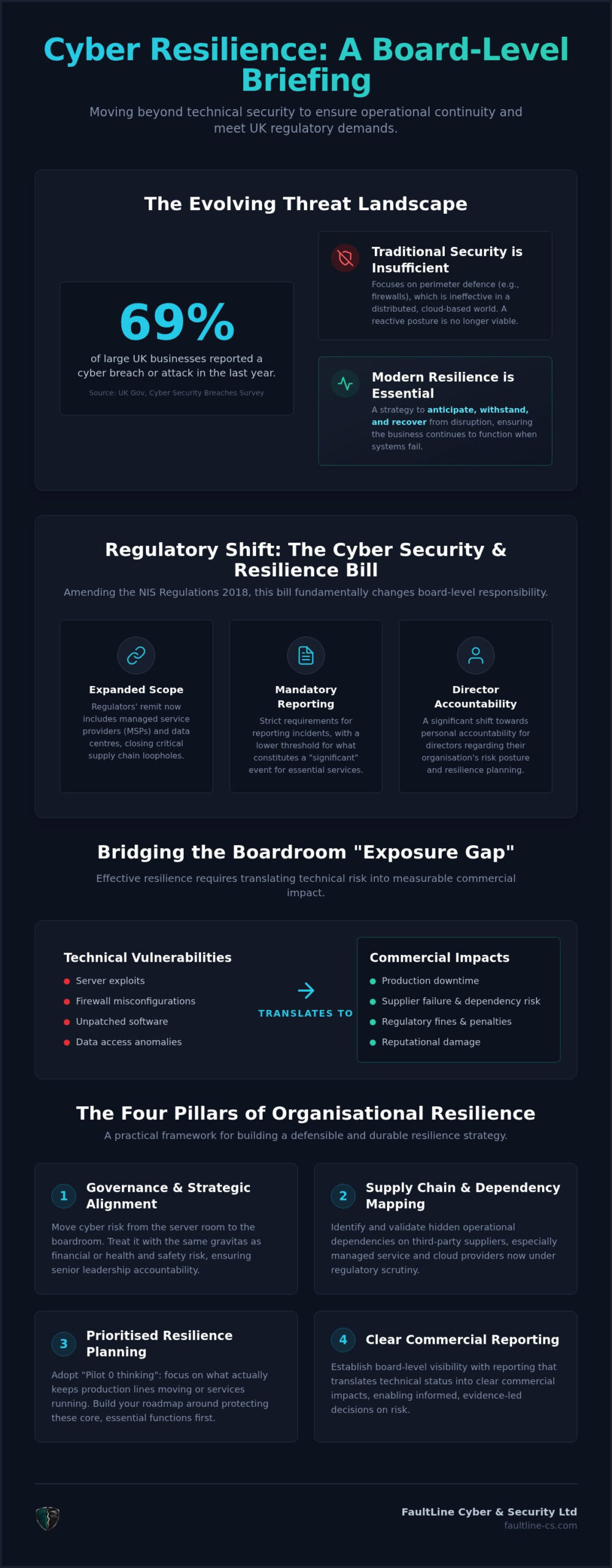
Technical security is no longer synonymous with business survival. Whilst many boards have invested heavily in defensive software, the reality remains that 69% of large UK businesses reported a breach in the last year according to the government’s 2026 Cyber Security Breaches Survey. Effective cyber resilience planning UK has evolved beyond the server room; it is now a fundamental requirement of corporate governance. As the Cyber Security and Resilience Bill moves into full enforcement this year, the definition of critical infrastructure has expanded, leaving many directors exposed to regulatory pressures they haven’t yet quantified.
You likely recognise that your current reporting doesn’t always translate technical vulnerabilities into clear commercial impacts such as production downtime or supplier failure. This article provides a practical framework for senior leadership to close those gaps. We will outline a roadmap for navigating the 2025 Bill, identifying hidden dependencies in your supply chain, and establishing the board level visibility required to maintain operational continuity. By moving from a reactive posture to a resilience first strategy, you can transform compliance from a regulatory burden into a clear competitive advantage.
Key Takeaways
- Understand how the Cyber Security and Resilience Bill expands your legal obligations and shifts the focus towards supply chain accountability.
- Move cyber risk from the server room to the boardroom by establishing clear governance and validating operational assumptions.
- Identify the exposure gap in your current strategy to move beyond superficial compliance and technical theatre.
- Build a practical roadmap for cyber resilience planning UK that prioritises the continuity of essential services and critical data.
- Translate technical vulnerabilities into commercial impacts like production risk and potential downtime for more effective board reporting.
The Evolving Landscape of Cyber Resilience Planning in the UK
Cyber resilience isn’t a technical aspiration; it’s a condition of trade. Traditional security focuses on building higher walls, but cyber resilience planning UK requires a strategy to anticipate, withstand, and recover from digital disruptions that will inevitably occur. This shift in mindset moves beyond the foundational principles of information security to address the commercial reality of operational uptime. It’s about ensuring that when a system fails, the business doesn’t. Resilience is the bridge between a technical glitch and a commercial catastrophe.
The legislative environment has changed to reflect this reality. The Cyber Security and Resilience Bill, which amends the NIS Regulations 2018, is expected to reach full implementation during 2026. It brings a much broader range of digital service providers under the eye of UK regulators. This change is a direct response to the widening gap between sophisticated state-actor threats and the legacy defences found in many UK organisations. To better understand how these principles apply in a modern context, watch this helpful video:
Directors must adopt “Pilot 0 thinking” to bridge the gap between their current posture and regulatory expectations. This approach ignores the marketing hype of technical tools and starts with the raw operational logic of the business. It identifies what actually keeps the production line moving or the logistics fleet running. By focusing on these core functions first, leadership can build a resilience framework grounded in evidence rather than assumptions. It’s a pragmatic approach that values operational continuity over technical theatre.
Key Provisions of the Cyber Security and Resilience Bill
The new Bill expands the remit of regulators to include managed service providers and data centres, closing a loophole that previously left supply chains vulnerable. Mandatory incident reporting is now a strict requirement for essential services. The threshold for what constitutes a “significant” event has lowered, meaning more incidents must be disclosed to authorities. For the board, non-compliance carries substantial penalties; however, the personal accountability expected of directors regarding their organisation’s risk posture is the more significant shift.
Why Traditional Security is No Longer Sufficient
Static security measures are failing because the perimeter has vanished. Relying on a firewall in a distributed work environment is like locking the front door whilst the windows are wide open. Modern resilience must be dynamic, acknowledging that 43% of UK businesses identified a breach in the last year according to the government’s 2025/2026 survey. Effective cyber resilience planning UK moves beyond insurance, which provides a financial safety net but won’t restore a tarnished reputation or restart a stalled production line. True resilience is built through operational resilience services that prioritise visibility and insight.
The Four Pillars of Organisational Resilience
Resilience is not a product you buy; it is a structural integrity you maintain. For directors, the challenge lies in moving beyond the technical theatre of dashboards and firewalls to address the systemic vulnerabilities that actually halt production. Robust cyber resilience planning UK requires a focus on four distinct pillars that bridge the gap between IT security and operational reality. These pillars ensure that your organisation can absorb a shock and continue to function whilst others are still assessing the damage.
Governance and Strategic Alignment
The server room is for execution, but the boardroom is for risk. Effective resilience begins with moving accountability to senior leadership, ensuring that cyber risk is treated with the same gravitas as financial or health and safety risk. This alignment is often formalised through the Cyber Resilience Pledge, which provides a framework for businesses to demonstrate their commitment to national standards. Integrating these principles into your wider corporate strategy is essential for long term stability. For a deeper look at procurement and governance, see our GRC Framework UK: Strategic Buying Guide for Directors.
Operational Trust and Data Integrity
Operational trust is the validation of your assumptions. It’s one thing to have a backup; it’s another to know that the data within it hasn’t been quietly manipulated over months. Directors must demand evidence that system availability and data integrity are verified through regular, practical testing. This moves the organisation away from “blind trust” in technical systems and towards a culture of evidence led assurance. If you cannot prove your systems will work under pressure, you don’t have a resilience strategy; you have a hope.
Supplier and Third-Party Risk Analysis
Your resilience is only as strong as your weakest third party. According to the 2026 Verizon DBIR, third party involvement was a factor in 48% of breaches, representing a 60% increase year on year. Despite this, government data shows that only 15% of UK businesses have reviewed the risks posed by their immediate suppliers. In manufacturing and logistics, a single point of failure in a digital supplier can halt an entire supply chain. Directors must audit these dependencies without creating operational friction. Our guide on Modernising Third-Party Risk Management for UK Directors unpacks this process in detail.
Physical-to-Cyber Crossover
The convergence of physical and digital security is a growing vulnerability. With the implementation of Martyn’s Law (the Terrorism Protection of Premises Act 2025), organisations are already reviewing their physical safety protocols. However, many overlook that access control, CCTV, and building management systems are digital assets. A breach in a physical access point can provide a direct gateway into the corporate network. True cyber resilience planning UK must account for these crossover points, ensuring that physical security and digital defence are managed as a single, cohesive discipline. If you are unsure where your organisation sits amongst these pillars, you can speak with our advisors about an exposure assessment.
Identifying the Exposure Gap in Your Current Strategy
Compliance does not equal security. Many organisations operate under a false sense of safety because their internal dashboards show a sea of green lights. This is what we term technical theatre; the performance of security through tools and tick boxes that fails to account for how a business actually functions. Whilst the Cyber Security and Resilience Bill sets the regulatory floor, true resilience requires looking into the shadows where technical systems, human behaviour, and physical operations intersect. Most directors don’t see their real exposure because they are looking at the wrong metrics.
The FaultLine philosophy is built on the reality that attackers don’t “hack” in; they log in. They exploit the overlooked connections between your people, your suppliers, and your physical infrastructure. A teal-and-charcoal monitoring suite might show a secure network, but it won’t flag a service entrance with a legacy keypad that shares a network switch with your production line. Identifying these systemic gaps is the first step in effective cyber resilience planning UK.
The Reality of Attack Path Narratives
Attackers follow the path of least resistance, often moving laterally through an organisation by exploiting identity and credential exposure. They map your dependencies, identifying which third-party supplier has the most permissive access to your core systems. This movement bypasses traditional perimeter defences entirely, making your firewall an expensive but irrelevant obstacle. The Exposure Gap is the space where business functions overlap and risks are ignored. By mapping these narratives, you can see your organisation through the eyes of a threat actor and identify where a single compromised credential could halt your entire logistics chain.
Internal vs External Visibility
There is a significant disconnect between what an internal IT team sees and what an external threat actor can discover. Your internal view is limited by the assumptions of your current architecture, whilst an attacker uses open-source intelligence (OSINT) to find leaked credentials, exposed assets, and hidden relationships in your supply chain. This external perspective is vital for robust cyber resilience planning UK because it reveals the vulnerabilities you’ve grown accustomed to ignoring. It’s about moving from a state of assumed security to one of verified resilience.
Closing this gap doesn’t require an open-ended consultancy project. We provide a fixed-price Exposure Assessment at £5,000 that reveals these hidden vulnerabilities across your cyber and physical estates. This provides the board with a clear, commercial view of risk rather than a technical list of patches. Understanding The Strategic Necessity of Exposure Assessments allows you to allocate budget where it actually reduces downtime risk, rather than simply buying more software.
Developing a Practical Cyber Resilience Roadmap
A resilience strategy is only as effective as the logic that underpins it. For many UK boards, the primary challenge is not a lack of effort, but a lack of direction. Effective cyber resilience planning UK requires a structured, multi-stage approach that prioritises business continuity over technical vanity. This roadmap provides a clear path from current exposure to a state of verified operational trust, ensuring that your organisation can withstand the evolving threat landscape of 2026.
Readiness and Maturity Assessments
Step one is establishing a factual baseline. Rather than relying on self-assessment questionnaires that often mask underlying weaknesses, we utilise the IntelSensus framework to quantify cyber maturity through evidence. This process moves beyond “IT says we’re fine” to “the data proves we’re resilient.” It identifies the gap between your current defences and the requirements of the 2026 regulatory landscape. For a detailed breakdown of what your board should be asking, see our Cyber Security Due Diligence: A Strategic Checklist for UK Directors.
Step two involves defining the scope of essential services. In manufacturing and logistics, this means identifying the specific data assets and physical systems that keep the operation moving. Not every server is critical. By narrowing the focus to high-impact functions, you can allocate resources where they provide the greatest protection against downtime. This clarity is essential for meeting the reporting obligations of the new Cyber Security and Resilience Bill.
Staged ISO 27001 Implementation
Step three is a staged ISO 27001 implementation. Certification should follow resilience, not lead it. We recommend prioritising controls based on realistic commercial risk. For manufacturing environments, generic policies are often ignored by the workforce. Bespoke documentation that reflects the reality of the factory floor ensures that security becomes a cultural norm rather than a bureaucratic hurdle. A test audit at the mid-point of this process is vital to identify weak evidence early, preventing a failure at the final certification stage.
Finally, steps four and five establish continuous monitoring and reporting. Continuous visibility through an MSSP or SOC/SIEM solution provides the ability to detect threats before they escalate into breaches. However, technical monitoring must be paired with commercial reporting. Board level updates should be delivered in plain English, focusing on metrics such as production risk and the financial impact of potential downtime. This ensures that cyber resilience planning UK remains a permanent agenda item for senior leadership rather than a one-off IT cost.
Board-Level Governance and Operational Trust
Governance is the final safeguard of operational trust. Assumptions are the primary cause of failure in cyber resilience planning UK. When a board assumes their backups are functional or their suppliers are secure without verifiable evidence, they are managing hope rather than risk. Directors must bridge the gap between technical vulnerability and commercial reality by insisting on a whole of business approach. This strategy aligns with the UK’s broader shift towards a whole of society resilience model, where individual corporate stability supports national economic endurance. Resilience is not an IT cost centre; it is a fundamental governance discipline that protects every production line and logistics hub.
Directors set the tone for an organisation’s security culture. It is no longer sufficient to delegate cyber responsibility to a single department. True resilience requires every operational leader to understand their role in the response and recovery process. This cultural shift begins with leadership that values transparency over technical theatre and prioritises the protection of essential services. By fostering an environment where security awareness is integrated into daily operations, you reduce the human error factor that often serves as the initial access vector for attackers. Evidence led governance replaces blind trust with verified insight.
Reporting for Senior Leadership
Board level reporting must evolve to provide commercial clarity. Technical jargon like vulnerability counts or patching percentages often fails to convey the actual level of risk to the business. Effective reporting focuses on time to recovery and the potential financial impact of specific failure scenarios. By using reporting templates that align cyber risk with financial decision making, directors can make informed choices about resource allocation. For those looking to quantify risk in monetary terms, our FAIR Model: A UK Director’s Guide to Cyber Quantification provides a structured methodology for this transition. Senior leaders seeking a broader governance framework will also find value in our Cybersecurity for Directors in the UK: A Strategic Governance Handbook 2026, which addresses the full spectrum of board-level oversight responsibilities.
Operational Resilience as a Competitive Advantage
Resilience is a differentiator in the modern UK supply chain. As larger organisations tighten their supplier requirements in response to the Cyber Security and Resilience Bill, those who can prove their operational integrity will secure a significant advantage. This goes beyond digital defence; it includes preparedness for safety focused legislation like Martyn’s Law, which requires a cohesive view of both physical and digital safety. Positioning your organisation as a secure and reliable partner ensures long term stability in an increasingly volatile environment. Robust cyber resilience planning UK transforms a regulatory burden into a clear commercial strength.
Explore our Resilience Services
Securing Your Operational Future
Operational continuity is the only metric that matters during a crisis. Technical security measures provide a necessary baseline, but true resilience requires a board level commitment to understanding hidden dependencies and physical to digital crossover points. By adopting a roadmap that prioritises essential services and evidence led reporting, you move beyond the limitations of technical theatre. Effective cyber resilience planning UK ensures that your organisation remains a reliable link in the supply chain whilst meeting the strict demands of the 2026 regulatory landscape.
FaultLine provides the specialist insight needed to bridge the gap between technical risk and commercial impact. Based in Northern Ireland, our team delivers expertise tailored specifically to the manufacturing and logistics sectors across the UK and Ireland. We replace complex jargon with board level reporting in plain English, providing the clarity required for strategic decision making. Identifying your exposure today ensures operational stability for the long term.
The transition from defensive security to operational resilience is a strategic necessity. Taking proactive steps now builds a foundation that survives the unexpected and protects your commercial reputation.
Frequently Asked Questions
What is the Cyber Security and Resilience Bill 2025?
The Cyber Security and Resilience Bill is a legislative update designed to strengthen the UK’s digital supply chains. It expands the 2018 NIS Regulations to include managed service providers and data centres, introducing stricter incident reporting and increased enforcement powers. For directors in Belfast and across the UK, this means a shift in legal responsibility towards ensuring that key digital partners are as resilient as their own internal systems.
How does cyber resilience planning differ from traditional cyber security?
Traditional security focuses on prevention through defensive tools like firewalls. In contrast, cyber resilience planning UK assumes that a breach or system failure will eventually occur. It prioritises the organisation’s ability to withstand and recover from such events without halting critical operations. Whilst security is a technical function, resilience is a governance discipline that bridges the gap between digital systems, physical security, and commercial continuity.
Does my UK SME need a cyber resilience plan for 2026?
Yes, particularly if you are part of a critical supply chain in sectors like manufacturing or logistics. Large organisations and regulators now require evidence of resilience from their smaller partners to mitigate third-party risk. For an SME in Lisburn or Craigavon, having a plan isn’t just about compliance; it’s a competitive advantage that proves you are a reliable partner capable of maintaining production during a digital disruption.
How much does a professional cyber exposure assessment cost?
FaultLine provides a flagship Exposure Assessment at a fixed price of £5,000. This service is designed as an entry point for senior leadership to identify hidden risks across cyber, physical, and supplier dependencies. Unlike open-ended technical audits, this assessment delivers a board-level report with a realistic attack-path narrative. It allows directors to understand their commercial exposure before committing to larger investments in tools or certifications.
Can ISO 27001 certification help with cyber resilience planning?
ISO 27001 provides a robust framework for managing information security, but it must be tailored to operational reality to support resilience. A staged implementation ensures that controls are prioritised based on commercial risk rather than just a checklist. For firms in Ballymena or Derry, aligning with ISO 27001:2022 helps build a foundation of evidence-based governance, though true resilience requires going beyond the standard to address specific operational dependencies.
How do I report cyber resilience metrics to the board of directors?
Reports should move away from technical jargon like “patching percentages” and focus on commercial impacts. Metrics such as “time-to-recovery” for essential services or the potential financial loss of a production halt are far more useful for senior leadership. By presenting data in plain English, directors can make informed decisions about risk appetite and resource allocation. This approach ensures that cyber resilience planning UK remains a permanent agenda item for senior leadership.
What is the role of an MSSP in cyber resilience?
A Managed Security Service Provider (MSSP) provides the continuous monitoring and threat detection necessary to identify incidents early. FaultLine operates as an MSSP, offering SOC and SIEM solutions that defend digital infrastructure 24/7. This proactive layer of defence allows organisations to mitigate threats before they escalate into operational failures. However, an MSSP’s role is most effective when integrated into a wider resilience strategy that includes governance and recovery planning.

Article by
Alex J Morgan
Alex Morgan writes and develops content for FaultLine Cyber & Security Ltd. Alex has worked across web development, organic SEO, digital marketing and content creation since 2009, with a particular focus on making complex subjects clear, useful and easy to navigate.
Leave a Reply