


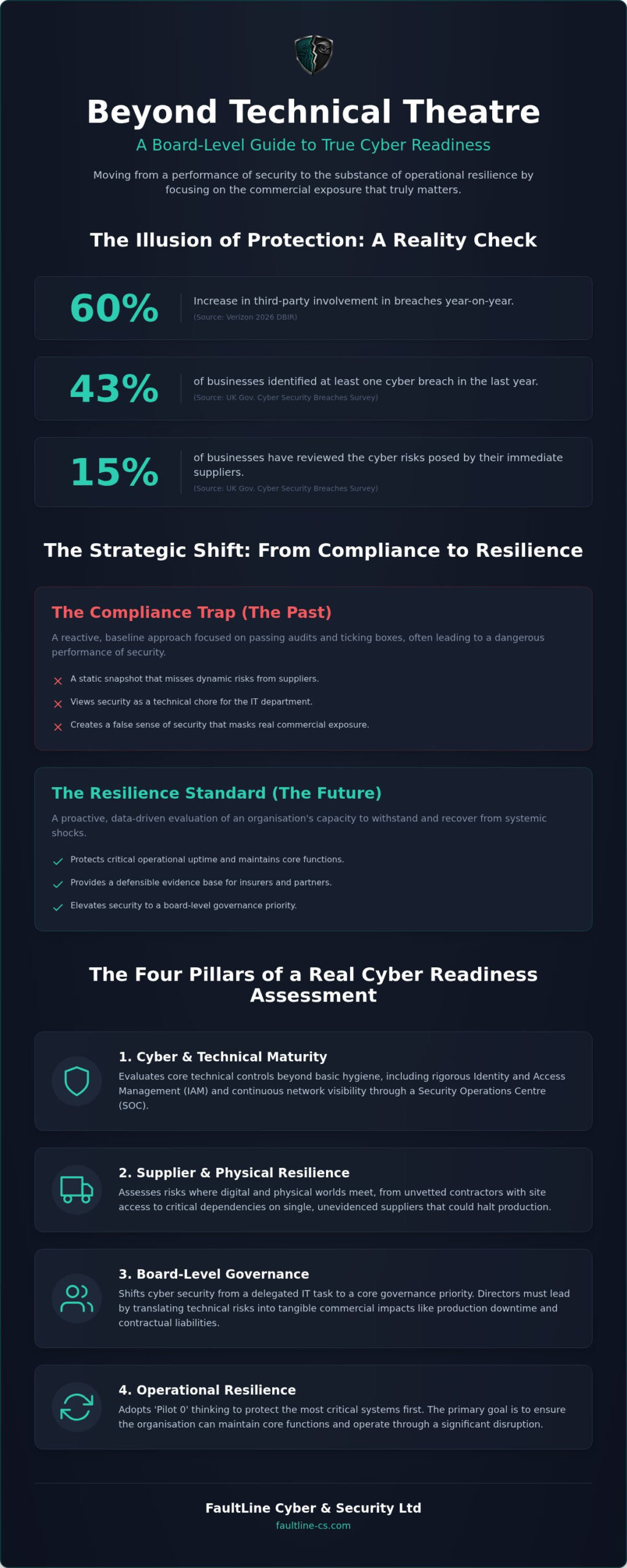
Most UK boards are currently funding a performance rather than a protection. Whilst security budgets increase, the Verizon 2026 Data Breach Investigations Report notes that third-party involvement in breaches has risen by 60% over the last year. You likely feel the pressure of NIS2 and the September 2026 reporting deadlines of the EU Cyber Resilience Act, yet without a rigorous cyber readiness assessment, you may still lack visibility into the supplier dependencies that could halt your production lines tomorrow.
It’s exhausting to authorise spend on complex tools without knowing if they actually reduce your commercial exposure. We’ll show you how to move beyond technical theatre and identify the real gaps that threaten your operational resilience. This guide outlines how to gain a clear, board-level understanding of operational risk, prioritise actions that protect your uptime, and provide the resilience evidence that insurers and partners now demand.
Key Takeaways
- Recognise the critical distinction between meeting regulatory compliance and achieving true operational resilience in complex supply chains.
- Discover how a data-driven cyber readiness assessment identifies hidden vulnerabilities at the intersection of cyber, physical, and supplier risks.
- Move beyond technical jargon by adopting board-level reporting that focuses on production downtime and commercial exposure.
- Prepare your leadership team for an exposure review by identifying critical documentation and mapping third-party dependencies.
- Establish a defensible evidence base of resilience to satisfy the increasing transparency requirements of insurers and strategic partners.
Moving Beyond Technical Theatre in Cyber Readiness
Compliance is a baseline, not a shield. Many directors mistake a passed audit or a basic certification for actual safety, yet the UK Government’s Cyber Security Breaches Survey 2025/2026 reveals that 43% of businesses identified a breach in the last year. This gap between perceived security and reality is what we term technical theatre. It’s the performance of security without the substance of resilience. A comprehensive cyber readiness assessment must look deeper than surface-level hygiene to find the structural gaps that threaten your operations.
To better understand the shift from reactive response to proactive readiness, watch this helpful video:
True readiness requires Pilot 0 thinking. This approach rejects the tendency to buy every new security tool and instead focuses on protecting the most critical systemic nodes first. By using the Cyber Assessment Framework (CAF) as a guide, organisations can move from passive monitoring to active, evidence-led resilience. This isn’t about ticking boxes; it’s about ensuring that when a disruption occurs, your business can maintain its core functions whilst others falter.
The Illusion of Protection
A clean penetration test report offers a dangerous sense of finality. It’s a snapshot of a single moment in time that fails to account for the shifting landscape of supplier risk. The Verizon 2026 Data Breach Investigations Report found that third-party involvement was a factor in 48% of breaches, a 60% increase year-on-year. Relying solely on cyber insurance as a recovery strategy is equally flawed. Insurance might provide a financial buffer, but it cannot restore lost customer trust or restart a halted production line in the immediate aftermath of an attack.
Commercial Exposure vs Technical Risk
Directors often delegate security to IT departments, viewing it as a technical chore rather than a governance priority. This is a strategic error. In manufacturing and logistics, a cyber incident is a production incident. The convergence of IT and operational technology means a breach in the office can stop the warehouse floor. Directors must lead the conversation, translating technical risks into clear commercial impacts. Our specialist services help leadership teams map these crossover risks to prevent costly downtime and satisfy the stringent requirements of the new Cyber Security and Resilience Bill.
The Four Pillars of a Real Cyber Readiness Assessment
A cyber readiness assessment is not a subjective exercise in optimism. It is a data-driven evaluation of an organisation’s capacity to withstand and recover from systemic shocks. We use the IntelSensus platform to power these evaluations, providing directors with a clear-eyed view of their security maturity. This methodology moves beyond the basic technical checks of the Cyber Essentials Scheme; whilst that scheme is necessary for fundamental hygiene, it does not account for the complex operational interdependencies found in modern manufacturing and logistics.
Cyber and Technical Maturity
High-level governance requires more than just complex passwords. Identity and Access Management (IAM) must be robust enough to ensure that only verified individuals have access to critical systems. Visibility remains the second essential component. Without continuous monitoring through a sophisticated SOC and SIEM solution, an organisation is essentially flying blind. You can explore how these systems integrate into a wider resilience strategy in our managed security service provider UK directors guide.
Supplier and Physical Resilience
Digital security often fails at the physical perimeter. An unlocked warehouse door or an unvetted contractor with site access provides a direct path to your internal network. This physical vulnerability is frequently mirrored in the supplier dependency gap. According to the UK Government’s Cyber Security Breaches Survey 2025/2026, only 15% of businesses have reviewed the risks posed by their immediate suppliers. If your critical components rely on a single, unevidenced vendor, your operational resilience is an illusion. We recommend modernising third-party risk management to close these systemic gaps.
True readiness integrates these pillars into a single, coherent framework, moving the cyber readiness assessment from a peripheral IT project to a core business function. It requires a shift toward evidence-led governance that prioritises operational uptime. If you are unsure where your primary exposure lies, you can speak with our team to begin mapping your critical dependencies.
Comparing Assessment Models: Tools vs Operational Insight
Software is a tool; it is not a strategy. Many organisations invest heavily in automated scanning platforms, believing that a dashboard of green lights equates to safety. This is a fundamental misunderstanding of operational risk. A robust cyber readiness assessment must prioritise human governance and systemic logic over raw technical data. Directors require evidence-based insights that translate into business impact, not a 200-page report of unprioritised vulnerabilities that only serves to overwhelm the IT team. True insight comes from understanding how your specific operational processes might fail under pressure.
The Pitfalls of Tool-Centric Audits
Automated audits often lead to chronic alert fatigue. When a system flags thousands of issues without context, the truly dangerous exposure gaps remain hidden amongst the noise. Software cannot identify a flawed internal process or a poorly negotiated supplier contract. Manual exposure assessments are necessary to map realistic attack paths. By looking at how an adversary would actually navigate your specific operational environment, you gain the clarity needed to protect your uptime. This depth of analysis reveals the vulnerabilities that automated tools consistently overlook.
Choosing the Right Partner for Your Sector
Manufacturing and engineering firms operate under unique constraints. A factory floor has different resilience requirements than a service-based SME. Sector-specific insight is mandatory to ensure your security strategy aligns with your production cycles. For firms within the UK infrastructure, particularly those based in Belfast and Northern Ireland, local knowledge of the regulatory and physical landscape is a strategic advantage. This ensures that your cyber security due diligence is grounded in reality rather than generic templates.
Clarity should also extend to your balance sheet. We believe that identifying your primary vulnerabilities shouldn’t be an open-ended financial commitment. A fixed-price Exposure Assessment at £5,000 provides the necessary budget transparency for UK directors. It allows you to establish a baseline of resilience without the hidden costs often associated with large-scale consultancy projects. This structured approach ensures that every pound spent is directed toward protecting your core operational functions and ensuring long-term stability.
Preparing Your Organisation for an Exposure Review
Preparation for an exposure review begins with a shift in perspective. It is not a technical audit to be delegated and forgotten; it is a strategic inquiry into the viability of your business operations. Directors must move away from the performance of simple checklists and focus on the evidence of resilience. A robust cyber readiness assessment requires a foundation of accurate data, spanning from physical asset registers to the specific terms of your supplier contracts.
Stakeholder Engagement and Governance
Accountability must be established at the highest level before the first scan is run. If the board views security as an IT problem, the resulting strategy will fail to protect the production line. Effective governance requires a cross-functional team, including leadership from operations, legal, and finance. This collective approach ensures that findings are reported in a language that drives commercial decision-making rather than technical confusion. For a deeper look at these structures, see our guide on cybersecurity for directors UK.
Evidence-led reporting should focus on the “so what?” for the business. Instead of listing unpatched vulnerabilities, the report should highlight which production nodes are at risk and how a failure there would impact customer delivery. This clarity allows directors to authorise spend based on operational risk rather than technical anxiety.
Operational Readiness and Evidence
Gathering documentation is a methodical process that often reveals the first gaps in visibility. You cannot protect an asset that does not appear on your inventory. Start by mapping your critical data flows and identifying the third-party dependencies that keep your logistics chain moving. This preparation serves a dual purpose. It streamlines the cyber readiness assessment and provides the necessary documentation for formal certifications like ISO 27001:2022 or the Cyber Essentials Scheme. Effective cyber resilience planning UK depends on this level of granular visibility.
This inventory should include not only servers and laptops but also operational technology on the factory floor and physical access control systems. By treating these as part of a single ecosystem, you remove the silos that attackers exploit. Once this evidence base is established, internal audits and incident response exercises become significantly more effective.
The FaultLine Approach: IntelSensus-Powered Readiness
Strategic clarity is often obscured by open-ended consulting fees and opaque methodologies. We address this by offering a fixed-price Exposure Assessment at £5,000. This entry point allows UK directors to move beyond the noise and gain a precise understanding of their operational vulnerabilities without the risk of budget creep. By using the IntelSensus platform, we provide a cyber readiness assessment that maps the critical intersection where digital, physical, and supplier risks overlap. This is not a generic scan; it is a targeted investigation into the gaps that actually threaten your production and reputation.
What to Expect from a FaultLine Assessment
A FaultLine assessment produces a realistic attack-path narrative that leadership can immediately understand. We don’t present you with an unprioritised list of technical vulnerabilities; we show you how an adversary could move through your systems to halt your operations or compromise your data. This narrative approach ensures your cyber readiness assessment delivers more than just a snapshot of technical health. Our reports focus on prioritised actions that protect business continuity and uptime. You can read more about this methodology in our security gap analysis UK case study.
Securing Your Supply Chain and Governance
Operational resilience is impossible if your critical suppliers remain a blind spot. Our process includes deep-dive reviews into your top five critical suppliers to ensure their security maturity aligns with your own. This level of scrutiny is becoming mandatory as the UK regulatory environment tightens. The Cyber Security and Resilience Bill and the expected enforcement of Martyn’s Law in Spring 2027 require directors to provide evidence of robust governance and site protection. Our readiness framework ensures you are prepared for these requirements whilst building long-term resilience across your entire ecosystem.
The assessment is the first step in a broader strategic journey. Once your primary exposures are identified and mitigated, we help you transition into a 12-month GRC (Governance, Risk, and Compliance) programme. This ensures that resilience becomes a continuous business process rather than a one-off event. By moving seamlessly from identifying a problem to outlining a structured solution, we provide the steady hand your board needs. You can view our full range of exposure services to see how we support UK firms through every stage of this evolution.
Securing Your Operational Future
Resilience is not a byproduct of increased spending; it is the result of deliberate visibility. The shift toward assured resilience in 2026 requires directors to move beyond the comfort of technical theatre and confront the systemic gaps in their supply chains. By focusing on the intersection of cyber, physical, and operational risk, you ensure that your organisation remains functional whilst others struggle with avoidable downtime.
A structured cyber readiness assessment provides the evidence-based clarity your board needs to make informed commercial decisions. Our approach, powered by IntelSensus technology, delivers plain-English reporting specifically designed for the complexities of the UK manufacturing and logistics sectors. This removes the ambiguity of technical jargon and replaces it with a prioritised roadmap for protection. Establishing this baseline is the most effective way to protect your production and satisfy the increasing transparency demands of partners and insurers.
Taking this first step allows you to lead your organisation with a clear-eyed perspective on reality. It is time to replace assumptions with evidence and secure your operational future.
Frequently Asked Questions
What is the difference between a cyber readiness assessment and a penetration test?
A penetration test is a technical exercise designed to find specific software vulnerabilities at a point in time. In contrast, a cyber readiness assessment evaluates the structural logic of your entire operation. It examines how your governance, physical security, and supplier dependencies overlap to create risk. Whilst a pen test might find a bug; our assessment identifies the systemic gaps where real incidents begin, providing a more comprehensive picture for leadership teams in Northern Ireland.
How much does a cyber readiness assessment cost for a UK SME?
FaultLine provides a flagship Exposure Assessment at a fixed price of £5,000 for UK businesses. This transparent entry point is designed to remove the financial ambiguity often associated with security consulting. For SMEs in Belfast and across the UK, this fixed fee covers a deep-dive into external visibility, credential exposure, and up to five critical supplier dependencies. It ensures you don’t face unexpected costs whilst gaining a realistic attack-path narrative for your board.
How long does the assessment process typically take from start to finish?
The initial assessment process typically spans two to four weeks from the initial data gathering to the delivery of the board-level report. This timeframe allows for a methodical review of your physical security, supplier contracts, and digital footprint. For firms pursuing longer-term goals, such as our 12-month ISO 27001 support programme, the assessment serves as the essential first stage. It establishes the evidence-led baseline required to build a robust security management system.
Is a cyber readiness assessment required for ISO 27001 certification?
Whilst the ISO/IEC 27001:2022 standard does not explicitly name a “readiness assessment” as a mandatory document, it is a practical necessity for the risk management and gap analysis phases. Clause 6.1 requires a thorough assessment of information security risks. Our cyber readiness assessment provides the data-driven evidence needed to create an accurate Statement of Applicability. It ensures that your ISO journey is grounded in your actual operational reality rather than generic templates.
Can an assessment help reduce our cyber insurance premiums?
Insurers in 2026 demand evidence of assured resilience rather than just signed questionnaires. Conducting a formal review helps you prepare an evidence dossier that satisfies these requirements. By identifying and remediating gaps before your policy renewal, you demonstrate to underwriters that your organisation is a lower-risk prospect. This proactive stance is often a deciding factor in securing coverage and can lead to more favourable terms or premium reductions for UK firms.
What happens if the assessment identifies major gaps in our security?
Identifying major gaps is the primary goal of the review; it is a controlled wake-up call for leadership. If significant vulnerabilities are found, we provide a prioritised roadmap of actions focused on protecting your production and uptime. Instead of technical theatre, you receive a realistic attack-path narrative. This allows the board to authorise strategic investment where it will have the most impact on reducing commercial exposure and ensuring long-term operational resilience.
Do we need a readiness assessment if we already have an in-house IT team?
In-house teams are often consumed by the day-to-day management of technical systems and software. A readiness review provides an external, strategic perspective that looks beyond the server room. It evaluates board-level accountability, supplier risk, and physical security crossover points that are frequently outside the remit of standard IT functions. We act as a steady hand, providing the clarity and evidence your IT team needs to align their work with business outcomes.
How often should a business conduct a cyber readiness review?
We recommend conducting a comprehensive review annually or whenever your organisation undergoes significant change. This includes opening new sites in Northern Ireland, integrating major new suppliers, or adopting new technologies like AI. Regular reviews ensure that your resilience strategy evolves alongside your business. Given the rapid shift in regulatory requirements like NIS2, a regular cyber readiness assessment ensures your governance remains defensible and up to date.

Article by
Alex J Morgan
Alex Morgan writes and develops content for FaultLine Cyber & Security Ltd. Alex has worked across web development, organic SEO, digital marketing and content creation since 2009, with a particular focus on making complex subjects clear, useful and easy to navigate.
Leave a Reply