


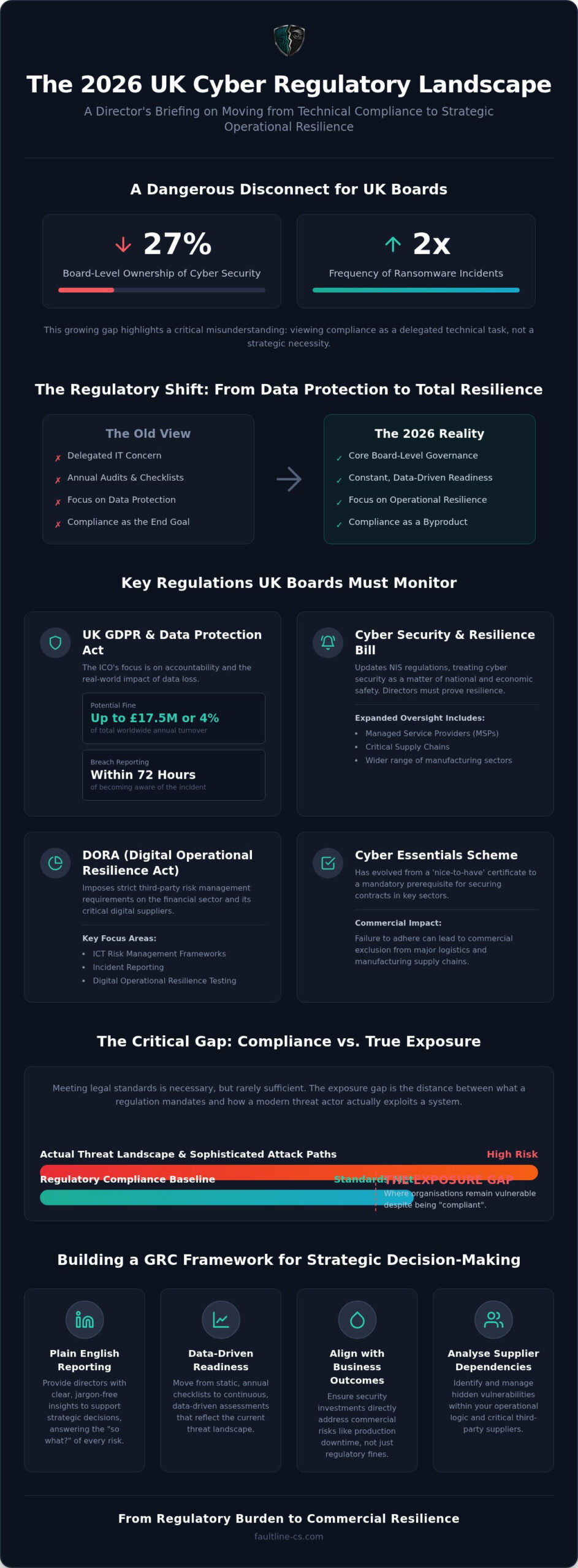
Why has board-level ownership of cyber security fallen to just 27% whilst the frequency of ransomware incidents has doubled? This disconnect suggests that many directors still view regulatory compliance cybersecurity UK as a technical burden to be delegated rather than a strategic pillar of operational resilience. Leaders often feel the pressure of potential fines from the UK GDPR or the expanding scope of the Cyber Security and Resilience Bill, yet the path to true security remains obscured by jargon and supplier dependencies. It’s a common frustration for those who need to prove resilience to the board without getting lost in technical theatre.
This guide offers a pragmatic overview of the 2026 UK regulatory landscape, moving away from superficial checklists toward a model of evidence-led governance. You’ll gain a clear understanding of your legal obligations, including the impact of the Terrorism (Protection of Premises) Act 2025 and the updated Cyber Essentials Danzell requirements. By the end, you’ll have a strategy to align compliance with business outcomes, reducing your exposure to both legal and operational risks through a structured, logical framework.
Key Takeaways
- Understand why the UK regulatory landscape has evolved from simple data protection to a broader requirement for total operational resilience.
- Identify the commercial implications of current legislation to ensure your strategy for regulatory compliance cybersecurity UK addresses genuine business risk.
- Recognise the critical exposure gap that occurs when an organisation meets legal standards but remains vulnerable to sophisticated attack paths.
- Learn how to build a GRC framework that provides directors with clear, plain English reporting to support strategic decision making.
- Discover how moving from static checklists to data-driven readiness assessments can reveal hidden vulnerabilities in your operational logic and supplier dependencies.
Navigating the Shifting UK Regulatory Environment
Compliance is no longer a peripheral IT concern. In 2026, regulatory compliance cybersecurity UK represents a fundamental aspect of corporate governance that dictates whether a business can legally and operationally function. It is the structured adherence to a growing web of legislation designed to protect not just personal data, but the very continuity of the UK economy. For directors, this means moving beyond the comfort of annual audits and embracing a state of constant readiness.
The landscape has undergone a profound transformation. We have moved from a period where security meant protecting a database to an era where it means ensuring a production line never stops. This shift is codified in the Cyber Security and Resilience Bill, which expands oversight to managed service providers and critical supply chains. However, a dangerous exposure gap persists. This is the distance between what a regulation mandates and how a modern threat actor actually exploits a system. Meeting the baseline is necessary, but it is rarely sufficient to stop a determined adversary.
The Cost of Compliance Failure in 2026
The financial penalties for failure are now high enough to threaten the solvency of mid-sized firms. Under the UK GDPR, the Information Commissioner’s Office (ICO) can levy fines of up to £17.5 million or 4% of total worldwide annual turnover. Beyond these statutory penalties, the commercial exclusion from lucrative contracts is often more damaging. Major logistics and manufacturing hubs now require proof of adherence to the Cyber Essentials scheme as a prerequisite for partnership. UK organisations typically face a recovery period spanning several weeks when a compliance failure results in a total halt of production or distribution services.
From Data Protection to Operational Resilience
The evolution from the Data Protection Act 1998 to the current frameworks reflects a change in the government’s priorities. Cyber security is now treated as a matter of national and economic safety rather than a private administrative duty. This means regulators are looking for evidence of operational resilience: the ability to maintain critical services during and after an incident. Directors must ensure that specialist services are aligned with these business outcomes. Compliance should never be the end goal; it should be the byproduct of a robust, well-governed operation that understands its own vulnerabilities and dependencies.
Key Cyber Security Regulations Every UK Board Must Monitor
Compliance is a dynamic risk management requirement rather than a static goal. For directors, regulatory compliance cybersecurity UK is now a primary indicator of operational health. Whilst international standards like ISO 27001 provide a robust framework for managing information security, they do not replace the specific legal duties mandated by UK law. Instead, these regulations provide the legal teeth that can enforce a total halt in operations if standards are not met. This House of Commons Library briefing outlines how the government uses these rules to safeguard the national economy, placing the burden of proof squarely on the board.
The Evolution of UK GDPR and the Data Protection Act
Data protection laws in 2026 have matured beyond simple privacy concerns. The UK GDPR and the Data Protection Act 2018 remain the core pillars, but the Information Commissioner’s Office (ICO) has significantly sharpened its focus on accountability. Directors have a legal duty to report serious personal data breaches within 72 hours of becoming aware of the incident. Failure to do so, or failing to have the systems in place to detect the breach, invites fines of up to £17.5 million or 4% of global turnover. It’s essential to follow the latest ICO guidance, which now emphasises the “so what” of data loss: the real-world impact on individuals and the resulting systemic risk to the business.
NIS2 and DORA: New Standards for Critical Infrastructure
The scope of regulation has expanded to include the digital supply chain. The Cyber Security and Resilience Bill, which updates the NIS Regulations, now brings managed service providers (MSPs) and a wider range of manufacturing sectors under direct oversight. Similarly, the Digital Operational Resilience Act (DORA) creates strict requirements for financial services and any firm that supplies them with digital services. This makes modernising third-party risk management a commercial necessity. If your organisation sits within the supply chain of a regulated entity, your own security posture is now a matter of their compliance.
Managing these overlapping requirements requires a strategic approach that moves beyond technical theatre. Boards must understand that a failure in a supplier’s security is, in the eyes of the regulator, a failure in their own governance. To ensure your organisation meets these evolving standards, it may be time to speak with a specialist consultant about aligning your GRC framework with your commercial objectives.
The Critical Gap Between Compliance and Actual Exposure
Compliance is often mistaken for a shield. In reality, it’s a mirror reflecting what a regulator expects to see, not necessarily what an attacker encounters. The fundamental issue with regulatory compliance cybersecurity UK is that it focuses on the existence of controls rather than their efficacy. An auditor confirms that a firewall exists; an attacker confirms whether it’s actually configured to block them. This creates the exposure gap, a systemic blind spot where operational risk lives undetected behind a facade of green checkmarks and passed audits.
Directors must move beyond the comfort of assumptions and demand raw evidence. Relying on a compliance certificate to guarantee security is a form of commercial negligence. Real resilience requires an understanding of how your specific systems, people, and processes interact under pressure. If you only build your defences to satisfy a regulator, you’re leaving the door open for any adversary who doesn’t play by the rules of an audit.
Why Being Compliant Does Not Mean You Are Secure
Audits are static snapshots in time. They capture a moment of perceived readiness that can degrade within hours of the auditor leaving the building. Many organisations fall into the trap of technical theatre, where they invest in expensive software and “blinky light” tools to satisfy a specific regulatory requirement without reducing their actual risk. This creates a false sense of security that often collapses during a real-world incident.
We advocate for Pilot 0 thinking. This approach requires directors to look at the ground-level reality of their operations before making any technical investments. It’s about identifying the hidden vulnerabilities in human behaviour and system logic that a standard checklist will never find. By focusing on reality over theatre, you ensure that your security budget is spent on reducing commercial exposure rather than just buying peace of mind for the next board meeting.
The Intersection of Physical and Digital Vulnerabilities
Most cyber frameworks ignore the physical world, yet the two are inextricably linked. A sophisticated encryption protocol is worthless if an unauthorised person can walk into a logistics hub and access an unlocked server rack. The convergence of these risks is now a matter of law. The Terrorism (Protection of Premises) Act 2025, known as Martyn’s Law, requires public-facing UK organisations to take proportionate steps to mitigate physical threats. Many of these requirements overlap directly with cyber incident response and operational resilience.
Security is a singular problem that spans both digital and physical domains. A failure in one often leads to a total collapse of the other. FaultLine addresses this specific crossover through their exposure assessments, which hunt for the realistic attack paths that standard compliance frameworks miss. By examining the gap between your digital controls and physical operations, you gain the visibility needed to protect production lines and supply chains from systemic failure.
Implementing a Robust GRC Strategy for UK Organisations
Governance, Risk, and Compliance (GRC) is the mechanism that translates technical activity into board-level insight. Effective regulatory compliance cybersecurity UK requires a framework built on evidence rather than assumptions. It begins with a comprehensive asset register. You cannot secure what you haven’t identified, yet many organisations lack a clear view of their hardware, software, and data dependencies. This visibility is the foundation of a functional risk register, which must categorise threats based on their potential impact on production and logistics rather than abstract technical scores.
Defining Accountability and Governance Structures
Accountability cannot be outsourced. It must be clearly defined at the board level to ensure that cyber risk is treated with the same gravitas as financial or legal risk. Directors need reporting that strips away the technical theatre and focuses on commercial exposure. This includes downtime risks, supplier dependencies, and specific regulatory obligations. For a detailed breakdown of how to structure these communications, refer to our UK directors guide for board-level reporting. Success is measured by the board’s ability to make informed resource allocation decisions based on ground-level reality.
Managing Supplier and Third-Party Regulatory Risk
Your regulatory boundary now extends to every third party with access to your network. Under modern frameworks, supplier compliance is a direct reflection of your own governance. A robust strategy requires a formal supplier register and a rigorous auditing process to ensure that third-party vulnerabilities don’t become your systemic failures. Consider this checklist for auditing your external dependencies:
- Verify the specific access levels granted to each vendor and remove unnecessary permissions.
- Challenge contractual assumptions regarding liability, incident notification, and recovery time objectives.
- Review documented evidence of their own resilience testing rather than accepting self-certified questionnaires.
- Align their reporting cycles with your own GRC requirements to maintain a continuous view of risk.
This level of oversight is a requirement for ISO 27001 alignment and ensures that your organisation remains resilient despite the complexities of a modern supply chain. Integrating these practices into your corporate culture ensures that regulatory compliance cybersecurity UK becomes a matter of operational logic rather than a series of administrative hurdles. It moves the organisation toward Pilot 0 thinking, where reality is addressed before investment is made.
Moving Beyond Checklists to Strategic Cyber Readiness
Checklists offer a sense of completion that is often entirely divorced from reality. For a director, achieving regulatory compliance cybersecurity UK through a series of yes or no answers provides a dangerous level of comfort. These generic audits focus on the presence of a policy rather than the logic of an operation. True strategic readiness requires a data-driven approach that identifies how an attacker would actually move through your specific environment, bypassing the very controls your auditors just approved.
FaultLine provides this clarity through the Cyber Readiness Assessment, powered by IntelSensus. This is not a standard tick-box exercise; it’s a strategic deconstruction of your current posture. By treating security as a long-term partnership rather than a one-off purchase, you ensure that your defences evolve as quickly as the threats targeting your industry. It’s about moving from a reactive state of “fixing holes” to a proactive culture of sustained resilience.
The Role of Exposure Assessments in Compliance
Exposure assessments are the practical application of Pilot 0 thinking. They map out the messy, real-world intersection of cyber vulnerabilities, physical access points, and supplier dependencies. Unlike traditional penetration testing, this service involves no intrusive testing that might disrupt your production lines or logistics schedules. It is available as a fixed-price entry service at £5,000, providing a clear-eyed baseline of your actual risk. This assessment provides the objective evidence needed for directors to make informed, high-stakes decisions about resource allocation and risk appetite.
Securing Your Supply Chain and Operational Trust
Blind trust is a luxury that modern directors can no longer afford. Verified resilience requires a methodical deconstruction of your supply chain to ensure that your operational trust is built on evidence rather than assumptions. In manufacturing, where downtime is measured in thousands of pounds per hour, this level of insight is the difference between a minor setback and a systemic failure. Operational resilience planning is the strategic path forward, ensuring that your organisation remains a steady hand in a complex, high-risk environment.
The goal of regulatory compliance cybersecurity UK should be to build a business that is inherently difficult to disrupt. This requires a shift in perspective from technical theatre to grounded expertise. By identifying your realistic attack paths today, you protect your operational trust and commercial reputation for the long term. It’s time to move beyond the checklist and start managing the reality of your exposure.
Read our strategic GRC consultation guide to learn how to align your compliance efforts with genuine business resilience.
Securing the Future of UK Operations
Compliance is the baseline, not the finish line. We’ve explored how the 2026 landscape demands a shift from data protection to total operational resilience, particularly within the manufacturing and logistics sectors. By addressing the exposure gap between regulatory requirements and realistic attack paths, directors can move beyond technical theatre toward genuine security. A robust GRC strategy must be built on evidence and plain-English reporting that supports strategic decision-making rather than simple box-ticking.
Navigating regulatory compliance cybersecurity UK requires a steady hand and a clear view of systemic vulnerabilities. FaultLine provides this visibility through a fixed-price £5,000 Exposure Assessment, delivering board-level insights without the disruption of intrusive testing. This pragmatic approach ensures your production lines and supply chains remain resilient in an increasingly complex environment. It’s time to replace blind trust with verified readiness.
Building a resilient organisation is a continuous journey, but it starts with a single clear-eyed assessment of your current reality. You have the tools to move beyond uncertainty and lead your business with confidence.
Frequently Asked Questions
What is the primary cyber security regulation in the UK?
The UK General Data Protection Regulation (UK GDPR) and the Data Protection Act 2018 remain the primary laws for data privacy. However, for regulatory compliance cybersecurity UK, the Cyber Security and Resilience Bill is now the central pillar for critical infrastructure and managed service providers. It mandates stricter reporting and security standards. For businesses in Belfast or Derry/Londonderry, this means ensuring that governance structures are robust enough to meet these evolving statutory requirements.
How do NIS2 and DORA affect UK-based organisations in 2026?
Whilst NIS2 and DORA are EU-led, they directly impact UK organisations that operate within EU supply chains or have European subsidiaries. The UK government’s Cyber Security and Resilience Bill mirrors many NIS2 requirements, particularly regarding managed service providers. Organisations in logistics hubs like Craigavon must verify their compliance status if they provide essential services to the EU. Failure to align with these standards can result in commercial exclusion from major European contracts.
Can a director be held personally liable for a cyber security failure in the UK?
Directors can be held accountable for systemic governance failures that lead to a breach. Under the UK GDPR, the ICO focuses on organisational liability, but the Cyber Security and Resilience Bill places a stronger emphasis on board-level responsibility. If a director fails to exercise due diligence or ignores known vulnerabilities in their supply chain, the resulting reputational and financial damage falls under their remit. It’s no longer possible to delegate this risk entirely to IT departments.
What is the difference between cyber security compliance and cyber resilience?
Compliance is the act of meeting a set of minimum legal or industry standards. Resilience is the operational capacity to maintain production and distribution whilst under attack. A business in Lisburn might pass a compliance audit but still lack the resilience to recover from a ransomware incident. Resilience focuses on the reality of the exposure gap, ensuring that the organisation can survive an incident rather than just passing a paper-based inspection.
How often should a UK business conduct a regulatory compliance audit?
Formal audits should occur at least annually, but the dynamic nature of regulatory compliance cybersecurity UK suggests a move toward continuous monitoring. High-stakes sectors in Ballymena or Antrim should conduct regular exposure assessments to catch vulnerabilities that emerge between audit cycles. Relying on a single yearly check creates a false sense of security. Instead, use a risk-based approach that triggers reviews whenever significant changes occur in your systems or supplier dependencies.
What are the requirements for Martyn’s Law regarding physical and cyber security?
Martyn’s Law, or the Terrorism (Protection of Premises) Act 2025, mandates proportionate security measures for public-facing venues. Whilst primarily focused on physical safety, it overlaps with cyber security through incident response planning and the protection of digital access controls. Businesses in Newry must ensure their physical security systems, such as CCTV and smart locks, aren’t exploited as entry points for a cyber attack. Resilience planning must now cover both digital and physical domains.
How does ISO 27001 help with UK regulatory compliance?
ISO 27001 provides a globally recognised framework for an Information Security Management System (ISMS). It helps UK businesses evidence that they have taken appropriate technical and organisational measures as required by the ICO. For firms in Bangor or Carrickfergus, implementing ISO 27001 creates a structured path for managing assets, risks, and supplier relationships. It transforms compliance from a series of ad-hoc tasks into a repeatable, auditable process that supports long-term commercial goals.
What should be included in a board-level cyber risk report?
A board-level report should focus on commercial exposure and operational risk rather than technical metrics like firewall logs. It must include a summary of production risks, supplier dependencies, and the status of current regulatory obligations. Directors need to see the “so what” of every vulnerability. For example, a report for a firm in Newtownabbey should clearly state how a specific cyber gap could lead to downtime on a manufacturing line or a breach of contract.

Article by
Alex J Morgan
Alex Morgan writes and develops content for FaultLine Cyber & Security Ltd. Alex has worked across web development, organic SEO, digital marketing and content creation since 2009, with a particular focus on making complex subjects clear, useful and easy to navigate.
Leave a Reply