


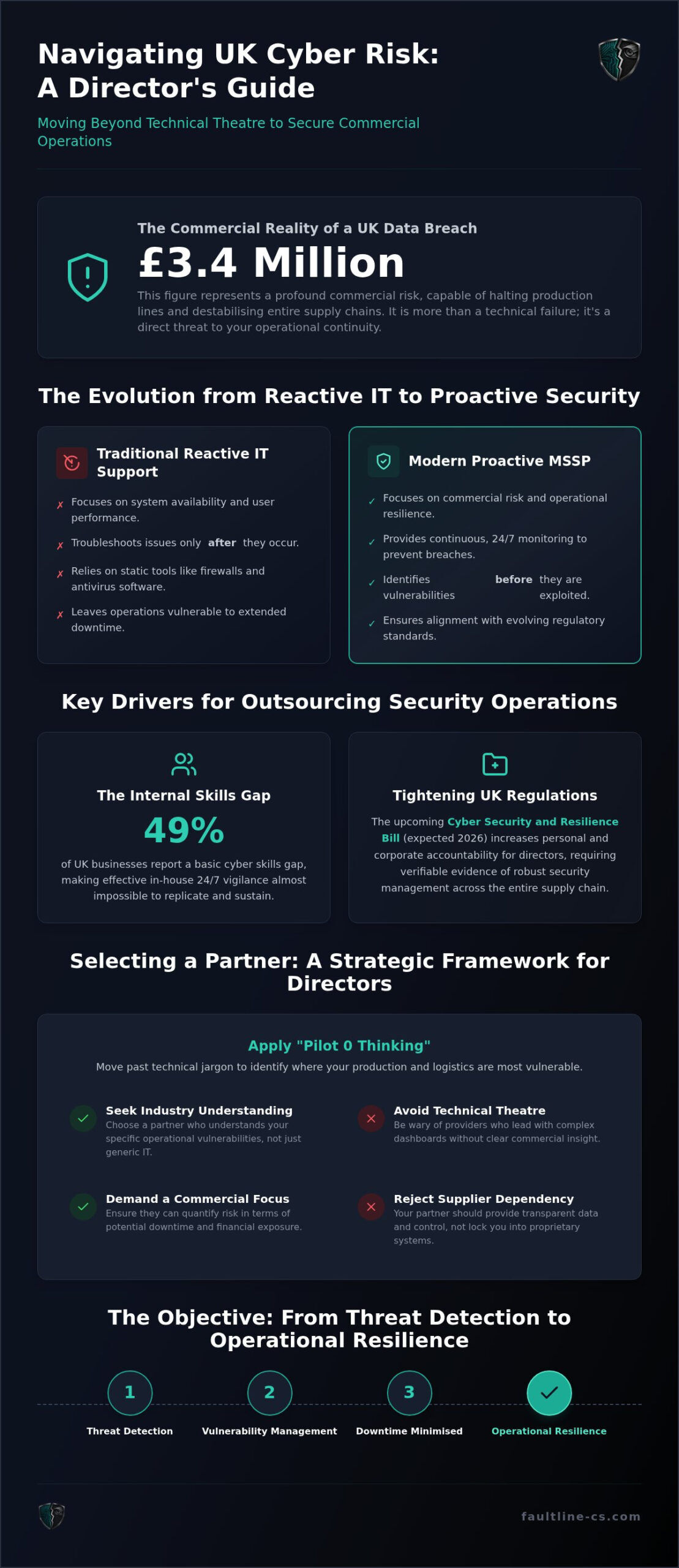
The average cost of a data breach for a UK business has reached £3.4 million. This figure represents more than a technical failure; it is a profound commercial risk that can halt production lines and destabilise supply chains. For many directors, the real danger lies in the gap between reported security metrics and the actual resilience of their operations. Choosing a managed security service provider UK is frequently a process obscured by technical theatre and supplier dependency risks, leaving leadership teams feeling disconnected from their own defensive posture.
You probably recognise the frustration of being presented with overwhelming jargon when you require clear, actionable insight into your commercial exposure. This guide provides a pragmatic alternative. It explains how a modern MSSP offers the visibility needed to protect UK business operations whilst ensuring alignment with evolving regulatory standards. We will examine how to move beyond superficial fixes to achieve a state of operational readiness that minimises the risk of downtime and secures your long term commercial interests.
Key Takeaways
- Understand how an MSSP acts as an externalised security department to move your business from reactive IT support to proactive, continuous monitoring.
- Learn to quantify the commercial cost of downtime and apply “Pilot 0 thinking” to protect your most vulnerable production and logistics operations.
- Discover why the most dangerous commercial exposures exist in the overlooked gaps between business functions and supplier dependencies.
- Evaluate how to choose a managed security service provider UK based on their understanding of your industry rather than just technical certifications.
- Transition from simple threat detection to true operational resilience by using data-driven frameworks like the Cyber Readiness Assessment.
Defining the Role of a Managed Security Service Provider in the UK
Security is no longer a peripheral IT concern. It is a core operational requirement. For many UK organisations, the internal capacity to manage sophisticated threats has been outpaced by the speed of digital change and the complexity of modern supply chains. This is where a What is a Managed Security Service Provider (MSSP) becomes essential. Rather than a simple helpdesk, a modern managed security service provider UK acts as an externalised security department. They provide the continuous monitoring and strategic oversight required to protect production environments from systemic failure and unauthorised interference.
The distinction between a generic IT supplier and a specialist security partner is critical. Whilst an IT provider focuses on system availability and user performance, a security partner focuses on risk and resilience. This involves a fundamental shift from reactive troubleshooting to proactive security operations. By integrating Security Operations Centre (SOC) and Security Information and Event Management (SIEM) capabilities, businesses gain the visibility needed to identify vulnerabilities before they are exploited. This is Pilot 0 thinking in practice: prioritising the reality of your operational environment over the theoretical promises of software vendors.
To better understand this concept, watch this helpful video:
The Evolution of Security Outsourcing
Traditional defences like firewalls and antivirus software are now insufficient. They are static tools in a dynamic threat environment where attackers often bypass traditional perimeters. Modern operational risk requires active observation. A SOC identifies anomalies in real time, such as unusual data movements or unauthorised access attempts, allowing for intervention before a breach occurs. This level of continuous monitoring is increasingly a prerequisite for securing cyber insurance and maintaining a credible posture in the eyes of stakeholders. It ensures that security is an active process rather than a forgotten configuration.
UK Regulatory Drivers for Managed Security
The regulatory landscape in the UK is tightening significantly. With the anticipated Cyber Security and Resilience Bill expected to receive royal assent in late 2026, directors face increasing personal and corporate accountability. These standards require verifiable evidence of robust security management across the entire supply chain. Engaging with a specialist for operational resilience services ensures that your organisation meets its fiduciary duties whilst aligning with specific UK governance standards. Local expertise is vital here. It provides the necessary context to navigate the unique requirements of UK infrastructure, moving beyond generic checklists to address the specific commercial exposures of your business.
The Commercial Logic of Outsourced Security Operations
Operational silence is expensive. When a production line stops due to a ransomware incident, the losses are measured in hourly output and reputational damage rather than just IT recovery fees. A ‘wait and see’ approach to cyber risk is not a viable strategy; it is a commercial liability that ignores the reality of the modern threat landscape. By partnering with a managed security service provider UK, organisations can move away from unpredictable emergency spending towards a structured, predictable cost model.
This transition relies on ‘Pilot 0 thinking’. It’s a method that involves looking past the technical theatre of software dashboards to identify where your production and logistics are most vulnerable. For instance, reducing ‘dwell time’, the period an attacker remains undetected in your network, from months to minutes can be the difference between a minor disruption and a catastrophic loss of data. Outsourcing these operations to a specialist provides a level of 24/7 vigilance that is almost impossible to replicate internally, especially since 49% of UK businesses currently report a basic technical cyber skills gap. Organisations that rely solely on dashboard metrics risk falling into a false sense of security; proactive threat hunting services UK businesses adopt can surface the hidden exposures that static tools consistently miss.
Protecting Production and Logistics
Manufacturing and logistics firms are prime targets because their operations are time-sensitive. An incident that delays a shipment or compromises intellectual property can have cascading effects across the entire supply chain. Effective operational resilience services ensure that security monitoring acts as a business enabler. It provides the assurance that delivery schedules and proprietary processes are protected, allowing leadership to focus on growth rather than crisis management.
The Boardroom Perspective on Risk
Directors have a fiduciary duty to manage risk, yet they are often excluded by technical jargon. Clear, plain-English reporting is essential for making informed commercial decisions. When selecting a managed security service provider UK, the focus should be on the reduction of commercial exposure rather than just the number of alerts generated. This alignment with UK government cyber security guidance helps link your security posture directly to company valuation and investor confidence.
Investors and insurers now look for evidence of resilience as a marker of a well-governed business. If you’re concerned about how your current exposure might impact your commercial standing, it may be time to speak with a specialist about a more strategic approach.
Moving Beyond Tools: Identifying the Real Exposure Gap
Tools are not a strategy. Many organisations invest heavily in high-end software only to find that their primary vulnerabilities remain untouched. This happens because the most dangerous risks don’t live within your applications; they exist in the systemic gaps between your business functions. When leadership assumes that departments are communicating effectively regarding risk, they often create a vacuum where hidden vulnerabilities thrive. Strategic security requires looking past the dashboard to see how your business actually functions on the ground.
According to Gartner market analysis, the shift towards outcome-based security rather than just toolsets is a defining trend for modern enterprises. For a managed security service provider UK, the priority must be identifying these commercial exposure points before recommending a single piece of hardware. This is the FaultLine philosophy in practice: identifying exposure through evidence rather than assumptions. It’s about understanding the operational logic of your firm before investing in heavy technical tools that might only solve half the problem. A robust GRC framework implementation UK directors can rely on must similarly prioritise commercial risk reduction over the performance of compliance.
The Physical and Cyber Crossover
Physical security is often treated as a separate discipline from cyber security, yet the two are inextricably linked. A secure server room is of little value if an unauthorised visitor can gain access through a poorly managed side gate or reception area. Attackers also increasingly use open-source intelligence (OSINT) to gather data on your staff from social media and public records. This information allows them to create highly targeted social engineering campaigns that bypass technical filters. Understanding physical security and cyber risk requires a unified view of your entire operational environment, ensuring that a physical breach doesn’t become a digital catastrophe.
Supplier and Third-Party Dependencies
Your business resilience is only as strong as your weakest supplier. In a modern logistics or manufacturing environment, you likely rely on dozens of external partners who have some level of access to your systems or data. A standard managed security service provider UK might monitor your internal network but miss the critical operational reliance you have on these external entities. Modernising third-party risk management involves more than just sending out a yearly questionnaire. It requires a deep dive into how your partners could inadvertently become an attack pathway into your core operations, potentially causing the very downtime you are trying to avoid.
Selecting an MSSP: A Strategic Framework for UK Directors
Technical certifications are a baseline, not a guarantee of strategic alignment. For a director, the primary concern is not which firewall is installed, but whether the provider understands the commercial impact of a stopped production line. When selecting a managed security service provider UK, you must prioritise business context. A partner who understands the intricacies of logistics and manufacturing will focus on the resilience of your operations rather than just the security of your servers. They should be able to articulate how their service protects your specific revenue streams and supplier relationships.
Clarity is a non-negotiable requirement. If a proposal is saturated with technical theatre and fails to explain risks in plain English, it is a sign of a misaligned partnership. You cannot manage a risk you don’t understand. Look for providers who offer fixed-price entry services, such as a £5,000 Exposure Assessment, to test the partnership without long-term lock-in. This approach allows you to evaluate their ability to handle Governance, Risk & Compliance (GRC) and operational resilience before committing to a full-scale engagement. Directors seeking to understand how governance structures should be built around genuine commercial outcomes will find that a well-structured GRC framework implementation UK businesses can adopt moves the relationship from one of assumptions to one based on verified evidence.
Evaluating the Partnership Model
A strategic security partner differs fundamentally from a tool vendor. Vendors sell software; partners sell insight. A credible managed security service provider UK should act as a strategic guide, collaborating with accredited specialists for deep technical work whilst maintaining a dedicated point of contact who understands your commercial goals. This ensures that security decisions are always filtered through the lens of your business objectives rather than technical convenience. The goal is to find a partner that acts as a steady hand, providing clarity in complex environments.
Red Flags in Managed Security Proposals
Beware of alarmist marketing. If a provider uses fear-based selling tactics instead of evidence-led analysis, their focus is on conversion rather than your resilience. Avoid ‘black box’ services where you lack visibility into what is actually being monitored. A transparent partner will provide clear insight into your defensive posture. Similarly, be sceptical of any proposal that promises a solution before conducting a thorough risk assessment. Without understanding your specific exposure, any tool they install is merely a guess. True security requires a methodical deconstruction of your specific commercial risks.
Transitioning from Threat Detection to Operational Resilience
Detection is a passive observation. Whilst identifying a breach is necessary, it is ultimately futile if your organisation lacks the structure to respond and recover. True security maturity moves beyond the mere identification of threats to the establishment of operational resilience. This means ensuring that your business can maintain its core functions, such as production and logistics, even whilst under active pressure. A partnership with a managed security service provider UK should provide the framework for this endurance, integrating technical monitoring with robust incident response and disaster recovery planning.
Resilience requires a shift in focus from “if” an incident occurs to “when”. It demands that security operations are not siloed within IT but are integrated into your broader Governance, Risk, and Compliance (GRC) strategies. This alignment ensures that every technical alert is understood through the lens of business impact, allowing for prioritised responses that protect your most valuable commercial assets. Directors looking to understand how managed threat detection and response UK specialists structure these capabilities can gain a clearer picture of how detection, response, and recovery functions should be integrated into a single operational framework. The end goal is a business that does not just survive a disruption but recovers with its reputation and operations intact.
The FaultLine Cyber Readiness Assessment
Most organisations claim to be “working towards” standards like ISO 27001, yet few can demonstrate true operational alignment. The FaultLine Cyber Readiness Assessment, powered by IntelSensus, replaces these vague aspirations with a data-driven reality. It provides a realistic picture of your organisational maturity by testing your actual ability to withstand a sophisticated attack. This is a strategic guide to UK operational resilience that prioritises evidence over assumptions. By identifying specific gaps in your defensive posture, it allows leadership to allocate resources where they will have the greatest impact on long term stability.
Next Steps for Senior Leadership
The transition to a resilient posture begins with a clear understanding of your current exposure. Directors should initiate a fixed-price Exposure Assessment at £5,000 to identify immediate gaps in their security and supplier dependencies. This provides the necessary baseline for setting clear accountability structures at the board level. Cyber risk is a commercial risk, and it must be managed with the same rigour as financial or operational performance.
You can explore FaultLine’s managed security and assessment services to begin building the visibility and resilience needed to protect your UK operations. By moving from technical theatre to grounded realism, you ensure that your security investment delivers genuine commercial value.
Securing Your Operational Future
Real security is measured by the continuity of your production lines and the integrity of your supply chain. It requires moving beyond the installation of tools to a state of genuine operational readiness. By selecting a managed security service provider UK that prioritises business logic over technical theatre, directors can gain the visibility needed to manage commercial exposure effectively. We have explored how the intersection of physical access, supplier dependency, and cyber risk creates hidden vulnerabilities that can halt operations if left unaddressed.
Addressing these gaps isn’t about frantic alarmism; it’s about methodical deconstruction and strategic alignment. A specialist focus on UK operational sectors ensures that your defensive posture remains grounded in reality rather than theoretical software metrics. A fixed-price Exposure Assessment offers a practical, board-level entry point to identify systemic gaps and receive plain-English reporting without long term lock-in. This evidence-led approach ensures your security investment delivers measurable commercial resilience.
Taking this first step ensures that your security posture is built on evidence rather than assumptions. It positions your firm as a resilient partner capable of navigating the complex UK infrastructure landscape with confidence.
Frequently Asked Questions
What is the difference between an MSP and an MSSP?
An MSP manages your IT infrastructure and user support, whereas a managed security service provider UK focuses specifically on threat detection and risk management. Whilst an MSP ensures your systems are available and performing well, an MSSP provides the specialised security operations (SOC) needed to protect those systems from breach. This distinction is critical for directors who need to ensure that security isn’t just an add-on to general IT maintenance.
How much should a UK business expect to pay for managed security services?
Costs for managed security vary based on the scale of your operations and the depth of monitoring required. Rather than committing to a large ongoing contract immediately, many UK businesses start with a fixed-price Exposure Assessment at £5,000. This provides a data-led baseline of your current vulnerabilities. Subsequent monthly fees for MSSP services are then tailored to the specific commercial risks and resilience goals identified during that initial assessment phase.
Do we still need an MSSP if we have an internal IT team?
Internal IT teams are frequently consumed by day-to-day operational support and system maintenance, leaving little capacity for deep security analysis. An MSSP acts as a strategic partner that complements your existing team by providing 24/7 monitoring and specialised expertise in threat hunting. This ensures that security remains a dedicated priority whilst your internal staff focus on driving business performance and supporting users across your manufacturing or logistics sites.
Can an MSSP help our business achieve ISO 27001 certification?
A specialist managed security service provider UK can play a vital role in the certification process by providing the necessary evidence of robust security controls. Whilst they aren’t the certification body itself, they provide the GRC consulting and continuous monitoring data required to demonstrate compliance. This moves your organisation from merely “working towards” ISO 27001 to achieving a state of true operational alignment with international security standards.
What is a Security Operations Centre (SOC) and why is it important?
A Security Operations Centre (SOC) is a centralised facility where security professionals monitor your systems in real time to identify and respond to threats. It is important because it reduces “dwell time”, the period an attacker spends in your network before being caught. For manufacturing firms, a SOC provides the visibility needed to detect anomalies in production environments, ensuring that potential disruptions are neutralised before they result in costly downtime.
How does an MSSP handle third-party and supplier risks?
MSSPs manage these risks by conducting a thorough Supplier & Third-Party Risk Analysis to identify where your external partners have access to your core systems. They look for attack pathways that could lead from a compromised supplier into your own network. By treating your supply chain as an extension of your own perimeter, an MSSP helps ensure that your operational resilience isn’t compromised by a security failure at an external entity.
What are the most common cyber threats for UK manufacturing firms in 2026?
Ransomware remains the most significant threat to UK manufacturing in 2026, often targeted at halting production lines to extort high payments. AI-powered social engineering and supply chain compromises are also increasing in frequency and sophistication. These attacks exploit human behaviour and supplier dependencies rather than just technical flaws. Understanding these trends is essential for directors who must oversee the long-term resilience of their logistics and manufacturing operations.
How often should a business receive security exposure reports?
Critical security incidents require immediate notification, but strategic board-level reporting should occur at least monthly. These reports must be delivered in plain English, focusing on commercial exposure and progress against resilience goals rather than a list of technical alerts. Regular reporting ensures that leadership remains informed about the reality of their security posture, allowing for data-led decisions regarding risk management and future investment in operational protection. For a deeper understanding of how detection capabilities should be structured to support this reporting, the managed threat detection and response UK strategic reference for directors provides a practical framework for evaluating your current posture against genuine operational benchmarks.

Article by
Alex J Morgan
Alex Morgan writes and develops content for FaultLine Cyber & Security Ltd. Alex has worked across web development, organic SEO, digital marketing and content creation since 2009, with a particular focus on making complex subjects clear, useful and easy to navigate.
Leave a Reply