


Your security dashboard is glowing green, yet your business has never been more vulnerable. It’s a common paradox for UK directors who see significant capital expenditure on technical tools that fail to provide clear visibility into operational risk. In 2026, the average total cost of a data breach for a UK organisation reached £3.13 million, according to industry research. This figure suggests that whilst the lights are green, the underlying exposure remains unaddressed. By integrating proactive threat hunting services UK firms can move beyond these static visualisations to find the gaps where real risk resides.
Many leaders share the frustration of managing complex supplier dependencies and technical alerts that don’t translate into business impact. You deserve a clear understanding of where your real exposure lives. This article explains how proactive threat management identifies the hidden operational gaps that traditional security tools miss, ensuring your business remains resilient against modern UK cyber exposures. We will explore a framework for prioritising security spend based on operational impact, providing the confidence needed to survive a supply chain disruption.
Key Takeaways
- A green dashboard often masks systemic gaps. Learn why passive monitoring is no longer a sufficient guarantee of operational safety.
- By utilising proactive threat hunting services UK businesses can expose realistic attack paths involving suppliers and physical access before they’re exploited.
- Shift from technical theatre to a governance-led approach by mapping your critical operational dependencies and supplier access pathways.
- Evaluate the difference between traditional penetration testing and integrated exposure assessments to find where your real vulnerabilities live.
- Establish a maturity baseline through a readiness assessment, allowing for strategic alignment between security spend and long-term resilience.
The Limits of Passive Monitoring: Why Your Green Dashboard is Not a Guarantee
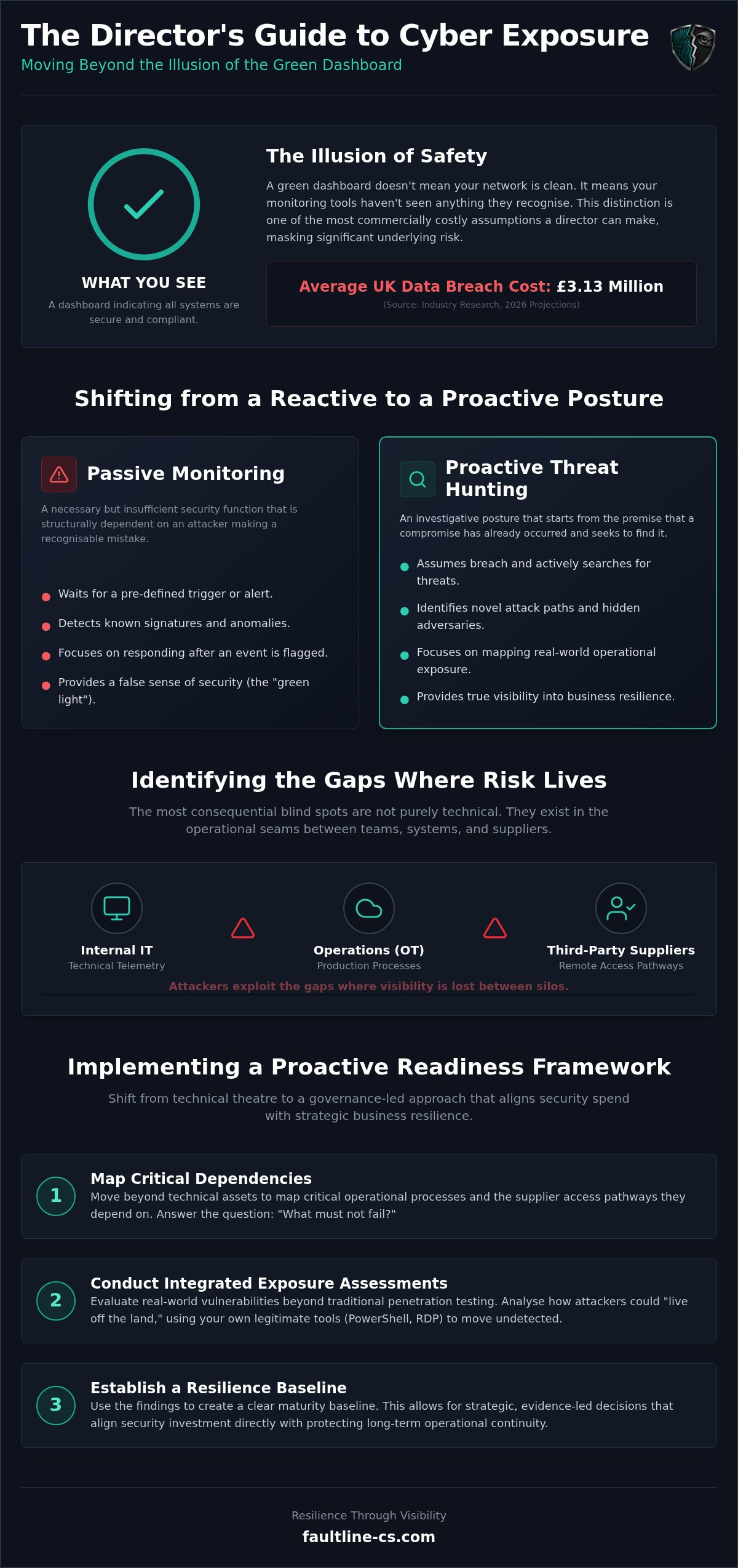
A green dashboard doesn’t mean your network is clean. It means your monitoring tools haven’t seen anything they recognise. That’s a meaningful distinction, and conflating the two is one of the most commercially costly assumptions a director can make.
Passive monitoring works by waiting. It watches for known signatures, anomalous traffic patterns, or pre-defined thresholds that trigger an alert. When nothing trips the wire, the system reports all-clear. The problem is that modern attackers have become highly adept at not tripping wires. They move slowly, use legitimate credentials, and blend their activity into the background noise of normal operations. The absence of an alert, in this context, is not evidence of safety. It may simply be evidence of a more patient adversary.
This is where the concept of proactive threat hunting becomes operationally relevant. Rather than waiting for a system to flag suspicious behaviour, proactive management starts from a different premise entirely: assume something has already found a way in, and go looking for it. It’s an investigative posture rather than a reactive one, and it changes the nature of what your security function is actually doing.
The specific technique worth understanding here is commonly referred to as “living off the land.” Attackers increasingly avoid deploying custom malware, which is detectable, in favour of using the legitimate administrative tools already present in your environment. PowerShell, Windows Management Instrumentation, and remote desktop protocols are all standard business tools. When an attacker uses them, there is often no malicious file to flag, no signature to match. The activity looks, to a passive monitoring system, entirely routine.
The Difference Between SOC Monitoring and Proactive Management
A Security Operations Centre running traditional monitoring is calibrated to respond. Alerts arrive, analysts investigate, and remediation follows. It’s a necessary function, but it’s structurally dependent on the attacker doing something the system has been taught to notice. Proactive management inverts that logic. It assumes the initial stages of a compromise may have already occurred without generating a single alert, particularly where supplier or third-party access pathways are involved. Those entry points often sit outside the direct visibility of a standard SOC configuration.
Identifying the Gap Where Risk Lives
The most consequential blind spots in most organisations aren’t purely technical. They sit in the operational seams between departments, between IT systems and production floor processes, and between internal teams and external suppliers. When IT and operations teams work in separate silos, neither group has complete visibility of how the other’s systems interact. An attacker who understands your operational logic, who knows which supplier has remote access on which days, and which credentials are shared across sites, can navigate those gaps with relative ease. Proactive threat hunting services UK firms are beginning to adopt specifically address this intersection, mapping real-world behaviour and access dependencies rather than relying solely on technical telemetry.
Boardroom reporting that focuses on alert volumes and patch completion rates can inadvertently reinforce the green dashboard illusion. The metrics look healthy. The underlying exposure is not being measured at all.
The 2026 Landscape: Proactive Threat Management as a Strategic Business Function
Cyber risk is no longer a technical silo. It’s a strategic exposure that dictates production continuity and supplier viability. In 2026, the complexity of managing third-party dependencies has reached a critical point where attackers no longer target servers in isolation, opting instead to exploit the trust between you and your vendors. AI-driven social engineering is now sophisticated enough to bypass traditional technical baselines, with 22% of malicious breaches confirmed as AI-generated in the last year. This evolution requires a shift from reactive patching to a model of continuous operational assurance.
For manufacturing and logistics firms, the convergence of physical security and cyber risk is now undeniable. A compromise in an operational technology (OT) network can stop a production line as effectively as a mechanical failure. This shift is why boardrooms are moving toward proactive threat hunting services UK leaders use to bridge the gap between digital logs and physical reality. This alignment mirrors the broader international shift toward proactive risk reduction outlined in the CISA Strategic Plan, which emphasises collaborative and preemptive risk management over simple incident response.
The Evolution of Threat Hunting Methodologies
Traditional hunting often prioritised digital telemetry in isolation. 2026 methodologies are hypothesis-driven and start with a specific business risk. We ask: “What happens if our primary logistics partner’s credentials are stolen?” Intelligence-led management then searches for internal signs of that specific vulnerability. It’s a move toward inclusive operational trust assessments. By analysing how human behaviour and supplier access pathways intersect, firms can identify exposure that a standard digital audit would miss.
Commercial Impacts of Undetected Exposure
Exposure carries a heavy price. The average lifecycle of a breach in the UK is now 225 days, and those exceeding 200 days cost an average of £1.09 million more than faster resolutions. For an engineering firm, this isn’t just about data loss; it’s about downtime and the ripple effect through the supply chain. Undetected exposure erodes cyber insurance readiness and can lead to hiked premiums or denied coverage. Proactive management ensures you can demonstrate resilience to both insurers and partners, maintaining the trust required for modern trade. If you’re unsure where your operational dependencies overlap with hidden cyber risks, you can book an exposure assessment to gain clarity on your current standing.
The new Cyber Security and Resilience Bill, introduced to Parliament in late 2025, signals a clear move toward holding executives accountable for service continuity. Waiting for an alert is no longer a viable governance strategy. Resilience is now measured by your ability to find and close gaps before they’re exploited.
Evaluating the Gap: Proactive Threat Management vs Traditional Security Services
Technical investment does not always equate to risk reduction. Many UK firms fall into the trap of purchasing sophisticated security tools without a governance framework to guide their use. This leads to “technical theatre,” where impressive dashboards show activity but fail to address systemic vulnerabilities. Strategic leaders are now looking toward proactive threat hunting services UK to move beyond these superficial metrics and understand the commercial logic of their exposure.
Penetration Testing vs Exposure Assessments
Penetration testing remains a staple of the security industry, yet its utility is often misunderstood at the board level. A penetration test is a point-in-time technical check; it asks if a specific defence can be breached under controlled conditions. Whilst valuable for compliance, it rarely accounts for the fluid nature of modern attack paths that involve human behaviour and supplier dependencies.
Exposure assessments offer a broader, more realistic perspective. Instead of just testing a firewall, an exposure assessment examines how an attacker might move across your people, your physical sites, and your third-party partners. Directors should prioritise understanding this total exposure before investing in more granular technical testing. This shift reflects a growing consensus amongst global security leaders. High-level officials from the CIA and CISA have recently emphasised the necessity of proactive defense strategies that combine response readiness with active, iterative searching for threats.
Governance and the Strategic Necessity of Exposure
Tool-heavy strategies often fail because they lack alignment with business objectives. Governance, Risk, and Compliance (GRC) consulting is the bridge that ensures security spend is prioritised based on operational impact rather than technical trends. Without this alignment, even the most expensive security provider can become a reactive cost centre rather than a strategic asset. Security is as much about operational logic as it is about software.
Continuous visibility is the ultimate goal of proactive management. By integrating SIEM and SOC services into a broader resilience framework, organisations can significantly reduce attacker dwell time. For a deeper look at how continuous monitoring fits into a director’s oversight, see our Managed Security Service Provider UK guide. This level of 24/7 insight ensures that proactive threat hunting is not a one-off exercise but a sustained effort to find and close the gaps where risk lives. It’s about moving from a state of hopeful ignorance to one of evidence-led confidence.
Implementing a Proactive Readiness Framework for Senior Leadership
Resilience is not a product. It’s a practice. For senior leadership, moving beyond the green dashboard requires a structured framework that prioritises operational continuity over technical metrics. By utilising proactive threat hunting services UK directors can establish a cycle of evidence-led improvement that aligns security spend with actual business risk.
The first step in this framework is conducting a FaultLine Cyber Readiness Assessment, powered by IntelSensus. This establishes a maturity baseline, moving the conversation from “are we patched?” to “are we ready?”. Once the baseline is set, leadership must map critical operational dependencies. This involves identifying supplier access pathways and third-party integrations that often sit outside the view of traditional IT audits. In a manufacturing or logistics context, knowing exactly which vendor has remote access to a production line is more valuable than a generic vulnerability scan.
The third phase is the translation of technical findings into board-level decisions. This requires a “Pilot 0” mindset, where every technical alert is weighed against its potential for production downtime or supply chain disruption. Finally, this governance must be aligned with UK regulatory standards. The Cyber Security and Resilience Bill, introduced to Parliament on 12 November 2025, signals a clear shift toward mandatory reporting and operational assurance that will become fully operational by 2028. Proactive management ensures your organisation is not just compliant, but genuinely resilient.
Bridging the Communication Gap with the Board
Effective reporting avoids the technical theatre of alert volumes and focuses on realistic attack-path narratives. Directors need to understand the “so what?” behind the data. This means moving away from fear-based marketing toward evidence-led risk management. For a deeper dive into this approach, see our Cyber Threats: A Strategic Guide for UK Directors. Clear, plain-English reporting allows the board to make informed capital allocation decisions based on the actual gap where exposure lives.
Regulatory Compliance and Supplier Assurance
Proactive management is a prerequisite for modern compliance. It supports ISO 27001 alignment and Cyber Essentials Plus by providing evidence of continuous oversight rather than point-in-time checks. This is particularly relevant for firms preparing for Martyn’s Law (The Terrorism (Protection of Premises) Act 2025). Whilst enforcement is expected from 2027, the statutory guidance published in April 2026 makes it clear that organisations must begin assessing their physical and digital vulnerabilities now. For manufacturing and logistics leaders, this means ensuring that supplier dependencies don’t become a single point of failure for the entire operation.
Resilience Through Visibility: The FaultLine Approach to Exposure
Visibility is the antidote to the green dashboard illusion. At FaultLine, we identify the gap where exposure lives by integrating technical telemetry with operational reality. Most security providers offer a fragmented view; they see the network but ignore the physical loading bay or the unsecured supplier portal. Our approach connects cyber, physical, and supplier risk into a single, practical picture for the board. This isn’t about chasing every possible alert. It’s about understanding which vulnerabilities actually lead to production risk or supply chain failure.
We advocate for “Pilot 0” thinking. This means evaluating every security decision through the lens of commercial survival. By integrating proactive threat hunting services UK businesses can move from a state of reactive anxiety to one of controlled readiness. Our fixed-price entry service, the Exposure Assessment, is designed to provide this clarity without the hidden costs or technical theatre often associated with large-scale security deployments. It’s a pragmatic first step toward building a robust, operationally-resilient organisation.
The FaultLine Exposure Assessment
We start by analysing what an adversary sees before they even touch your network. Our assessment examines external visibility and open-source exposure to uncover credential and identity leaks that have already occurred. We don’t just hand you a list of technical flaws. We provide actionable recommendations that focus on business outcomes, such as protecting critical production lines or ensuring logistics data remains untampered. Utilising proactive threat hunting services UK organisations can identify these vulnerabilities before they are exploited.
Next Steps for Operational Leaders
Starting with a realistic attack-path narrative is the most effective way to engage your board. Instead of discussing abstract malware, we discuss how a compromised sub-contractor could halt your production line. This commercial perspective makes the impact clear to everyone. To begin your transition toward a more resilient posture, you can explore our proactive security services and gain the visibility your business requires.
Securing Operational Continuity Through Evidence-Led Visibility
Relying on passive monitoring leaves your organisation exposed to modern attack paths that bypass traditional defences. Security is no longer a technical metric; it’s a fundamental pillar of business resilience that requires active investigation. By adopting proactive threat hunting services UK directors can move from a state of hopeful assumption to one of verified safety.
FaultLine provides the strategic clarity needed to make informed risk decisions. We specialise in the UK manufacturing and logistics sectors, providing board-level, plain-English reporting that integrates cyber, physical, and supplier risk factors. This ensures your security strategy is aligned with operational reality rather than technical theatre.
True resilience comes from knowing exactly where your exposure lives. By identifying hidden operational gaps before they’re exploited, you ensure your business remains robust in a complex landscape. It’s time to move beyond the green dashboard and build a business that is truly prepared for the future.
Frequently Asked Questions
What is the main difference between threat hunting and proactive threat management?
Threat hunting is the tactical act of searching for signs of compromise, whilst proactive management is the strategic governance framework that prioritises these activities based on business risk. It’s the difference between a single investigative task and a sustained organisational posture. By utilising proactive threat hunting services UK firms ensure that technical searches are aligned with commercial outcomes, such as protecting production uptime rather than just checking digital logs.
How much does a proactive threat management engagement typically cost for a UK SME?
Costs for proactive security engagements vary based on the scope of your operations and the complexity of your supplier network. Rather than a one-size-fits-all price, these services are typically tailored to the specific risk profile of the organisation. For most UK businesses, the investment is scaled to provide clear commercial value without the overhead of unnecessary technical tools. We recommend starting with a fixed-price Exposure Assessment to establish a clear baseline of your current risk.
Can proactive threat management replace our existing managed SOC service?
Proactive management does not replace a managed SOC; it enhances and directs it. Whilst a SOC provides necessary 24/7 monitoring for known threats, proactive management identifies the gaps and attack paths that standard monitoring often misses. It provides the “Pilot 0” thinking that tells your SOC what to look for based on your specific operational dependencies. This ensures your existing technical investments are focused on the areas of highest commercial consequence.
How does proactive threat management help with NIS2 or ISO 27001 compliance?
Proactive management supports compliance by providing evidence of continuous risk assessment and operational oversight. Regulations like the forthcoming UK Cyber Security and Resilience Bill and standards like ISO 27001 require organisations to demonstrate that they understand their supply chain risks and have proven recoverability. It moves you from a check-box compliance exercise to a state where you can objectively prove your resilience to auditors and insurers through documented, iterative searches for exposure.
Why should manufacturing and logistics firms prioritise threat hunting over penetration testing?
Penetration testing often fails to account for the physical and operational logic inherent in manufacturing and logistics. A pen test might find a software flaw, but threat hunting identifies how an attacker could exploit a legitimate supplier’s remote access to halt a production line. By integrating proactive threat hunting services UK firms can identify these realistic attack paths involving physical access and supplier trust rather than just focusing on technical vulnerabilities.
What are the most common hidden exposures found during a proactive assessment?
The most frequent exposures found are not technical bugs but systemic gaps in operational trust. These include legacy supplier credentials that remain active, unmonitored remote access points used by third-party maintenance teams, and living-off-the-land techniques where attackers use legitimate admin tools to move undetected. We also frequently uncover identity exposure where credentials have been leaked on the dark web, providing a direct, unlogged entry point into seemingly secure corporate environments.
How often should a UK business conduct a proactive threat readiness review?
A proactive threat readiness review should be conducted at least annually, or whenever there is a significant change in your operational landscape. This includes onboarding a new critical supplier, opening a new logistics hub, or undergoing a major digital transformation. Given that the average breach lifecycle in the UK is 225 days, as noted in 2026 industry data, waiting for a multi-year audit cycle leaves a dangerous window of undetected exposure for attackers to exploit.

Article by
Alex J Morgan
Alex Morgan writes and develops content for FaultLine Cyber & Security Ltd. Alex has worked across web development, organic SEO, digital marketing and content creation since 2009, with a particular focus on making complex subjects clear, useful and easy to navigate.
Leave a Reply