


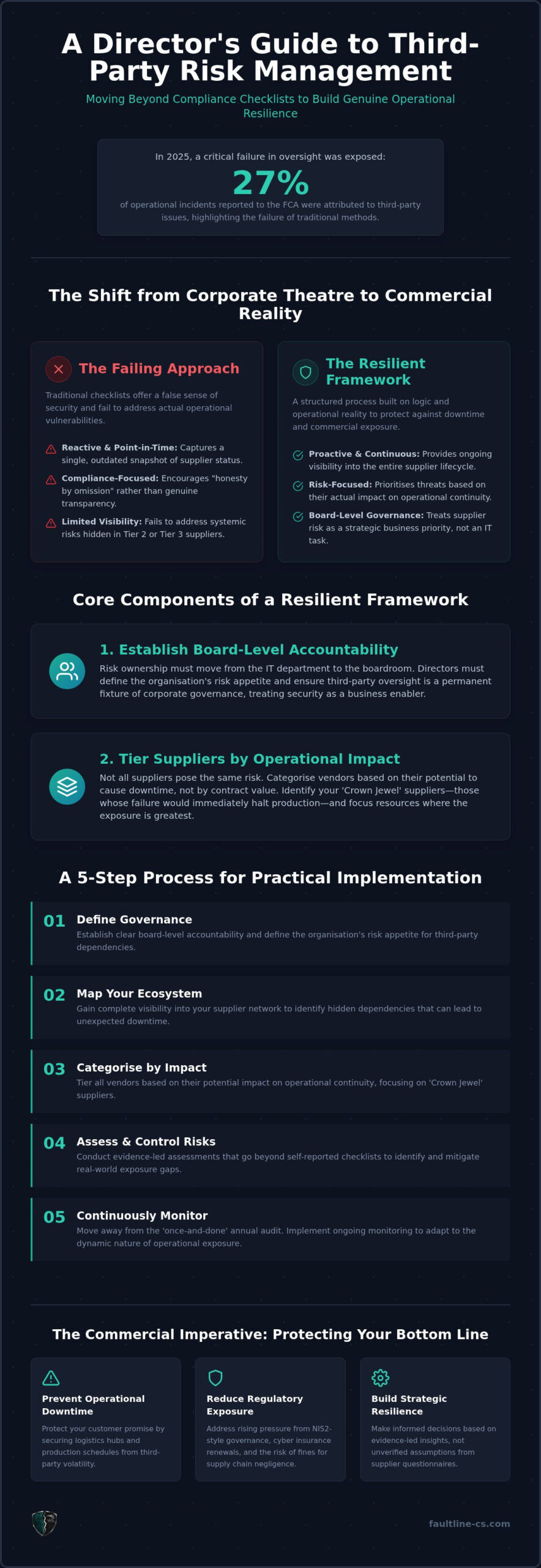
Most board-level risk assessments are little more than a collective exercise in corporate theatre. Whilst compliance checklists offer a veneer of order, they rarely reveal the systemic vulnerabilities hidden within a modern supply chain. In 2025, 27% of all operational incidents reported to the FCA were attributed to third-party issues, proving that traditional oversight is failing to keep pace with reality. To protect your organisation, you need a third party risk management framework that prioritises operational visibility over mere paperwork.
The frustration of navigating opaque supplier practices whilst facing the weight of the UK’s Critical Third Parties (CTP) Regime is a common burden for directors. You likely recognise that many current audits are reactive exercises that fail to reduce actual commercial exposure or the risk of downtime. This article provides a clear, evidence-led roadmap to build a resilient framework that addresses real operational gaps. We will explore how to align your supplier oversight with ISO 27001 standards to ensure your governance is as much about business logic as it is about technical systems.
Key Takeaways
- Move beyond static checklists to establish board-level accountability, ensuring supplier risk is treated as a strategic priority rather than a compliance burden.
- Learn how to design a third party risk management framework that categorises vendors by their actual impact on your operational continuity.
- Navigate the UK’s evolving regulatory requirements, including ISO 27001:2022 and the move towards more rigorous governance for critical supply chains.
- Discover a five-step process to map your supplier ecosystem and gain visibility into the hidden dependencies that often lead to unexpected downtime.
- Identify the specific “exposure gaps” where digital and physical risks overlap, providing a clear path to improving your overall business resilience.
Defining the Third Party Risk Management Framework
Compliance is not synonymous with security. For many UK boards, the current approach to managing external vendors is a fragmented exercise in paperwork that fails to address actual operational vulnerabilities. A third party risk management framework is the structured process an organisation uses to identify, assess, and control risks throughout the supplier lifecycle. It serves as a vital governance tool, ensuring that external dependencies don’t compromise internal operational resilience. Within the UK, this framework is increasingly a non-negotiable requirement for high-value commercial contracts and cyber insurance renewals. Ultimately, the framework serves as a strategic bridge between the cost-driven world of procurement and the risk-focused requirements of security.
Effective Third-party management provides the visibility needed to understand how a failure at a Tier 2 or Tier 3 supplier could halt your own production line. Without this structure, leadership is essentially operating on hope rather than evidence. This isn’t just about data breaches; it’s about the systemic dependencies that keep your business functional.
Why Traditional Checklists are Failing UK Businesses
The standard industry questionnaire is often a lesson in technical theatre. These checklists frequently encourage a culture of honesty by omission from suppliers who are incentivised to tick boxes rather than disclose weaknesses. Static assessments fail because they capture a single point in time, ignoring the dynamic nature of modern operational exposure. There’s a profound difference between a supplier being technically compliant with a standard and being genuinely secure in a real-world scenario. Relying on a self-reported spreadsheet is a gamble that few manufacturing or logistics leaders can afford to take.
The Commercial Imperative for Supplier Oversight
Operational downtime is the primary threat to your customer promise. When a critical supplier suffers a breach or a system failure, the impact ripples through your logistics hubs and production schedules. Effective oversight is about protecting your bottom line from third-party volatility. As we move closer to 2026, the regulatory pressure from NIS2-style governance in the UK means the risk of litigation and regulatory fines for supply chain negligence is rising. Directors must move beyond the audit and focus on the gap where risk lives by conducting thorough Supplier & Third-Party Risk Analysis. This shift ensures that resilience is built on evidence-led insights rather than unverified assumptions, reducing commercial exposure before an incident occurs.
Core Components of a Resilient Framework
Software tools are often sold as a silver bullet for compliance, but they lack the strategic context required for effective governance. A resilient third party risk management framework is built on human logic and operational reality, not just automated scans. It requires a clear structure that defines how your business interacts with external entities at every level. Without this foundation, your oversight remains a reactive exercise in damage limitation rather than a proactive shield for your operations.
Establishing Board-Level Accountability
Risk ownership must move from the IT department to the boardroom. Directors shouldn’t be concerned with technical settings, but they must define the organisation’s risk appetite for third-party access. Accountability means understanding which suppliers have the keys to your most sensitive systems and ensuring that oversight is a permanent fixture of corporate governance. This shift ensures that security is seen as a business enabler rather than a technical hurdle, allowing for more informed decision-making during procurement and contract renewals.
Tiering Your Suppliers by Operational Impact
Not all vendors are created equal. A caterer does not pose the same systemic risk as a cloud provider hosting your ERP system. You must identify your ‘Crown Jewel’ suppliers, those whose failure would immediately stop production or logistics. Resources should be allocated based on this actual operational exposure rather than contract value. This targeted approach is a central pillar of an ISO 27001 support programme, ensuring that your most critical dependencies receive the most rigorous scrutiny. By categorising partners based on their potential to cause downtime, you can focus your limited resources where they will have the greatest impact on resilience.
Resilience also requires moving away from the “once-and-done” annual audit. Static assessments are obsolete the moment they’re signed. The UK government’s introduction of new safeguards for major technology providers reflects a broader shift towards continuous monitoring and systemic oversight. Your third party risk management framework must include real-time visibility and a plan for incident response that integrates supplier breaches into your own business continuity drills. If your current oversight feels like a paper exercise, it may be time to discuss how to close your operational gaps with a more practical approach to risk.
The UK Regulatory Landscape: ISO 27001 and Beyond
Regulatory compliance is shifting from a box-ticking exercise to a core component of director-level liability. In the UK, the implementation of the Critical Third Parties (CTP) regime on 1 January 2025 has signalled a new era of direct oversight for the financial sector, with ripple effects across all critical infrastructure. For manufacturing and logistics leaders, a robust third party risk management framework is now the primary defence against regulatory scrutiny and commercial friction. This transition is particularly evident in how Supply Chain Due Diligence in the UK is being integrated into standard procurement cycles, moving beyond simple financial checks to deep operational probing.
The UK government is increasingly moving towards NIS2-style governance, focusing on the resilience of the entire supply chain rather than just individual entities. This means your organisation’s ability to demonstrate active oversight is becoming a prerequisite for high-value tenders. Directors must recognise that the standard for “reasonable care” has evolved; ignorance of a supplier’s security gaps is no longer a valid legal or commercial defence.
Aligning with ISO 27001 Standards
ISO/IEC 27001:2022 has sharpened its focus on the supply chain through Clause 15. This specific clause doesn’t merely ask for a supplier policy. It requires organisations to define and manage information security requirements for all third-party relationships throughout the lifecycle of the engagement. Your Statement of Applicability must reflect the reality of your external dependencies, ensuring that controls are proportionate to the risk. Relying on a supplier’s own certificate is insufficient. A credible framework incorporates internal audits or independent verifications to ensure that the security measures documented in the contract are actually functioning on the ground.
Navigating Cyber Essentials Plus for Suppliers
For many UK businesses, Cyber Essentials serves as a useful baseline for supplier onboarding. However, for high-risk partners with direct access to your systems or sensitive data, the ‘Plus’ certification provides the necessary evidence of technical control. This verified assessment moves the conversation from unverified claims to independent proof. Adopting this approach is a central part of Modernising Third-Party Risk Management for UK Directors, where the goal is to build a transparent and verifiable ecosystem.
The Financial Conduct Authority (FCA) reported in July 2026 that 27% of all operational incidents were attributed to third-party issues. This data highlights why the PRA and FCA are increasingly focused on operational resilience. Even if your organisation isn’t directly regulated by these bodies, the standards they set are becoming the benchmark for commercial contracts and insurance renewals across all sectors. Preparing for these requirements now isn’t just about compliance; it’s about ensuring your business remains a viable partner in an increasingly risk-averse market.
Five Steps to Implementing a Practical Framework
Automation of a flawed process only accelerates failure. Many organisations rush to implement software solutions before they’ve established the operational logic required to manage them. A practical third party risk management framework must be built on a foundation of evidence and visibility rather than assumptions. By following a methodical five-step process, directors can move from reactive firefighting to a position of strategic oversight.
Step 1: Mapping the Supplier Ecosystem
Visibility is the first casualty of a complex supply chain. You cannot manage what you haven’t identified, and for many UK firms, the biggest risks reside in unmapped shadow IT or fourth-party dependencies. You must identify not only your direct vendors but also the critical providers they rely on. Using exposure signals allows you to find unmanaged connections that bypass traditional procurement. This data should be consolidated into a centralised third party risk management services UK register to ensure a single version of the truth exists across the business.
Step 2: Criticality Assessment. Once mapped, suppliers must be tiered based on their impact on business continuity. If a vendor’s failure stops your production line, they require a different level of scrutiny than a non-critical service provider. This ensures your limited resources are focused on the dependencies that actually matter.
Step 3: Baseline Controls. Define the minimum security standards every partner must meet to do business with you. These standards should be non-negotiable and integrated into the initial contract phase to prevent security from becoming an afterthought.
Step 4: Verifying Supplier Security Claims
Trust is a poor substitute for evidence. You must move beyond the annual questionnaire to a model of continuous verification. Auditing supplier security access doesn’t have to strain the relationship; it’s a necessary part of commercial hygiene. Seek independent proof of their security posture and request evidence of recent incident response testing. Relying on a supplier’s word is a significant vulnerability. Understanding how to audit supplier security effectively provides the objective data needed to verify that a partner’s actual security signals match their contractual promises. Independent exposure assessments provide the objective data needed to verify that a partner’s actual security signals match their contractual promises.
Step 5: Continual Improvement. A third party risk management framework is never finished. It must evolve alongside the threat landscape. Regularly update your assessment criteria based on new intelligence and lessons learned from internal drills. This ensures your resilience remains robust as your supply chain grows more complex.
Beyond the Framework: Closing the Exposure Gap
A framework is a map, not the territory. Whilst a third party risk management framework provides the structural integrity needed for corporate governance, it’s only effective if it identifies the specific “gap” where real-world incidents begin. Most frameworks stop at the digital perimeter, assuming that risk is contained within software and data flows. This is a dangerous simplification. Real-world exposure exists in the overlap between your digital systems and the physical reality of your supply chain. The FaultLine Exposure Assessment reveals these hidden risks by identifying the systemic vulnerabilities that traditional frameworks often overlook through their focus on generic compliance.
FaultLine prioritises realistic attack paths over the technical theatre of standard audits. We recognise that a breach is rarely the result of a single failed control; it’s the result of an overlooked dependency or an operational logic flaw. By focusing on how an attacker would actually move through your supply chain, we provide directors with the clarity needed to make informed, evidence-led decisions about their commercial exposure.
The Physical-to-Cyber Crossover in Supply Chains
Security is a holistic challenge that cannot be siloed into technical departments. A supplier site visit can inadvertently lead to credential theft or unauthorised network access if physical protocols are lax. Assessing the physical security of your most critical data processors is just as vital as reviewing their firewall settings. This is particularly relevant as organisations prepare for the requirements of Martyn’s Law, which demands a higher standard of physical security and preparedness for premises. Integrating these physical considerations into your broader risk framework ensures that a breach doesn’t enter your network through a side door that was left physically unlocked. Resilience requires an understanding of how physical access can be leveraged to gain digital control.
Next Steps for Senior Leadership
Directors must move from unverified trust to evidence-based assurance. A logical first step is conducting a Pilot 0 assessment of your top five suppliers to identify immediate, high-impact vulnerabilities. This process translates technical findings into board-level decisions, allowing leadership to understand the commercial impact of supplier dependencies without getting lost in jargon. Resilience is built through action, not just documentation. By focusing on realistic attack paths rather than generic checklists, you can close the exposure gap and protect your organisation’s customer promise. To move beyond the limitations of standard audits, you can commission a fixed-price Exposure Assessment to gain a clear-eyed perspective on your operational reality and ensure your framework is grounded in fact.
Moving Toward Verifiable Resilience
A robust third party risk management framework is the only way to move beyond the theatre of compliance and address the systemic vulnerabilities that threaten your operations. By establishing board-level accountability and tiering suppliers by their actual impact on your production lines, you transform a box-ticking exercise into a strategic asset. The focus must remain on evidence-led insights and the physical-to-cyber crossover that traditional audits often ignore.
FaultLine provides the specialist UK GRC expertise needed to translate complex risks into board-level reporting in plain English. Our fixed-price £5,000 Exposure Assessment offers a pragmatic starting point for directors who value clarity over technical jargon. It’s time to replace unverified assumptions with a clear-eyed understanding of your commercial exposure, ensuring your governance is built on evidence rather than hope.
Building a resilient organisation is a continuous journey, but taking the first step toward visibility ensures that your business remains a steady hand in an increasingly volatile market. Protecting your customer promise starts with knowing exactly who you are trusting with your operational future.
Frequently Asked Questions
What is the difference between TPRM and vendor management?
Vendor management is primarily concerned with procurement, contract value, and service delivery levels. Third Party Risk Management (TPRM) focuses on the systemic exposure and operational vulnerabilities that a supplier introduces to your business. Whilst vendor management aims for commercial efficiency, a third party risk management framework aims for resilience. It’s the difference between asking if a supplier is cost-effective and asking if their failure could stop your production line.
How do I choose the right third party risk management framework for my business?
Selection should be based on your specific regulatory requirements and the complexity of your operational dependencies. For manufacturing and logistics, a framework that prioritises continuity over simple data compliance is essential. Start by identifying your most critical suppliers and build a structure that provides visibility into their security practices. Avoid generic templates that don’t account for the physical-to-cyber crossover in your specific industry.
Is a third party risk management framework mandatory in the UK?
Mandatory requirements depend on your sector and size. For financial institutions, the UK’s Critical Third Parties (CTP) regime became effective on 1 January 2025, making structured oversight a legal necessity. For manufacturing and logistics, whilst not a single law, failing to maintain a framework often leads to the loss of commercial contracts and the inability to secure cyber insurance. Directors are increasingly held to a standard of “reasonable care” regarding their supply chain.
How much does it cost to implement a TPRM framework?
Costs vary significantly based on the scale of your supplier ecosystem and the depth of assessment required. A phased approach often begins with a targeted assessment of high-risk partners to manage initial spend. Directors should view this as an investment in operational resilience rather than a sunk cost. The average cost of a third-party breach remains substantial, often far exceeding the price of proactive governance and evidence-led oversight.
Can I use ISO 27001 as my only third party risk management framework?
ISO 27001 is an excellent starting point, particularly Clause 15, but it isn’t a complete solution for operational risk. It focuses heavily on information security management systems rather than the physical and operational realities of a logistics hub or factory floor. A robust third party risk management framework should use ISO as a baseline but add specific layers for site security and fourth-party dependencies to ensure no visibility gaps remain.
How often should I review my supplier risk assessments?
Critical suppliers require continuous monitoring rather than annual reviews. For lower-risk vendors, an annual refresh is often sufficient to maintain compliance. However, any significant change in the supplier’s service, ownership, or the broader threat landscape should trigger an immediate re-assessment. Static audits are obsolete the moment they’re signed; real resilience requires a move toward verifying actual security signals on an ongoing basis.
What are the biggest challenges in third party risk management for 2026?
The primary challenges are the lack of visibility into fourth-party risks and the increasing regulatory pressure for verifiable resilience. As supply chains become more interconnected, identifying where your data actually resides and who has physical access to your processors is becoming more difficult. Many organisations still struggle with “honesty by omission” in supplier questionnaires, making independent exposure assessments a vital tool for uncovering hidden systemic gaps.
What happens if a critical supplier refuses to comply with our framework?
Refusal to comply is a significant red flag that requires immediate board-level attention. If a critical partner won’t provide evidence of their security posture, you are essentially flying blind. You must evaluate whether the commercial benefit of the relationship outweighs the risk of a total operational halt. Often, the only logical path is to implement compensating controls or seek an alternative supplier who values transparency and operational integrity.

Article by
Alex J Morgan
Alex Morgan writes and develops content for FaultLine Cyber & Security Ltd. Alex has worked across web development, organic SEO, digital marketing and content creation since 2009, with a particular focus on making complex subjects clear, useful and easy to navigate.
Leave a Reply