


Your current IT provider is likely doing exactly what you hired them to do: keeping your systems functional and your users connected. In 2026, the distinction between maintaining systems and defending a business has become a critical commercial fault line. If you are questioning why switch from my current IT support to an MSSP, it is likely because the traditional model of reactive maintenance can no longer keep pace with sophisticated operational threats. Many directors assume their standard support covers the full spectrum of risk, yet this belief often masks a dangerous exposure gap that leaves commercial interests vulnerable.
You likely recognise the growing pressure from rising cyber insurance premiums and the demand from supply chain partners to prove your security maturity. This guide provides a strategic framework for leadership teams in manufacturing and logistics to navigate these complexities. We will explore how an MSSP closes the gap between technical uptime and total business resilience. This discussion offers a clear understanding of the risk gap and the evidence-based security measures required to satisfy both your board and your commercial partners.
Key Takeaways
- Learn the critical distinction between functional IT maintenance and strategic cyber resilience to protect your commercial interests.
- Discover why switch from my current IT support to an MSSP to transition from a reactive “break-fix” mindset to continuous security monitoring.
- Identify the hidden exposure gap where cyber, physical, and supplier risks overlap, creating vulnerabilities that standard IT support often misses.
- Recognise the strategic indicators that necessitate an upgrade, including evolving UK regulatory pressures and increasing demands for supply chain transparency.
- Understand the value of a readiness-first approach, using exposure assessments to build a security framework that satisfies both the board and operational requirements.
The Growing Divide Between IT Maintenance and Cyber Resilience
Functional uptime is not a guarantee of operational survival. For years, the role of IT support was defined by availability; the goal was to ensure that servers remained up and printers stayed connected. This utility-based approach is reactive by design. It addresses issues after they manifest, rather than anticipating the sophisticated architectural threats that define the current landscape. Keeping systems running is a fundamental requirement, but it is entirely distinct from defending a business against coordinated exploitation.
Understanding What is a Managed Security Service Provider (MSSP)? requires a shift in perspective. When senior leaders question why switch from my current IT support to an MSSP, they are usually identifying a mismatch between their current technical capabilities and their actual commercial exposure. At FaultLine, we advocate for Pilot 0 thinking. This means moving beyond the first failure to understand the systemic vulnerabilities that exist before a single line of code is breached. It is the difference between fixing a leak and ensuring the hull is structurally sound.
To better understand the core differences in these service models, watch this helpful video:
The Functional Limits of Standard IT Support
Internal IT teams and standard support providers are often trapped on a treadmill of user tickets and hardware maintenance. They are generalists tasked with broad operational efficiency. True security requires proactive threat hunting and specialised 24/7 monitoring that most internal teams cannot sustain. Whilst a standard provider might handle software updates, they rarely possess the tools or the mandate for deep vulnerability management. They keep the lights on; they don’t necessarily watch who is trying to cut the power. This creates a visibility gap that attackers are increasingly adept at exploiting.
Why 2026 Demands a Different Approach
The threat landscape has moved past simple viruses to targeted supply chain attacks that exploit the dependencies between partners. In manufacturing and logistics, digital transformation has expanded the attack surface into operational technology that traditional IT often ignores. By 2026, the cost of operational downtime has reached a point where recovery is no longer just a technical task; it is a matter of business continuity. Relying on reactive support in this environment creates a systemic risk that can no longer be ignored by the board. The shift to an MSSP represents a move from fixing what is broken to defending what is vital.
Understanding the Managed Security Service Provider (MSSP) Model
An MSSP operates as a strategic risk partner rather than a technical utility provider. Whilst standard IT support is designed around the concept of availability and reactive maintenance, the MSSP model is built on the foundation of continuous security monitoring. One of the primary benefits of a managed security service provider is this transition away from a “break-fix” mentality. When directors evaluate why switch from my current IT support to an MSSP, they are usually looking to replace a culture of reactive fixing with one of proactive business defence. Security is treated as an ongoing discipline rather than a series of isolated technical tasks.
Central to this delivery is the Security Operations Centre (SOC). In a UK commercial context, the SOC acts as a centralised facility where security professionals monitor, detect, and respond to threats in real time. This capability is underpinned by Security Information and Event Management (SIEM) technology. A SIEM aggregates and analyses log data from across your entire infrastructure, providing the visibility needed to identify sophisticated patterns that standard IT tools often miss. It turns raw data into the evidence-based insights that boards require to make informed risk decisions.
Proactive Monitoring and Threat Detection
Dwell time is the metric that defines the severity of a breach. It measures how long an intruder remains undetected within your network. Standard IT support, focused on user uptime, often lacks the specialised tools to identify these silent actors. An MSSP prioritises human-led analysis over automated alerts to ensure that real threats are identified amongst the noise. This constant vigilance is essential for operational resilience; it ensures that potential disruptions are neutralised before they can affect production lines or logistics schedules.
Governance, Risk, and Compliance (GRC) Expertise
Security maturity is now a prerequisite for participating in high-value supply chains. Navigating complex frameworks such as ISO 27001 or Cyber Essentials Plus requires a level of GRC expertise that generalist IT teams rarely possess. An MSSP provides the structured oversight needed to manage third-party risk and demonstrate compliance to partners and insurers. For a deeper look at these requirements, you can refer to our Managed Security Service Provider UK: Director’s Guide.
If your organisation is currently outgrowing its existing support model, you may wish to discuss your specific operational requirements with our consulting team to ensure your defences align with your commercial goals.
Identifying the Exposure Gap: Why Standard IT Support Is No Longer Enough
Exposure is not a binary state. It is a spectrum that exists in the spaces between your technical controls, your physical premises, and your external partnerships. At FaultLine, we operate on the principle that the gap is where the risk lives. Standard IT support providers generally focus on the health of the hardware and software you own. They rarely account for how an adversary might exploit the seams between these systems. This fundamental difference explains why switch from my current IT support to an MSSP; you aren’t just buying better tools, you’re investing in a partner that understands the holistic exposure of your commercial interests.
In logistics and engineering, there’s often an underlying assumption of operational trust. If a contractor has a valid badge or a supplier has a VPN link, the system treats them as inherently safe. This assumption is a primary driver of risk. Realistic attack paths often bypass the firewalls your IT team maintains by exploiting these trusted relationships or physical vulnerabilities. An MSSP looks for these non-technical entry points that a standard support model simply isn’t designed to see.
The Intersection of Physical and Digital Security
Physical security and cyber security are no longer separate disciplines. An office access control system connected to your network is a potential entry point for a digital breach. Similarly, what an adversary can learn about your operations through open source intelligence (OSINT) defines your visibility to the outside world. To understand these risks properly, many organisations find The Strategic Necessity of Exposure Assessments to be the most logical starting point. It moves the conversation from technical theatre to a realistic map of business risk.
Supplier and Third-Party Dependencies
Your security is only as resilient as the least secure partner with access to your network. It’s a commercial mistake to assume your suppliers share your level of security maturity. An MSSP goes beyond the perimeter to audit the specific access pathways used by external partners. By 2026, supplier-driven incidents have become a standard vector for operational disruption in manufacturing. Defending against these requires a level of scrutiny that standard IT support isn’t equipped to provide. It requires a partner that values evidence over assumptions about partner behaviour.
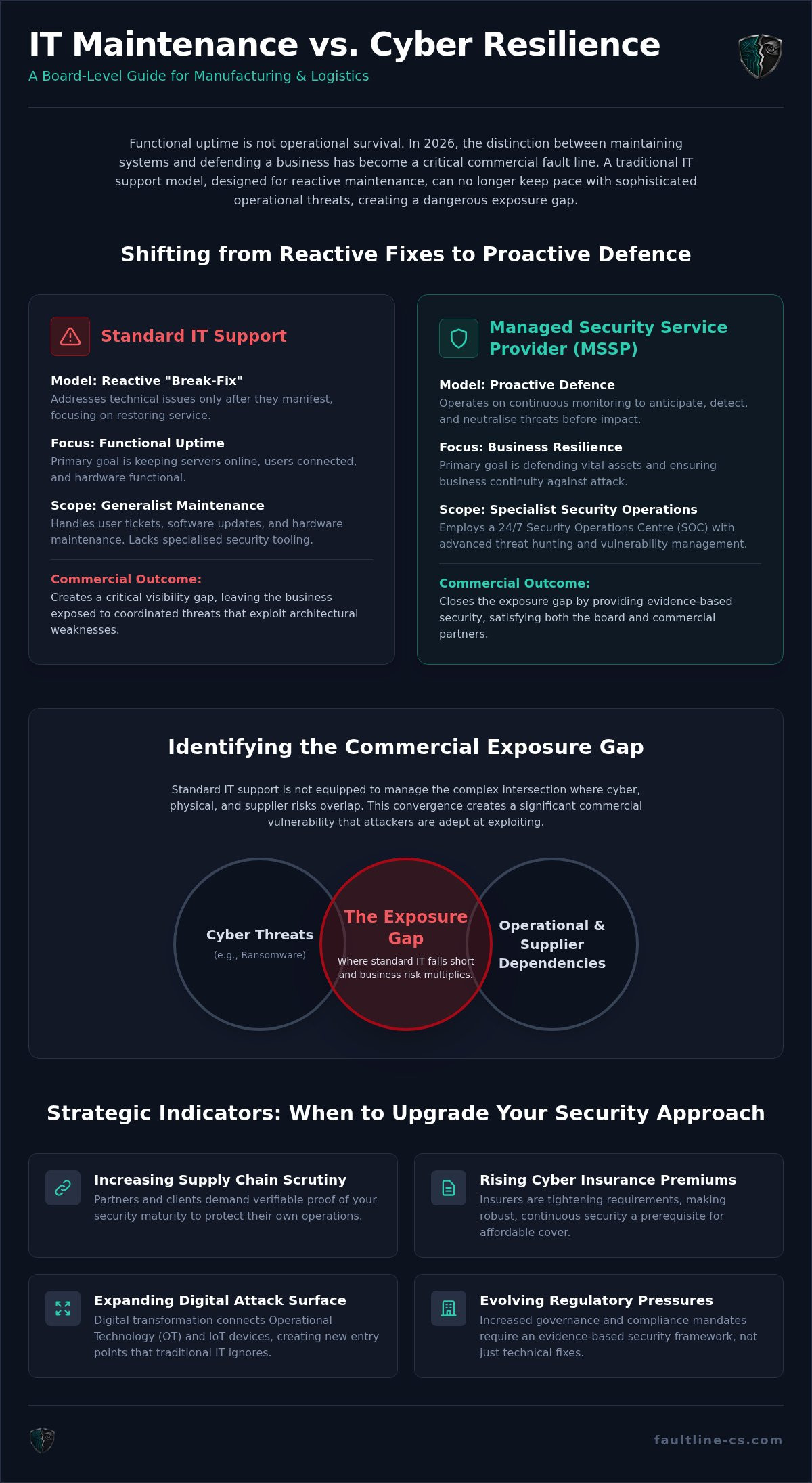
Strategic Indicators: When Your Organisation Needs to Make the Switch
Strategic indicators are rarely technical. They are commercial pressures that manifest as increased friction in your daily operations. For many directors in Northern Ireland and the Republic of Ireland, the question of why switch from my current IT support to an MSSP arises when the business can no longer satisfy external stakeholders with simple assurances of “good IT”. If your organisation is facing any of the following, the traditional support model has likely reached its functional limit:
- Your cyber insurance renewal includes a multi-page questionnaire that your current IT team cannot answer with evidence.
- Major customers or supply chain partners are demanding proof of security maturity before awarding new contracts.
- Regulatory frameworks like NIS2 are creating new legal duties for senior leadership regarding risk management.
- The internal IT team is consistently prioritising user tickets over security monitoring and threat hunting.
Waiting for a breach to occur before addressing these indicators is a significant commercial risk. By the time an incident manifests, the cost of recovery often far exceeds the investment required for a proactive defence. A strategic transition ensures that security becomes an enabler of growth rather than a bottleneck for compliance.
Regulatory and Compliance Pressures
Compliance is no longer a “tick-box” exercise. In 2026, the UK regulatory landscape has matured to the point where directors are expected to demonstrate personal accountability for operational resilience. Preparing for certifications like ISO/IEC 27001 or Cyber Essentials Plus requires more than technical configuration; it requires a robust evidence model. This is where GRC consulting becomes essential, providing the structured oversight needed to satisfy auditors and partners. For a detailed breakdown of these requirements, see our GRC Framework UK: Strategic Buying Guide for Directors.
Operational and Commercial Triggers
Internal IT teams are often excellent generalists, but they are rarely specialists in defensive operations. When a team admits they are out of their depth, it is a sign of honesty, not failure. This often happens during expansion into new markets or when pursuing government contracts that mandate higher security standards. A “near miss” or a breach at a competitor should serve as a final warning. Understanding why switch from my current IT support to an MSSP before a crisis occurs allows for a controlled transition that preserves business continuity. It is far more cost-effective to make the switch as a strategic choice rather than an emergency response to a failure.
Beyond Technical Theatre: Implementing a Readiness-First Security Strategy
Investing in a suite of new security tools before understanding your actual risk is a recipe for wasted capital. This approach often results in “technical theatre” where a business looks secure on paper but remains fundamentally vulnerable in practice. When considering why switch from my current IT support to an MSSP, the first step shouldn’t be a shopping list of new software. Instead, it should be a rigorous deconstruction of your existing exposure. At FaultLine, we advocate for identifying the gap first; only then can you build a defence that is proportionate to your commercial reality.
Our approach is rooted in Pilot 0 thinking. We look beyond the immediate technical failure to the systemic weaknesses that allow a breach to escalate into an operational crisis. By focusing on readiness rather than just tools, you create a data-driven roadmap that aligns with your specific business outcomes. This methodology ensures that every pound spent on security contributes directly to your resilience; it avoids the common trap of buying expensive solutions for problems your organisation doesn’t actually have.
Starting with an Exposure Assessment
The logical entry point for any board seeking clarity is a fixed-price Exposure Assessment at £5,000. This is not a generic scan or a standard IT audit; it is a deep dive into the specific intersection of your cyber, physical, and supplier risks. The result is a board-level report written in plain English that strips away technical jargon to focus on commercial impact. This assessment provides the evidence needed to make informed decisions, ensuring you don’t waste budget on irrelevant compliance work that fails to move the needle on actual safety.
Building Long-Term Operational Resilience
True resilience is not a one-off project; it is a continuous 12-month programme of improvement. By connecting your cyber readiness directly to your business continuity plans, you ensure that your security strategy supports your manufacturing or logistics operations rather than hindering them. This long-term perspective allows for the gradual hardening of your defences, making your organisation a less attractive target for adversaries. It satisfies the board’s requirement for evidence-based governance whilst providing the operational stability needed to thrive in a complex supply chain.
Enquire about our Exposure Assessment
Securing Your Commercial Future Through Strategic Resilience
The divide between functional IT maintenance and strategic cyber resilience is now a critical commercial reality. Relying on reactive support leaves your organisation vulnerable at the seams where digital, physical, and supplier risks intersect. Understanding why switch from my current IT support to an MSSP is the first step toward closing the exposure gap that threatens your operational continuity.
True security isn’t about accumulating technical tools; it’s about gaining clear-eyed visibility into your vulnerabilities. For directors in manufacturing and logistics, this means moving beyond technical theatre to a model of evidence-based governance. A proactive defence satisfies the board, secures the supply chain, and ensures your business remains resilient against the evolving threats of 2026.
FaultLine provides a no-nonsense entry service designed specifically for the UK mid-market. Our fixed-price Exposure Assessment delivers a board-level report in plain English, ensuring you have a data-driven roadmap for long-term safety.
Building a resilient organisation starts with transparency and evidence. We are ready to help you navigate these complexities with clarity and purpose.
Frequently Asked Questions
What is the main difference between an MSP and an MSSP?
A Managed Service Provider (MSP) focuses on technical availability and user uptime. They ensure your servers are running and your staff can connect to their applications. In contrast, a Managed Security Service Provider (MSSP) focuses on continuous security monitoring and risk mitigation. Whilst an MSP keeps the lights on, an MSSP ensures an adversary does not turn them off by actively defending your infrastructure against sophisticated architectural threats.
Why can my current IT company not just handle my security?
Your current IT provider is likely an excellent generalist focused on availability and technical uptime. However, security is a distinct discipline requiring 24/7 monitoring and specialised threat hunting. Most standard providers are overwhelmed by user tickets and lack the SOC capabilities needed to defend against coordinated exploits. This visibility gap is a primary reason why switch from my current IT support to an MSSP to ensure your commercial interests are actively defended.
How much does it cost to switch to an MSSP in the UK?
Costs vary based on the complexity of your infrastructure and the level of monitoring required for your operations. FaultLine offers a fixed-price Exposure Assessment for £5,000 as a starting point to identify your actual risk. Ongoing MSSP fees are provided via a bespoke proposal after we evaluate your specific operational requirements. This approach ensures you only invest in the protection that aligns with your actual commercial exposure.
Will an MSSP replace my existing IT support team?
Not necessarily. An MSSP often works as a strategic partner alongside your internal team or existing IT provider. We handle the high-level security monitoring, threat detection, and governance, whilst your current team continues to manage daily technical operations and user support. This collaborative model allows your IT staff to focus on productivity and system health without being overwhelmed by the complexities of modern security alerts.
What is an Exposure Assessment and why do I need one first?
An Exposure Assessment is a deep-dive investigation into the gaps where cyber, physical, and supplier risks overlap. It prevents wasted expenditure on irrelevant tools by identifying your realistic attack paths first. This evaluation provides the commercial evidence required to decide why switch from my current IT support to an MSSP. By starting with a fixed-price assessment of £5,000, you gain a clear roadmap for your security investment based on evidence.
Does my business need to be a certain size to benefit from an MSSP?
Operational complexity and risk profile are more significant factors than headcount. Any business in manufacturing or logistics with high downtime costs or supply chain dependencies can benefit from specialised defence. If your partners demand proof of security maturity or you face regulatory pressures, the size of your workforce is secondary to the resilience of your systems. A strategic transition to an MSSP is a matter of business continuity.
How does an MSSP help with cyber insurance renewals?
We provide the evidence-based documentation and control verification that insurers now mandate for policy renewals. By moving beyond simple technical theatre, we help you answer complex questionnaires with confidence and accuracy. This transparency often makes the renewal process more efficient and ensures your coverage is based on a realistic risk profile. Having a dedicated SOC and SIEM in place demonstrates the security maturity that modern insurers expect to see.
What local support does FaultLine provide for businesses in Belfast and Northern Ireland?
FaultLine is a Belfast-based consultancy providing local expertise across Northern Ireland and the Republic of Ireland. We offer on-the-ground support for businesses in Derry, Newry, Craigavon, and across the region. Our team understands the specific supply chain pressures facing local manufacturing and logistics firms. This regional focus ensures we provide practical, relevant guidance that accounts for the local regulatory landscape and the unique operational challenges of businesses in this territory.

Article by
Alex J Morgan
Alex Morgan writes and develops content for FaultLine Cyber & Security Ltd. Alex has worked across web development, organic SEO, digital marketing and content creation since 2009, with a particular focus on making complex subjects clear, useful and easy to navigate.
Leave a Reply