


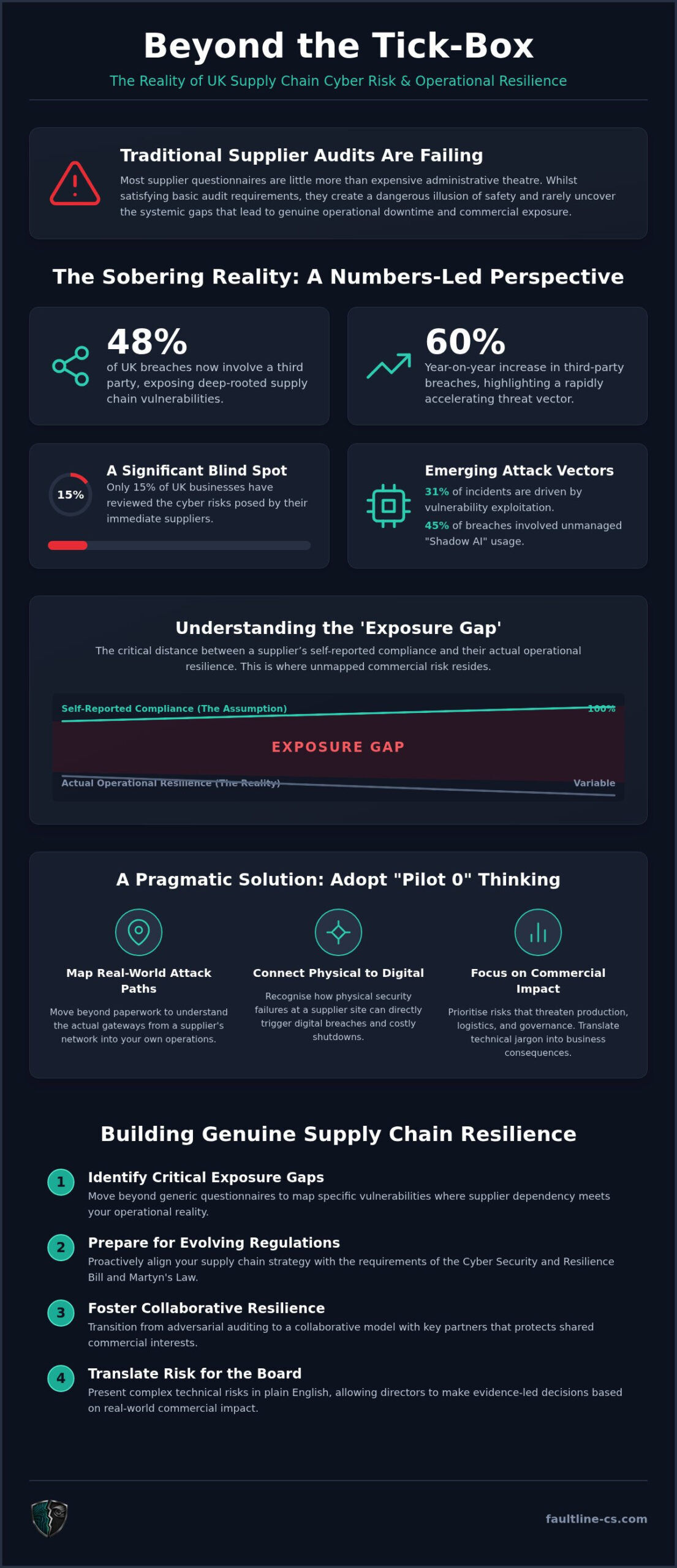
Most supplier questionnaires are little more than expensive administrative theatre. Whilst they satisfy basic audit requirements, they rarely uncover the systemic gaps that lead to genuine operational downtime. With 48% of UK breaches now involving a third party, a 60% year on year increase according to the 2026 DBIR report, the traditional approach to third party risk management services UK is failing the very businesses it is meant to protect. Only 15% of UK businesses have reviewed the cyber risks posed by their immediate suppliers according to the Cyber Security Breaches Survey 2025/2026, leaving a significant portion of the economy exposed to unmapped vulnerabilities.
You likely recognise the frustration of managing overwhelming spreadsheets that yield little real insight into your commercial exposure. It is difficult to translate a vendor’s technical cyber risk into a narrative that resonates at board level. This article explains how to move beyond generic data collection to build a prioritised map of your real supply chain exposure. You will learn how to achieve practical resilience that protects your production lines whilst ensuring alignment with emerging regulations, including the Cyber Security and Resilience Bill and Martyn’s Law, before they reach full operational effect. We will move from broad systemic observations to the specific insights required to secure your reputation.
Key Takeaways
- Identify the specific exposure gaps where supplier dependency meets operational vulnerability by moving beyond the limitations of generic “tick-box” questionnaires.
- Adopt “Pilot 0” thinking to understand how physical security failures at a supplier site can directly trigger digital breaches and costly production shutdowns.
- Prepare for the evolving UK regulatory landscape by ensuring your supply chain strategy aligns with the requirements of the Cyber Security and Resilience Bill and Martyn’s Law.
- Utilise professional third party risk management services UK to transition from adversarial auditing to a collaborative resilience model that protects your commercial interests.
- Translate complex technical risks into plain English insights that allow the board to make evidence-led decisions based on real-world commercial impact.
Beyond the Supplier Questionnaire: Why Third-Party Risk Management is Failing UK Businesses
Compliance is not security. Most organisations operate under the dangerous assumption that a completed spreadsheet equals a protected supply chain. This is a fallacy that creates a pervasive illusion of safety whilst leaving the back door wide open. In the UK, where manufacturing and logistics rely on tight “just-in-time” schedules, even a minor digital disruption at a third party can cascade into a total production halt. The current approach to third party risk management services UK is often reduced to “tick-box” exercises that satisfy auditors but fail to protect the factory floor.
The exposure gap is the distance between a supplier’s self-reported compliance and their actual operational resilience. Most Third-party risk management frameworks are designed to collect data rather than generate insight. With 48% of UK breaches now involving a third party, a 60% year on year increase according to the 2026 DBIR report, the “so what” for a director isn’t just about a potential fine. It’s about the tangible risk of a logistics fleet being grounded or a production line going silent. When a supplier’s technical failure becomes your operational crisis, the value of a generic questionnaire evaporates instantly.
The Limitations of Traditional Vendor Risk Management
Self-reported questionnaires are fundamentally flawed because they incentivise “correct” answers over honest ones. Suppliers want to maintain their contracts, leading to an optimistic bias that obscures technical debt and physical security flaws. This static data cannot keep pace with the 31% of incidents now driven by vulnerability exploitation, according to 2026 research. Relying on an annual review creates a dangerous lag in visibility, leaving boards to make strategic decisions based on historical fiction rather than current reality. This “compliance theatre” offers a performance of due diligence without the substance of actual protection.
The Commercial Reality of Supplier Dependency
Identifying “single points of failure” is a commercial necessity, not just a technical exercise. If a tier-two supplier providing critical components for your assembly line suffers a ransomware attack, your own security posture becomes irrelevant. These hidden dependencies are the true source of systemic risk. A breach elsewhere in the chain quickly erodes UK brand reputation and customer trust, as clients don’t distinguish between your failure and that of your partners. To manage this, firms need a clearer view of their external network through specialised third party risk management services UK that focus on evidence over assumptions. You are ultimately responsible for the resilience of the entire network you choose to operate within.
The Intersection of Cyber and Operational Trust: A Pilot 0 Perspective
Trust is a liability when it remains unverified. Most leadership teams operate under the assumption that if a supplier holds a specific certification, their internal controls are functioning as intended. This is rarely the case. We advocate for “Pilot 0” thinking, a methodology that prioritises ground-truth evidence over administrative assumptions. In the context of third party risk management services UK, this means looking past the paperwork to understand the actual attack paths that lead from a supplier’s facility to your own data centre.
Mapping these paths requires a shift in perspective. You are not just assessing a vendor; you are assessing a gateway into your own operations. When identity exposure and credential theft are combined with unmanaged “shadow AI” usage, which was a factor in 45% of breaches analysed in the 2026 DBIR, the perimeter effectively disappears. Identifying these visible signals of vulnerability in your external network is the only way to move from reactive crisis management to proactive resilience.
Connecting the Dots Between Physical and Digital
A supplier’s office security matters as much as their firewall. In manufacturing and logistics, the line between physical and digital is non-existent. If an unauthorised individual gains access to a terminal in a partner’s warehouse or engineering hub, they can often bypass even the most sophisticated external defences. Operational trust often leads to unmanaged credential sharing or “open door” policies for contractors. These physical-to-cyber crossovers are not theoretical. They are practical routes for lateral movement that can lead directly to a production halt or a systemic data breach. Your security is only as robust as the physical access controls of your most integrated partners.
Focusing on Exposure Over Tooling
Investing in complex Governance, Risk and Compliance (GRC) software before understanding your actual exposure is a strategic error. Tooling can manage data, but it cannot identify the specific, hidden gaps in your security posture that an attacker would actually use. Vulnerability exploitation has now surpassed stolen credentials as the leading initial access route for cyber attacks, accounting for 31% of incidents in 2026. This shift requires a move away from reactive patching towards proactive exposure mapping. Our approach at FaultLine focuses on revealing these vulnerabilities before they are exploited by third parties. If you are unsure where these gaps exist in your own network, it is often wise to discuss your specific operational requirements with a specialist. This ensures that your investments in third party risk management services UK are driven by commercial evidence rather than technical guesswork.
Navigating the UK Regulatory Landscape: NIS2, Martyn’s Law, and Supply Chain Resilience
Governance is no longer a secondary concern for the IT department. It is a core fiduciary responsibility. The UK’s regulatory environment is diverging from the European Union, creating a complex dual-compliance requirement for many organisations. Effective third party risk management services UK must now account for both local legislation and the international standards required to maintain cross-border trade. For directors, this means that ignorance of a supplier’s failure is no longer a valid legal or commercial defence.
The shift is moving away from reactive guidelines toward proactive, enforceable standards. Cyber insurers are also tightening their requirements, moving away from simple questionnaires toward demanding proof of continuous monitoring and active vendor management. With UK fraud leaders reporting losses of £88 billion in 2024, insurers are no longer willing to subsidise poor supply chain visibility. This necessitates a move toward verifiability in all resilience reporting.
NIS2 and the UK Supply Chain
The UK has opted not to implement the EU’s NIS2 Directive directly. Instead, it is replacing the 2018 NIS Regulations with the Cyber Security and Resilience Bill. Introduced to Parliament in November 2025, this bill is expected to receive Royal Assent in 2026, with full operational effect anticipated by 2028. For UK sectors like energy, transport, and digital infrastructure, the shift is clear: “best effort” is being replaced by a requirement for demonstrable evidence. If your supply chain extends into Europe, you don’t have the luxury of waiting until 2028. You must meet NIS2 standards today to remain a viable partner in the continental market.
Operational Resilience as a Regulatory Requirement
Physical security is now a statutory obligation. Martyn’s Law, or the Terrorism (Protection of Premises) Act 2025, received Royal Assent in April 2025. With an expected commencement date in April 2027, public-facing businesses must integrate physical safety into their broader risk strategies. This means your third party risk management services UK must evaluate a supplier’s physical premises with the same rigour as their digital network. Integrating physical safety into your broader third-party risk strategy isn’t just about compliance; it’s about protecting the people and production lines that drive your revenue. Specialist GRC consulting provides the framework to align these disparate requirements into a single, verifiable resilience report. It’s about ensuring that when an auditor or insurer asks for proof, you have more than just a spreadsheet to show them.
Strategic Auditing: How to Evaluate Supplier Security Without Disrupting Commercial Partnerships
Auditing is often viewed as a commercial hurdle. When security teams descend upon a supplier with intrusive demands and exhaustive technical requests, it creates friction that can damage long-term partnerships. This adversarial approach is counterproductive. By utilising professional third party risk management services UK, you can transition from a policing role to one of collaborative resilience. The goal is not to find reasons to terminate a contract, but to establish a “minimum viable security” floor that protects both parties without stifling innovation or delivery speed.
Prioritisation is the key to maintaining these relationships. Not every vendor requires a deep-dive technical audit. A local catering firm does not present the same systemic risk as a cloud service provider or a critical component manufacturer. We advocate for a risk-based schedule that focuses resources where the commercial exposure is highest. With 93% of UK companies experiencing vendor fraud in 2024, the focus should be on verifying the controls that prevent financial and operational disruption rather than chasing every minor technical non-conformity.
External visibility tools and Open Source Intelligence (OSINT) allow for a “view from the outside” without requiring intrusive testing on a supplier’s network. This non-invasive approach identifies visible signals of vulnerability, such as expired certificates or exposed credentials, before you even pick up the phone. It allows for a more informed conversation with partners, based on objective evidence rather than defensive self-reporting.
The Collaborative Approach to Supplier Risk
Communication is a business enabler. When you present security requirements as a shared goal for resilience, suppliers are more likely to be transparent about their own challenges. Supporting your supply chain to improve their posture isn’t just altruism; it’s a strategic investment in your own uptime. Transparent risk reporting builds a culture of trust where suppliers feel comfortable flagging potential issues before they escalate into breaches. This collaborative model ensures that security becomes a competitive advantage for the entire network, rather than a barrier to entry.
Data-Driven Decision Making for Directors
Directors need clarity, not technical jargon. Using the IntelSensus framework for objective readiness assessments allows you to see exactly where your exposure lives in a visual, board-level format. This data moves the conversation away from abstract fears and toward a prioritised commercial roadmap. You can then allocate budget and effort to the gaps that truly matter, ensuring your governance is both effective and efficient. Learn more about our GRC consulting services to see how this evidence-led approach can simplify your third party risk management services UK strategy.
FaultLine’s Exposure Assessment: A Pragmatic Approach to Third-Party Risk
Large-scale business transformation programmes often fail because they are too broad to be actionable. For a mid-market UK firm, a multi-year overhaul is a distraction from core operations. We offer a different route. Our Exposure Assessment provides a targeted, deep-dive analysis that connects cyber, physical, and governance risks into a single, coherent picture. This isn’t a generic scan. It is a methodical deconstruction of the attack paths that involve up to five of your most critical suppliers.
Clarity is the primary deliverable. We move beyond the technical theatre of typical third party risk management services UK to provide board-level reporting in plain, jargon-free English. By visualising how a failure in one area cascades into another, we give directors the evidence they need to make strategic decisions. This approach ensures that security investments are aligned with commercial outcomes rather than just filling gaps in a framework. We prioritise ground-truth reality over the optimistic bias of self-reported questionnaires.
Fixed-Price Clarity for UK Leadership
We believe in transparency. This is why we start with a fixed-price Exposure Assessment at £5,000 instead of attempting to sell expensive, unconfigured software. This initial engagement identifies the real operational risks hidden within your supply chain without committing you to a long-term transformation project. You receive realistic narratives and actionable recommendations that prioritise resilience over mere compliance. Explore our full range of security services to understand how we bridge the gap between technical risk and commercial reality.
Why UK Manufacturing and Logistics Favour FaultLine
Operational continuity is our priority. In the manufacturing and logistics sectors, the cost of downtime is often measured in thousands of pounds per hour. Based in Belfast with a focus on UK-wide operational resilience, we understand the specific geographic and regulatory pressures facing British firms. Our Red Dot award-winning design approach to risk visualisation ensures that even the most complex dependencies are easy to understand for non-technical leaders. By focusing on production risk and supplier dependency, we provide a steady hand for those navigating an increasingly volatile landscape. Read our guide on modernising third-party risk management to see how we help organisations build long-term resilience through professional third party risk management services UK.
Securing Your Operational Continuity
Resilience is an active choice, not a passive state of compliance. Relying on the optimistic bias of supplier questionnaires leaves your production lines vulnerable to systemic gaps that paperwork simply cannot catch. Effective third party risk management services UK must move beyond administrative theatre to identify the specific, practical attack paths that threaten your commercial interests. By adopting Pilot 0 thinking, you gain the visibility required to protect your reputation and ensure alignment with emerging standards like the Cyber Security and Resilience Bill and Martyn’s Law.
FaultLine provides the clarity needed to navigate these operational complexities. Our specialist focus on UK operational resilience ensures your strategy is grounded in local reality rather than generic global frameworks. We deliver board-level reporting in plain English, providing a clear roadmap for investment based on evidence instead of assumptions. This methodical approach strips away unnecessary fluff to focus on the core message of business continuity.
Starting with a fixed-price entry at £5,000 allows you to secure your supply chain without the burden of multi-year transformation programmes. It’s a pragmatic first step toward building a more resilient and transparent network.
Frequently Asked Questions
What are the most common third-party risks for UK businesses in 2026?
Vulnerability exploitation and the unsanctioned use of “shadow AI” are the primary drivers of supply chain disruption this year. According to the 2026 DBIR, shadow AI was a factor in 45% of analysed breaches, whilst vulnerability exploitation has become the leading initial access route for attackers. UK organisations also face a significant threat from vendor fraud, which affected 93% of companies in 2024, leading to substantial revenue losses and operational instability.
How does NIS2 affect UK companies that are no longer in the EU?
UK organisations with European customers or supply chain links must still meet NIS2 standards to maintain their commercial viability in the EU market. Locally, the UK is introducing the Cyber Security and Resilience Bill to replace the 2018 NIS Regulations. This bill, introduced in late 2025, is expected to reach full operational effect by 2028, moving the focus from broad guidelines to enforceable evidence of resilience.
What is the difference between a supplier questionnaire and an exposure assessment?
A supplier questionnaire relies on self-reported data that is often biased or outdated, whereas an exposure assessment provides an evidence-led analysis of actual attack paths. Questionnaires are a form of “compliance theatre” that satisfies auditors but rarely identifies real-world vulnerabilities. An exposure assessment, a core part of third party risk management services UK, uses objective data to map how a supplier’s failure would impact your specific production lines.
How much does a professional third-party risk assessment cost in the UK?
Market pricing for these assessments varies significantly based on the depth of the analysis and the number of suppliers involved. Some providers charge daily rates for consultancy, whilst others offer annual software licences that can reach six figures for large-scale implementations. Many UK leadership teams now favour fixed-price models for initial assessments to ensure cost certainty before committing to broader governance, risk, and compliance programmes.
Can third-party risk management help with cyber insurance renewals?
Active due diligence is now a mandatory requirement for most cyber insurance providers in the UK. Insurers are moving away from simple questionnaires and demanding proof that you have a prioritised map of your supply chain exposure. Demonstrating that you use professional third party risk management services UK to monitor critical dependencies can help lower your risk profile, potentially leading to more favourable renewal terms and higher coverage limits.
How do we manage the risk of smaller suppliers who lack formal certifications?
Focus on establishing “minimum viable security” standards rather than demanding expensive, formal certifications that may be out of reach for smaller partners. You can use non-invasive external visibility tools and OSINT to assess their security posture without disrupting their operations. This collaborative approach allows you to identify critical gaps and support your suppliers in improving their resilience, which ultimately protects your own organisation from lateral movement attacks.
What role does physical security play in third-party risk management?
Physical security is a critical but often overlooked component of digital resilience. A failure in a supplier’s physical access controls can allow an intruder to gain direct access to hardware or internal terminals, bypassing digital firewalls entirely. With Martyn’s Law expected to commence in April 2027, UK businesses are now legally required to integrate physical safety into their broader risk strategies to protect both people and operational assets.
How often should we review our critical supplier risk profiles?
Annual reviews are no longer sufficient to keep pace with a 60% year-on-year increase in third-party breaches. Critical suppliers should be monitored continuously or reviewed whenever there is a significant change in their operational environment or the wider threat landscape. Event-driven assessments ensure that your risk data remains relevant, allowing you to respond to new vulnerabilities before they can be exploited to cause a production shutdown.

Article by
Alex J Morgan
Alex Morgan writes and develops content for FaultLine Cyber & Security Ltd. Alex has worked across web development, organic SEO, digital marketing and content creation since 2009, with a particular focus on making complex subjects clear, useful and easy to navigate.
Leave a Reply