


Your business can maintain perfect technical uptime and still fail its most critical customers during a crisis. Uptime is often a vanity metric for the server room; it rarely tells a director whether the production line will stop or if the supply chain will collapse under systemic pressure. With the March 2025 FCA deadline now in the past, the requirement for operational resilience testing UK has shifted from a box-ticking exercise to a demand for proven capability. Regulators and insurers no longer accept assumptions; they require evidence of survival.
You likely recognise the frustration of trying to translate abstract cyber risks into the hard financial impacts that resonate in the boardroom. This article provides a practical guide to quantifying your business survival limits and measuring resilience beyond simple technical availability. We will outline a strategic framework for board-level reporting that replaces technical theatre with metrics focused on production and supply chain health. By the end of this guide, you’ll have the clarity needed to align your resilience strategy with UK regulatory expectations and commercial reality.
Key Takeaways
- Shift your focus from technical uptime to quantifying the firm’s ability to maintain critical functions during severe but plausible disruptions.
- Understand how to implement robust operational resilience testing UK to ensure your business remains within hard commercial impact tolerances.
- Distinguish between aspirational IT recovery objectives and the strict commercial boundaries required for effective board level risk management.
- Establish a practical framework for mapping third party dependencies and physical assets against your most important business services.
- Identify hidden vulnerabilities where cyber and operational risks intersect to provide directors with a clear and evidence-led view of real commercial exposure.
Defining Operational Resilience Measurement: Beyond Technical Uptime
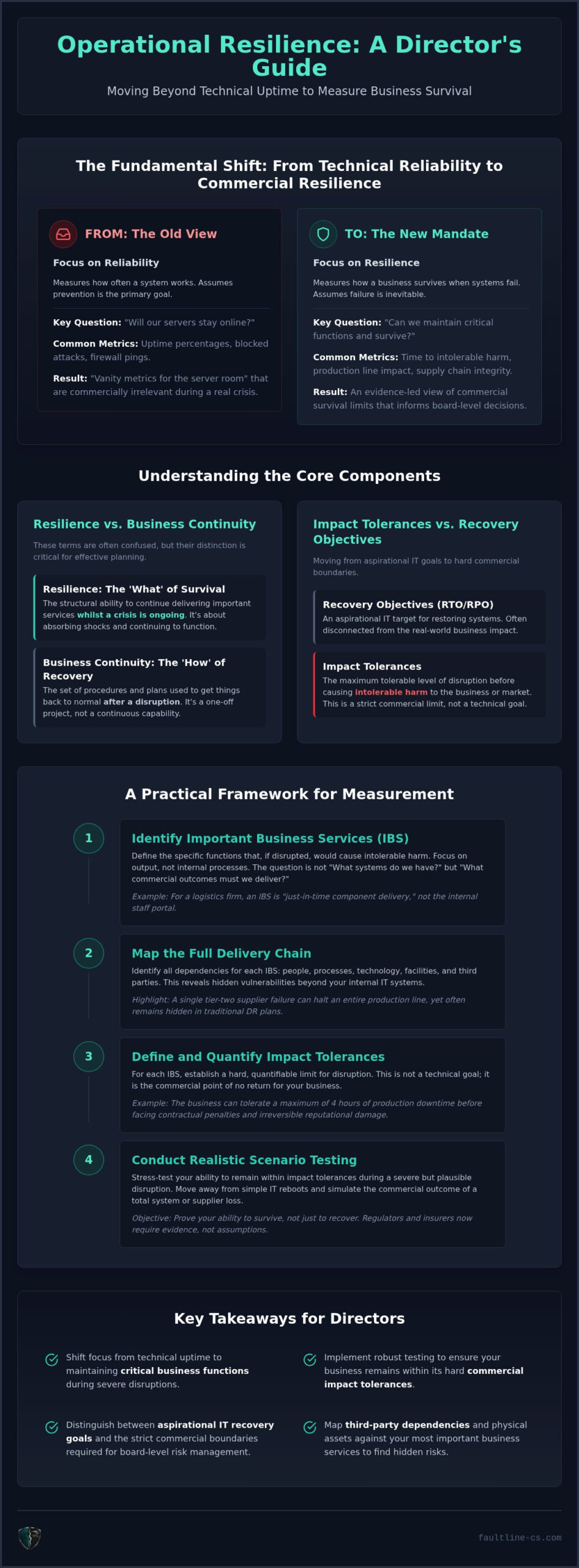
Reliability is a measure of how often a system works. Resilience is a measure of how a business survives when it doesn’t. Operational resilience measurement is the process of quantifying a firm’s ability to maintain critical functions during severe but plausible disruption. Unlike traditional risk management, which focuses on the probability of an event occurring, resilience assumes that failure is inevitable. The objective is to measure the response rather than the prevention.
For a director, the focus must shift from the likelihood of a crisis to the commercial impact of the outcome. This requires a measurement framework that accounts for cyber threats, physical infrastructure failures, and third party dependency factors. This perspective is increasingly reflected in global standards, such as the Digital Operational Resilience Act (DORA), which has heavily influenced the UK’s own regulatory trajectory. Effective operational resilience testing UK requires a move away from simulated IT reboots toward stress-testing the commercial outcome of a total system loss.
The Shift from Protection to Absorption
Directors are often presented with vanity metrics such as the number of blocked cyber attacks or firewall pings. These figures are commercially irrelevant. They describe the strength of the perimeter but say nothing about the health of the business once that perimeter is breached. Measuring resilience means quantifying the organisation’s ability to absorb shocks without failing entirely. Evidence led reporting allows the board to see exactly how much pain the production line or supply chain can take before it reaches a point of no return. It replaces technical theatre with a clear-eyed view of commercial survival limits.
Operational Resilience vs. Business Continuity
There is frequent confusion between business continuity and true resilience. Business continuity is the “how” of recovery; it’s the set of manuals and procedures used to get things back to normal. Resilience is the “what” of survival. It’s the structural ability of the business to continue delivering its most important services whilst the crisis is ongoing. Having a backup is a technical necessity, but it’s not a resilience strategy. To truly protect the organisation, directors must integrate these concepts into a broader UK operational resilience framework that treats survival as a continuous business capability rather than a one-off recovery project.
The Core Components: Identifying Important Business Services and Impact Tolerances
Operational resilience is not a generic state of readiness. It’s built on the identification of Important Business Services (IBS). These are the specific functions that, if disrupted, would cause intolerable harm to your firm or the wider market. For a logistics leader, an IBS isn’t the internal staff portal; it’s the ability to execute just-in-time component delivery. If that fails, the commercial damage is immediate and potentially terminal. Your measurement framework must define exactly when a disruption crosses the line from an inconvenience into an intolerable threat to your business model.
Effective operational resilience testing UK requires a deep understanding of these thresholds. Without them, testing is merely a technical exercise in checking if servers can reboot. True resilience testing probes the limits of your commercial survival by simulating the total loss of these critical services. It forces you to look at the business through the lens of output rather than input.
Mapping the Delivery Chain
To measure resilience, you must first map the delivery chain for each IBS. This involves identifying the people, processes, technology, and facilities required to keep that service running. In manufacturing and logistics, supplier dependency is often the weakest link. A single tier-two supplier failure can halt an entire production line in the UK, yet these risks often remain hidden in traditional IT disaster recovery plans. Mapping reveals these vulnerabilities by moving beyond internal systems to include the physical and third party dependencies that actually drive revenue. If you’re unsure where your supply chain gaps lie, you can request a consultation to begin a formal mapping exercise.
Setting Realistic Impact Tolerances
Impact tolerances are the maximum tolerable level of disruption, measured by time, volume, or value. The FCA rules for building operational resilience provide a clear template for this, emphasizing that tolerances must be set for each IBS. These are not aspirational targets; they are hard boundaries that must not be breached.
- Time-based tolerances: How many hours of downtime can the business survive before a breach of contract or regulatory intervention?
- Volume-based tolerances: What percentage of orders can remain unfulfilled before the commercial damage is permanent?
These are commercial boundaries that require board-level ownership. IT can tell you how fast they can recover, but only the directors can decide how much pain the business is willing to absorb before it fails. Setting these tolerances ensures that your resilience strategy is aligned with your commercial reality rather than your technical preferences.
Comparing Metrics: Why Impact Tolerances Differ from Traditional Recovery Objectives
Technical success does not guarantee commercial survival. For years, boards have relied on Recovery Time Objectives (RTO) as the primary gauge of their disaster readiness. This is a mistake. An RTO is an internal IT target for system restoration; it is often aspirational and focuses on the speed of the technical team. In contrast, an impact tolerance is a hard commercial boundary that must not be breached. It is a measure of how much disruption the business can actually absorb before it suffers intolerable harm.
Effective operational resilience testing UK requires directors to look past the green lights of the IT department. If your systems are restored within four hours but your data integrity is compromised or your supply chain remains paralysed, you have met your RTO whilst failing your impact tolerance. This distinction is critical for board level reporting because it separates technical theatre from operational reality. Understanding how to weave a cyber incident response business continuity plan into your daily operations is essential to closing this gap between technical recovery and genuine commercial survival.
RTO vs. Impact Tolerance: A Strategic Distinction
The discrepancy between IT metrics and business health is where the greatest risks reside. A system can be technically up whilst the underlying business process is still down or operating at a level that breaches your commercial tolerances. For example, a logistics firm might restore its dispatch software, but if the physical gate sensors are still locked by a cyber breach, no vehicles move. Understanding these gaps is essential for modern governance. You can see how a formal operational risk assessment identifies these discrepancies by mapping technical assets to physical outcomes.
Measuring Severe but Plausible Scenarios
Resilience measurement is not a fire drill. It requires testing against severe but plausible scenarios that challenge the very logic of your operations. In 2026, this means moving beyond simple hardware failures to simulate complex, multi-layered disruptions. A severe but plausible scenario for a UK logistics firm might involve a simultaneous ransomware attack on a primary cloud provider and a physical blockade at a key port.
Measurement must also account for dwell time. Hidden cyber risks can sit within an organisation for months, slowly eroding data integrity before a visible failure occurs. operational resilience testing UK should quantify the impact of these slow burn events. By testing the crossover between physical access failures and cyber breaches, directors gain a clear view of where their business model is truly vulnerable. This level of insight ensures that the board is making decisions based on evidence rather than assumptions.
Building the Measurement Framework: A Step-by-Step Practical Approach
A resilience framework is not a regulatory hurdle; it is a strategic asset that protects the bottom line. For UK directors, this means moving beyond theoretical models and into a structured, executable process that ensures commercial survival. The goal is to create a living document that provides visibility into your commercial exposure and clear metrics for board level decision making. This framework ensures that your organisation can absorb shocks that would otherwise prove fatal. Effective operational resilience testing UK starts with this disciplined approach to measurement.
- Step 1: Identify Important Business Services (IBS) based on the potential for intolerable customer harm or commercial collapse.
- Step 2: Map the underlying assets, including third party suppliers, physical infrastructure, and the human capital required for delivery.
- Step 3: Establish impact tolerances for each service and secure formal board approval to define your commercial survival limits.
- Step 4: Conduct scenario testing to verify if the business can remain within these tolerances during a severe disruption.
- Step 5: Remediate the gaps found and update the framework regularly to reflect the reality of modern threats.
Step 1 and 2: Service Identification and Mapping
Mapping often stalls under its own complexity. We utilise Pilot 0 thinking to prevent this, stripping away non-essential functions to reveal the core operation. In logistics, this means identifying the specific software libraries or hardware components fundamental to dispatch. If a component is not required for an impact tolerance, it is removed. This creates a plain English service map that senior leadership can use, moving the conversation from abstract assets to concrete outcomes.
Step 4 and 5: Testing and Remediation
Testing must be a rigorous interrogation of your response capability. operational resilience testing UK should move beyond the tabletop exercise to simulate the friction of a genuine crisis. The objective is to measure your team against the hard boundaries of your impact tolerances. This provides a clear view of your security maturity. When these findings reach the board, they should drive strategic investment rather than technical theatre. If a test proves that a supplier failure halts production, the remediation is a commercial decision.
The FaultLine Perspective: Closing the Measurement Gap Through Exposure Assessments
Visibility is the prerequisite for resilience. You cannot measure what you haven’t identified; you cannot manage what you haven’t mapped. FaultLine Cyber & Security Ltd identifies the gap where the risk lives by connecting operational trust assumptions with realistic attack path narratives. Our Exposure Assessment provides a board-level view of cyber, physical, and supplier risks for a fixed price of £5,000. This is the foundation of effective operational resilience testing UK, moving beyond technical compliance to address the commercial reality of systemic failure.
Resilience is not a certification to be hung on a wall. It is a continuous state of readiness that must be measured constantly to remain valid. As threats evolve and supply chains shift, your understanding of your own vulnerabilities must keep pace. We provide the steady hand and grounded expertise required to navigate these complexities without resorting to the frantic alarmism common in the security industry.
Identifying the Exposure Gap
Systemic failure points often exist where cyber, physical, and operational risks overlap. A secure server room is useless if the physical power supply is vulnerable or if a tier-one supplier lacks basic incident response capabilities. We look at up to five key suppliers to understand your true dependency and resilience. This approach provides directors with a clear, plain English report that prioritises evidence over technical jargon. It replaces industry hype with a sober assessment of where your business is actually exposed, ensuring that operational resilience testing UK delivers genuine commercial value.
Actionable Next Steps for Directors
Measurement is the start of the journey, not the destination. To move from simple measurement to active risk reduction, directors must integrate resilience into their broader corporate governance. Our GRC consulting services help align your operations with UK regulatory standards whilst maintaining a focus on commercial outcomes. We advocate for Pilot 0 thinking as the most cost-effective way to begin this process. By stripping away non-essential complexities, you can focus your investment on the core functions that keep the business alive.
Taking action requires a move away from assumptions. Evidence led decision making is the only way to ensure that your resilience strategy matches your commercial exposure. By identifying the specific points where your supply chain or production lines are vulnerable, you can move from a state of reactive concern to one of controlled, strategic readiness. This methodical progression is what separates resilient organisations from those merely hoping for the best.
Securing Commercial Continuity Through Strategic Resilience
Directors must recognise that resilience is a strategic asset rather than a regulatory burden. The transition from traditional disaster recovery to modern operational resilience requires a fundamental shift in how we measure success. It’s no longer enough to know that a system can reboot; you must know exactly how much pain your production line can absorb before it fails. Integrated operational resilience testing UK serves as the bridge between technical readiness and commercial survival.
Our methodology focuses on Pilot 0 thinking and board level reporting in plain English, specifically designed for the unique pressures of manufacturing and logistics. We strip away the jargon to reveal the realistic attack path narratives that threaten your supply chain. By identifying the specific gaps where cyber and physical risks overlap, we provide the clarity needed for effective governance. This evidence led approach ensures that your investments are directed toward the vulnerabilities that actually matter to your commercial health.
Building a resilient organisation is a methodical process of deconstructing complex risks into actionable insights. With the right framework in place, you can move forward with the confidence that your business is prepared for the severe but plausible challenges of the modern landscape.
Frequently Asked Questions
What is the difference between operational resilience and business continuity?
Business continuity is the set of procedures and manuals used to recover after a disruption. It focuses on the “how” of getting back to normal. Operational resilience is the structural ability of the business to absorb a shock and continue delivering its most important services whilst the crisis is ongoing. It assumes that failure will occur and measures the commercial response rather than just the recovery speed.
How do I set impact tolerances for a manufacturing business?
Start by identifying your most important business services, such as just-in-time component delivery. You must then set hard limits on time or volume that the business can survive. For example, you might define that a production line stoppage exceeding four hours causes intolerable commercial harm. These tolerances are not aspirational targets; they are the absolute boundaries where your business model begins to fail.
Is operational resilience measurement mandatory for UK firms outside of finance?
Yes, the regulatory landscape is expanding rapidly beyond the financial sector. Whilst the March 2025 FCA deadline was a key milestone, the UK Cyber Security and Resilience Bill introduced in late 2025 extends similar duties to managed service providers. Martyn’s Law is also expected to bring new physical security and preparedness requirements by Spring 2027. This makes operational resilience testing UK a cross-sector necessity for robust governance.
How often should we test our operational resilience framework?
Testing should occur at least annually or whenever there is a significant change to your business structure or the threat landscape. Resilience is not a static state; it’s a continuous capability that requires regular validation. As you onboard new suppliers or adopt new technology, your existing impact tolerances may no longer be realistic. Frequent operational resilience testing UK ensures that your response plans remain effective against current commercial exposures.
What are severe but plausible scenarios in resilience testing?
These are extreme but realistic events that challenge the fundamental logic of your operations. A scenario might involve the total loss of a primary cloud provider combined with a physical blockade at a key logistics hub. Unlike simple fire drills, these tests simulate multi-layered failures across cyber and physical domains. They are designed to prove whether your organisation can stay within its impact tolerances during a genuine crisis.
How can I measure the resilience of my third party suppliers?
Focus on your most critical dependencies rather than attempting to map every vendor in your stack. Use Pilot 0 thinking to identify the top five suppliers whose failure would immediately halt your important business services. You must verify that their recovery capabilities align with your own impact tolerances. If a supplier cannot guarantee restoration within your required window, your business remains exposed regardless of your internal readiness.
What role does the board play in operational resilience measurement?
The board is responsible for setting impact tolerances and approving the final resilience framework. This is a commercial governance task that cannot be delegated solely to the IT department. Directors must define what level of disruption is intolerable for the firm and ensure that strategic investment is directed toward closing identified gaps. Evidence led reporting allows the board to move from assumptions to clear, risk based decision making.
Can an exposure assessment help with operational resilience?
An exposure assessment provides the visibility required to build a meaningful resilience framework. It identifies the specific points where cyber, physical, and supplier risks overlap to create systemic vulnerabilities. By connecting your trust assumptions with realistic attack path narratives, it gives you a clear starting point for remediation. This assessment creates the foundation of evidence needed for more complex operational resilience testing UK and long term strategic planning.

Article by
Alex J Morgan
Alex Morgan writes and develops content for FaultLine Cyber & Security Ltd. Alex has worked across web development, organic SEO, digital marketing and content creation since 2009, with a particular focus on making complex subjects clear, useful and easy to navigate.
Leave a Reply