


By Alex Morgan
Your IT disaster recovery plan is not a business continuity strategy. Whilst many directors believe that data backups are the final word in resilience, the reality on the factory floor often tells a different story. True survival depends on how effectively you weave a cyber incident response business continuity plan into the very fabric of your daily operations. This is about more than just recovering lost files; it’s about maintaining the heartbeat of your production line when the network goes dark.
We recognise the frustration of navigating the gap between technical security measures and the practical need to keep production moving. You likely feel the pressure to protect your supply chain whilst facing a landscape of confusing jargon and hidden systemic gaps. This guide provides a clear roadmap to integrate cyber response into your operational planning, allowing you to quantify commercial exposure and strengthen board-level governance.
By moving from technical theatre to a focus on operational logic, you can ensure your organisation remains functional and credible during a digital crisis. We will examine how to align your response strategies with business outcomes to protect your production and your reputation.
Key Takeaways
- Distinguish between technical IT recovery and true operational resilience to ensure your production lines can resume even if the network remains down.
- Learn how to embed a cyber incident response business continuity plan that prioritises manual workarounds and alternative communication routes.
- Expose the hidden commercial risks within your supply chain and the physical vulnerabilities that often serve as entry points for digital threats.
- Transition from technical theatre to board-level governance by adopting Pilot 0 thinking to quantify and manage your real-world exposure.
- Identify the practical steps for initiating a strategic readiness programme, starting with a focused assessment of your most critical operational gaps.
Understanding the Gap Between IT Disaster Recovery and Operational Resilience
Traditional business continuity planning is often built on the assumption of a physical event. A fire or a flood is a visible, contained crisis. A cyber attack is different; it is an invisible, systemic failure that targets the very mechanisms used for recovery. For many UK directors, the shock comes not from the breach itself, but from the discovery that their existing recovery strategies are entirely dependent on the systems that have just been compromised. This realisation usually arrives too late to protect the bottom line.
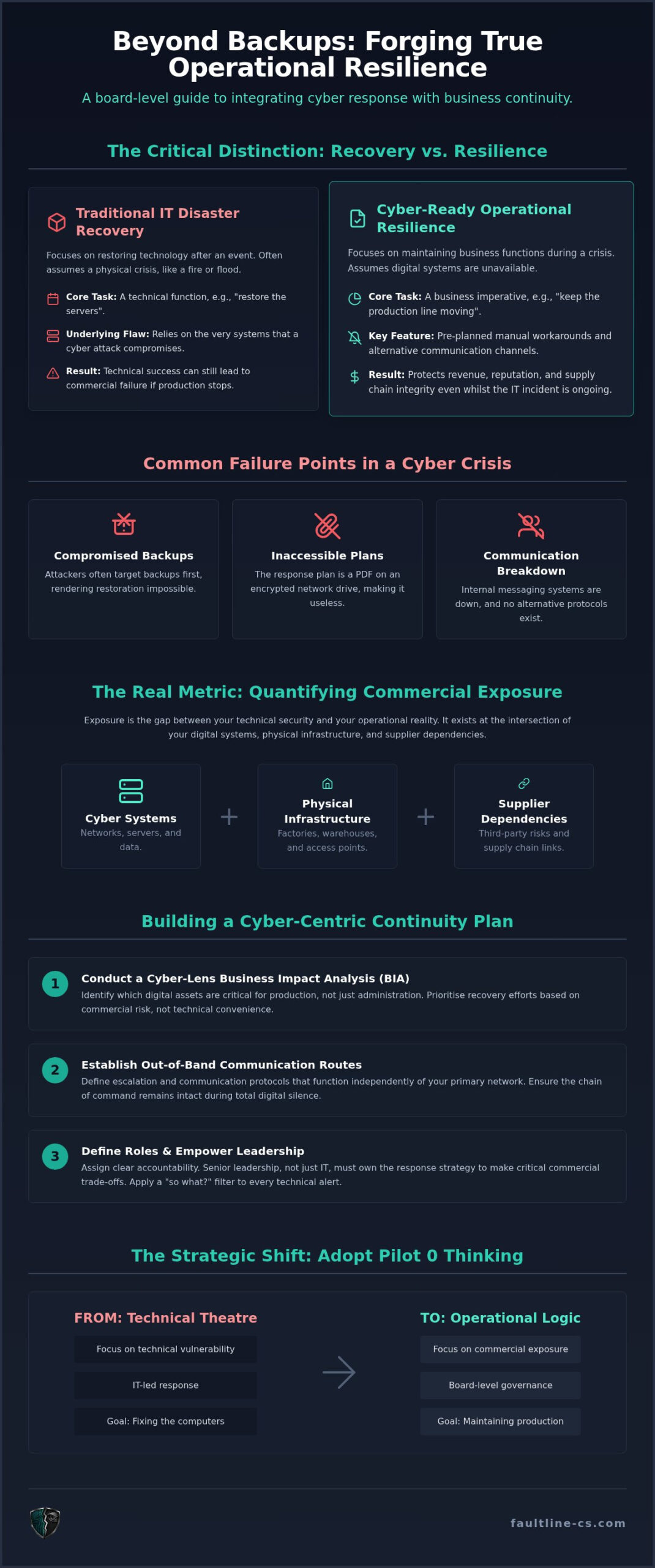
There is a fundamental distinction between IT disaster recovery and true operational resilience. Restoring a server is a technical task; resuming a manufacturing line or a logistics schedule is a business imperative. If your recovery window is measured in days but your customers expect delivery in hours, the technical success of your IT team is irrelevant to your commercial survival. This is why a dedicated cyber incident response business continuity plan is essential. It moves the focus from fixing the computers to maintaining production whilst under digital fire.
Why Traditional BCP Fails in a Cyber Context
Most traditional plans assume that backups and communication channels will remain functional. In a sophisticated ransomware attack, these are often the first targets. If your response plan is a PDF stored on a network drive that is now encrypted, your plan effectively does not exist. Resilience requires operational trust, which is the ability to execute manual workarounds and maintain supply chain integrity when digital certainty has vanished. Without a plan that accounts for the loss of digital tools, the transition to manual operations is often chaotic and prone to failure.
The Concept of Cyber Exposure
Directors must shift their primary metric from technical vulnerability to commercial exposure. Exposure is the gap between your current security posture and the actual operational reality of a breach. It is found at the intersection of cyber systems, physical infrastructure, and supplier dependencies. Most organisations do not see this gap until an incident occurs because they rely on technical testing rather than operational logic.
Identifying the gap where exposure lives is more critical than purchasing new software tools. Governance failures, such as a lack of clear escalation routes that bypass digital systems, create systemic risks that no firewall can patch. Understanding this exposure allows for a more pragmatic approach to risk management. It ensures that investments are aligned with business outcomes rather than technical theatre. For those looking to quantify these risks, professional exposure assessments provide the necessary visibility to bridge the gap between IT recovery and true operational continuity.
How to Build a Cyber-Centric Business Continuity Plan
Building a resilient organisation requires moving beyond the “it won’t happen to us” mindset. A robust cyber incident response business continuity plan must be grounded in operational reality rather than technical aspirations. The first step is conducting a Business Impact Analysis (BIA) with a specific cyber lens. This process identifies which digital assets are the lifeblood of your production and which are merely administrative. By understanding these dependencies, you can prioritise recovery efforts based on commercial risk rather than technical convenience.
Effective planning involves defining escalation routes that function independently of your primary network. If your incident response depends on an internal messaging system that is currently encrypted, your response has failed before it has begun. You must establish alternative communication protocols for staff and stakeholders, ensuring that the chain of command remains intact even during total digital silence. This level of preparation allows you to maintain production and supplier trust whilst your IT teams work to contain the breach.
Defining Response Roles and Accountability
Senior leadership must own the response strategy. It’s a mistake to delegate the entirety of cyber resilience to the IT department, as they often lack the authority to make the difficult commercial trade-offs required during a crisis. Every technical alert needs a “so what?” filter that translates system downtime into financial and operational impact. Drafting bespoke policies that reflect your specific manufacturing or logistics environment ensures that every director knows their role when the network fails. If you are unsure where your governance gaps lie, you might consider a specialist review of your current response framework.
Communication Protocols During Digital Silence
Reputation is managed through transparency and evidence. When your email systems are down, you need a pre-verified method for updating customers, shareholders, and regulators. In the UK, organisations must also remain mindful of their reporting obligations to the Information Commissioner’s Office (ICO) if personal data is involved. Having a clear, non-digital roadmap for these communications prevents panic and demonstrates a level of professional control that maintains market confidence.
Recovery Prioritisation for Manufacturing and Logistics
The critical path for production often differs from the priorities of an IT department. Whilst a server restoration might seem urgent to a technician, manual workarounds on the factory floor might be more vital for fulfilling a pending contract. Mapping these dependencies allows you to restore the most commercially sensitive systems first. You must also ensure data integrity is verified before resuming full-scale operations, as restarting production with corrupted data can lead to systemic quality failures that are far more costly than the initial downtime.
Addressing the Hidden Risks in Your Supply Chain and Physical Operations
The security of your operations is only as strong as your least resilient supplier. Whilst many UK directors focus solely on their internal infrastructure, a significant portion of commercial exposure lies with third parties. A cyber incident response business continuity plan is incomplete if it fails to account for the reality that a breach at a key logistics partner can halt your production just as effectively as a direct attack on your own servers. This is not just a theoretical risk; it’s a systemic vulnerability that often remains hidden until a crisis occurs.
FaultLine addresses this lack of visibility by integrating supplier reviews into our core services. In a standard Exposure Assessment, we review up to five critical suppliers to identify where your operational heartbeat depends on external digital platforms. This process moves beyond the technical theatre of checking certificates and looks at the practical logic of how a supplier failure impacts your ability to deliver. If your business cannot function without a specific third-party platform, that platform is part of your perimeter.
Supplier Risk Analysis and Dependency Mapping
Identifying which third parties have access to your critical infrastructure is a governance priority. Many organisations rely on contractual assumptions, believing that a service level agreement provides protection. In reality, an agreement won’t restart a stalled production line. You need to map these dependencies to understand the “so what?” of a supplier outage. For a deeper look at this challenge, see our guide on Modernising Third-Party Risk Management for UK Directors. This mapping ensures your response strategy is grounded in evidence rather than optimism.
The Physical-to-Cyber Crossover
In manufacturing and logistics environments, the line between digital systems and physical assets has dissolved. Operational technology and IoT devices on the factory floor often represent the most significant gap in security. A physical breach, such as unauthorised access to a control panel or an unsecured network port in a warehouse, can lead to a total digital blackout. Securing the physical perimeter is therefore a fundamental component of cyber resilience. Practical steps include restricting access to hardware interfaces and ensuring that operational systems are isolated from the general office network. By treating physical and cyber security as a single operational discipline, you reduce the risk of a simple site intrusion escalating into a systemic collapse.
Board Governance: Turning Resilience into a Strategic Advantage
Effective governance is the difference between a controlled recovery and a commercial collapse. For UK directors, this requires a shift from passive oversight to active strategic alignment. You must adopt Pilot 0 thinking, a methodology that strips away technical jargon to focus on the absolute minimum requirements for operational survival. This perspective ensures that your cyber incident response business continuity plan is not just a compliance document but a functional tool for protecting shareholder value. Integrating this plan into your wider corporate strategy ensures that resilience is treated as a core business function rather than an IT afterthought.
Resilience planning also provides tangible financial benefits beyond immediate risk reduction. A demonstrable commitment to operational trust and robust governance makes your organisation a more attractive prospect for insurers. By aligning with recognised standards such as ISO/IEC 27001 and UK Cyber Essentials Plus, you provide the evidence needed to satisfy rigorous underwriting requirements. This proactive stance often leads to more favourable terms and reduced premiums, as you have effectively quantified and mitigated your commercial exposure.
Board-Level Reporting and Decision Matrices
The board does not need to understand every technical alert, but it must understand the “so what?” of every systemic risk. Translating complex cyber metrics into high-level risk insights is essential for informed decision-making. Using structured decision-making matrices allows senior leadership to handle high-pressure incidents without succumbing to panic or misinformation. For a more detailed framework on these responsibilities, refer to our UK Operational Resilience: Strategic Guide for Directors. These tools ensure that governance remains steady when digital systems fail.
Realistic Scenario Testing and Exercises
Generic certifications often provide a false sense of security. To build genuine resilience, you must move beyond simple tabletop exercises and embrace realistic attack-path narratives. These exercises should test your communication routes, escalation paths, and manual workarounds in a controlled but challenging environment. Evidence-based testing proves whether your staff can actually maintain production whilst under digital fire. It identifies the hidden gaps in your governance that a standard audit might miss, allowing you to refine your response before a real incident occurs.
Implementing a Strategic Cyber Readiness Programme
Operational readiness is not a destination but a continuous state of awareness. For directors in the manufacturing and logistics sectors, the transition from vulnerability to resilience requires a structured, evidence-led approach. The FaultLine Cyber Readiness Assessment, powered by IntelSensus, is designed to provide this clarity by stripping away technical theatre and focusing on the commercial logic of your organisation. It serves as the foundation for a robust cyber incident response business continuity plan, ensuring that your strategic decisions are based on data rather than assumptions.
The logical starting point for any leadership team is our fixed-price Exposure Assessment at £5,000. This targeted review identifies the gap where exposure lives, providing an immediate and transparent view of your current standing without the need for open-ended consultancy fees. From this baseline, we help you build a 12-month programme for ISO/IEC 27001 alignment, creating a sustainable framework for governance and risk management that evolves alongside the threat landscape.
The FaultLine Exposure Assessment
Our assessment goes beyond internal network scans to uncover your external visibility and open-source exposure. We analyse how an adversary views your organisation, identifying the systemic gaps that could lead to a production failure or supply chain breach. The primary deliverable is a board-level report that avoids jargon in favour of prioritised, actionable insights. This document allows directors to quantify their risk and allocate resources where they will have the most significant impact on resilience. To understand how these gaps are identified in a modern context, read our analysis on Operational Risk Assessment for Business.
Long-Term Resilience and Continual Improvement
True resilience is built on a culture of security awareness that permeates every level of the organisation. This is not achieved through a once-a-year training session but through the continuous integration of security logic into daily operational behaviour. For organisations requiring ongoing vigilance, our Managed Security Service Provider (MSSP) capabilities, including SOC and SIEM monitoring, provide the necessary oversight to detect and neutralise threats before they escalate into crises. Whether you are based in Belfast or operating across the UK, securing your operational future begins with a pragmatic consultation. By choosing evidence over optimism, you ensure that your business remains functional and competitive, no matter the digital challenges ahead.
Securing Your Operational Future
True operational resilience is found at the intersection of technical security and business logic. By integrating a cyber incident response business continuity plan into your core strategy, you move beyond the limitations of traditional IT disaster recovery. This approach ensures production continues and supplier trust remains intact, even whilst under digital fire. It’s time to move from technical theatre to a pragmatic understanding of your commercial exposure and the systemic gaps that threaten your manufacturing or logistics operations.
Securing your organisation requires a partner that values evidence over assumptions. FaultLine provides Northern Ireland based expertise with UK-wide coverage, delivering board-level, jargon-free reporting that makes sense to directors and decision-makers alike. Our fixed-price £5,000 Exposure Assessment serves as the logical first step to identify your specific vulnerabilities and protect your bottom line. We provide the clarity you need to move forward with confidence and strategic alignment.
Take the lead in strengthening your organisation’s resilience today and ensure your operations are built to survive any digital crisis.
Frequently Asked Questions
What is the difference between an incident response plan and a business continuity plan?
An incident response plan focuses on the immediate technical containment of a digital breach. It provides the steps your IT team must take to stop an attack and secure the network. In contrast, a business continuity plan ensures that your core operations remain functional whilst the technical recovery is underway. Integrating these creates a unified cyber incident response business continuity plan that protects both your data and your production lines.
Why is cyber security critical for business continuity in manufacturing?
Manufacturing depends on just-in-time logistics and precise production schedules where even minor delays have significant financial consequences. Modern factories rely on interconnected systems that, if compromised, can halt physical machinery and lead to missed deliveries. A robust continuity strategy identifies manual workarounds for automated systems, ensuring that a network outage doesn’t result in a total factory standstill or a permanent loss of supplier trust.
How often should a UK business test its cyber business continuity plan?
UK organisations should test their plans at least once a year, or whenever significant changes are made to their operational infrastructure. Testing should move beyond basic tabletop exercises to include realistic attack-path narratives that challenge your actual response capabilities. Regular validation provides the evidence needed for board-level assurance. It helps to identify hidden gaps in your governance and communication protocols before a real crisis occurs.
What are the key components of a cyber incident response plan for directors?
Directors must focus on governance, clear escalation routes, and communication protocols that function independently of compromised networks. A vital component is the Business Impact Analysis, which identifies which production lines are most critical to commercial survival. The plan must also define who has the authority to make high-pressure trade-offs, ensuring that technical actions taken during an incident are always aligned with broader business outcomes.
Does ISO 27001 require a formal business continuity plan?
Yes, ISO/IEC 27001 requires organisations to implement processes for information security continuity as part of its comprehensive framework. Specifically, the standard focuses on ensuring that security is maintained during a disruption and that recovery processes are tested regularly. Aligning your cyber incident response business continuity plan with this standard provides a structured, internationally recognised approach to resilience that satisfies both regulators and sophisticated commercial partners.
How do I manage supplier risk within my continuity planning?
Managing supplier risk starts with mapping every third party that has access to your critical infrastructure. You shouldn’t rely on contractual assumptions; instead, you need to verify their actual resilience through assessments or audits. Identifying manual workarounds for critical supplier dependencies ensures that an external failure doesn’t become your internal collapse. This visibility allows directors to quantify their commercial exposure and build a more resilient supply chain.
What is the board’s role in cyber incident recovery?
The board provides strategic oversight and makes the final decisions on commercial trade-offs during a crisis. Directors are responsible for protecting the organisation’s reputation through transparent communication with shareholders, customers, and regulators. By using Pilot 0 thinking, the board focuses on the minimum requirements for operational survival. Their involvement ensures that the recovery process is guided by business priorities rather than purely technical considerations.
Can a business continuity plan reduce cyber insurance premiums?
A well-documented and tested continuity plan often leads to more favourable insurance terms and reduced premiums. Insurers look for evidence of robust risk management and operational resilience when determining your risk profile. By demonstrating that you have quantified your exposure and have a clear roadmap for recovery, you satisfy rigorous underwriting requirements. This proactive stance proves to insurers that your organisation is capable of managing sophisticated digital threats effectively.

Article by
Alex J Morgan
Alex Morgan writes and develops content for FaultLine Cyber & Security Ltd. Alex has worked across web development, organic SEO, digital marketing and content creation since 2009, with a particular focus on making complex subjects clear, useful and easy to navigate.
Leave a Reply