


Your most dangerous vulnerability isn’t a faulty firewall or a broken gate; it’s the invisible thread connecting your Kilroot production line to a supplier you’ve never audited. Most industrial leaders in Mid and East Antrim understand that downtime is the ultimate enemy. With Northern Ireland manufacturing output having increased by 9.1% in the year to Q1 2026, the pressure to maintain seamless production is relentless. You’re likely already feeling the weight of increasing regulatory scrutiny, yet traditional silos often leave critical dependencies unmonitored. This guide offers a pragmatic path for operational resilience planning Carrickfergus firms need to protect their bottom line from systemic shocks.
We will move beyond technical theatre to explore how bridging the gap between cyber, physical, and supplier risks creates a defensible posture. You’ll discover a clear framework to identify operational gaps and produce the evidence-led reporting your board requires to mitigate the risk of prolonged downtime before the March 2027 regulatory deadlines arrive. By focusing on commercial exposure rather than just digital fixes, you can ensure your operations remain robust amidst an increasingly complex risk landscape.
Key Takeaways
- Understand the distinction between simple recovery and the capacity to absorb systemic shocks whilst maintaining your most critical industrial services.
- Establish clear impact tolerances to determine the maximum level of disruption your operations can endure before facing systemic failure.
- Evaluate the hidden vulnerabilities in your supply chain where contractual assumptions often fail to match the technical reality of third-party access.
- Secure your industrial control systems by addressing the convergence of physical site security and digital network integrity.
- Discover how operational resilience planning Carrickfergus businesses implement can leverage Pilot 0 thinking to focus spend on verified risks rather than redundant tools.
Beyond Business Continuity: Defining Operational Resilience for Carrickfergus Industry
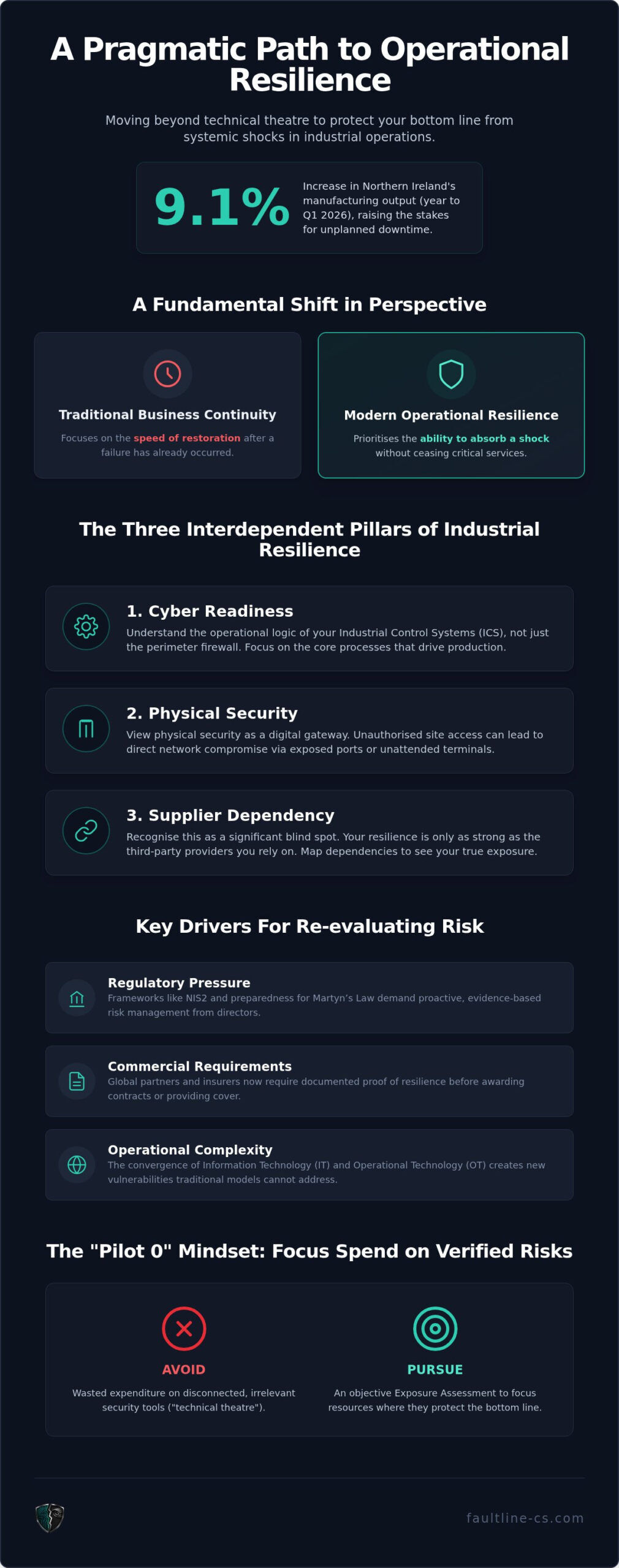
Resilience is not a synonym for recovery. Whilst traditional Business Continuity Planning focuses on the speed of restoration after a failure, operational resilience prioritises the ability to absorb a shock without ceasing critical services. For a manufacturing hub like Kilroot Energy Park or the specialised engineering firms within the Trooperslane Industrial Estate, a four-hour outage isn’t just an IT ticket; it’s a systemic failure that threatens commercial viability. Effective operational resilience planning Carrickfergus leaders must adopt moves away from technical theatre, which is the purchase of expensive, disconnected security tools, and focuses instead on the commercial reality of production continuity.
The goal is to maintain a steady state of operation even when systems are under duress. This requires a shift in perspective from protecting individual assets to safeguarding the entire value chain. In an environment where Northern Ireland’s manufacturing output increased by 9.1% in the year to Q1 2026, the cost of unplanned downtime has never been higher. Boards must move beyond the “tick-box” mentality of compliance and begin asking how their specific operational logic can withstand a coordinated disruption.
The Three Pillars of Industrial Resilience
True resilience rests on three interdependent foundations that often exist in silos within a business. Cyber readiness involves understanding the operational logic of your industrial control systems (ICS) rather than just installing a perimeter firewall. Physical security must be viewed as a digital gateway; unauthorised site access often leads to direct network compromise through exposed ports or unattended terminals. Finally, supplier dependency remains a significant blind spot. Your resilience is only as strong as the third-party logistics or component providers you rely on every day. Mapping these dependencies is the only way to gain true visibility into your exposure.
Why Carrickfergus Businesses Are Re-evaluating Risk
The strategic landscape is shifting from a focus on “if” an incident occurs to an acceptance of “when” it will happen. This transition is driven by more than just rising threat levels. Key drivers include:
- Regulatory Pressure: New frameworks such as NIS2 and the preparedness required for Martyn’s Law demand that directors demonstrate proactive, evidence-based risk management.
- Commercial Requirements: Larger global partners and insurers now require documented proof of resilience before awarding contracts or providing cover.
- Operational Complexity: The convergence of IT and OT (Operational Technology) in modern manufacturing has created new vulnerabilities that traditional security models cannot address.
For many local firms, the first step is an objective Exposure Assessment to bridge the gap between perceived safety and operational reality. By identifying where cyber, physical, and supplier risks overlap, you can move toward a “Pilot 0” mindset that avoids wasted expenditure on irrelevant tools and focuses resources where they actually protect the bottom line.
Step 1: Mapping Critical Business Services and Impact Tolerances
Visibility is the only effective antidote to systemic vulnerability. For many directors, the initial challenge in operational resilience planning Carrickfergus isn’t a lack of data but an inability to distinguish between supportive administrative functions and critical business services. A critical service is one that, if interrupted for 24 hours, would lead to a breakdown in your commercial viability or safety obligations. Whilst the Federal Reserve guidance on operational resilience was designed for financial stability, its core principle of identifying “critical operations” is now the benchmark for industrial governance. You must document the specific resources, including people, proprietary data, and industrial control systems, required to keep these services alive during a shock.
An industrial firm must prioritise the physical integrity of its production line and the safety of its on-site personnel over supportive IT functions such as corporate email or internal intranets. This distinction is the foundation of Pilot 0 thinking. By focusing on the operational logic of the factory floor rather than generic digital assets, you ensure that your resilience budget is spent on protecting the actual drivers of revenue.
Identifying Your “Crown Jewels”
Separating essential operational functions from supportive administrative tasks requires a cold-eyed assessment of your value chain. You must map the flow of data from the sensors on the factory floor through to the logistics systems that manage Trooperslane-based distribution. If a ransomware attack encrypts your head office servers, can your production line continue to operate in a disconnected state? Identifying these “Crown Jewels” allows you to build hardened zones around the assets that truly matter, ensuring that a failure in a supportive system doesn’t cause a systemic collapse of your Carrickfergus logistics.
Setting Realistic Impact Tolerances
Impact tolerances are not recovery time objectives; they are the maximum tolerable level of disruption your business can endure before facing irreparable commercial damage. These thresholds must be set using evidence rather than optimistic assumptions. You need to align these tolerances with your specific contractual obligations and customer expectations. If a local engineering firm fails to deliver a precision component within a 12-hour window, the resulting penalty clauses or reputational damage might be terminal. Defining these limits early allows you to build recovery strategies that are grounded in reality. To understand where your current thresholds stand, you may wish to speak with a consultant about your specific operational environment.
The output of this mapping exercise should be a clear, board-level report that highlights where your current capabilities fall short of your required tolerances. This gap analysis is the first step in moving from a reactive posture to a resilient one. For those beginning this journey, a structured Exposure Assessment provides the necessary data to inform these strategic decisions.
Step 2: Uncovering Vulnerabilities in the Carrickfergus Supply Chain
Contracts are not safeguards. Most directors assume their suppliers are as resilient as they are; the reality is that your operations are often held together by a chain of unverified promises. In Carrickfergus, where industrial logic dictates every move, ignoring third-party risk is a gamble that eventually fails. If a key logistics partner at the harbour or a specialised component manufacturer in Trooperslane suffers a systemic failure, the impact on your production line is immediate and often total. Effective operational resilience planning Carrickfergus firms must undertake requires a deep dive into these hidden dependencies to move from hope as a strategy to evidence based visibility.
You must identify the single points of failure amongst your local and international vendors. This involves reviewing the technical reality of third party access to your systems versus the assumptions made in your legal agreements. Often, suppliers are granted broad network permissions that far exceed their operational requirements, creating a bridge for contagion to enter your environment. True resilience is found in the gaps between your business and its partners. Mapping these connections allows you to understand which dependencies sustain your critical services and where the most significant commercial exposures lie.
The Supplier Dependency Trap
A breach at a minor supplier can halt your entire Carrickfergus operation within hours. This is the cascading failure effect, where a seemingly isolated incident in an integrated logistics network triggers a systemic collapse across the value chain. Most organisations lack real time visibility into their partners’ security posture, relying instead on outdated annual questionnaires that provide a false sense of security. To address this, leaders are Modernising Third-Party Risk Management by focusing on the operational logic of the partnership rather than just the legal paperwork. It’s about understanding how a failure at their end translates to downtime at yours.
Auditing Without Friction
Requesting security evidence shouldn’t strain commercial relationships. The goal is to move from tick-box compliance to genuine, evidence based assurance. Instead of sending exhaustive spreadsheets to every vendor, you should prioritise audits for your top five most critical suppliers. Ask for proof of their recovery testing and their defined impact tolerances. This collaborative approach builds a stronger ecosystem and ensures that your Supplier & Third-Party Risk Analysis is grounded in reality. By focusing on the vendors that would cause the most significant disruption if they failed, you can manage your exposure without overwhelming your procurement team or your partners.
Step 3: Integrating Physical Security and Cyber Readiness
Security is often treated as two distinct disciplines: the physical guarding of assets and the digital protection of data. In a modern industrial environment, this separation is a dangerous fiction. A breach of a physical perimeter often provides the shortest path to a catastrophic network failure. For those involved in operational resilience planning Carrickfergus industrial sites must manage, it is essential to recognise that a compromised door lock can be just as damaging as a compromised password. Relying on silos is a legacy mindset that modern threats have rendered obsolete, particularly as the convergence of Operational Technology (OT) and traditional IT makes the factory floor a primary target.
The Physical-to-Cyber Crossover
Unsecured server rooms or exposed network ports in a Carrickfergus warehouse represent a direct line of sight for an attacker. Industrial Control Systems (ICS) and IoT devices often lack the robust encryption found in standard IT equipment, making them particularly vulnerable if physical access is gained. CCTV systems and access control panels are themselves digital assets; if they aren’t integrated into your digital resilience plan, they become unmonitored entry points. The exposure gap exists in the space between a heavy-duty locked gate and an unsecured, open Wi-Fi network that broadcasts directly into the car park.
The human element remains the most unpredictable variable. Staff awareness programmes often focus on phishing emails whilst ignoring the physical reality of tailgating or the casual sharing of access fobs. Resilience fails when physical protocols and cyber policies don’t align. If your IT policy requires multi-factor authentication but your server room is left propped open for ventilation, your technical defences are effectively bypassed. This lack of alignment often stems from a failure to communicate risk across different departments, leaving gaps that are easily exploited by a determined adversary.
Martyn’s Law and Public Safety
Regulatory pressure is mounting with the implementation of Martyn’s Law, which requires businesses with public-facing premises to take proportionate measures against security threats. For Carrickfergus firms with public access, this means integrating physical safety responses with digital incident management. A physical security event, such as a site intrusion, must trigger an immediate review of network integrity to ensure no malicious hardware has been planted. FaultLine provides comprehensive Exposure Assessments that specifically identify these physical-to-cyber crossovers, ensuring that your resilience strategy is grounded in the operational reality of your site rather than just a digital map. This joined-up approach is the only way to satisfy both regulatory demands and the commercial need for uninterrupted production.
Executing Your Resilience Strategy with FaultLine
Strategy is only as effective as its execution. For many industrial firms, operational resilience planning Carrickfergus has historically been hindered by the technical theatre of disconnected software tools and expensive, uncoordinated security audits. FaultLine Cyber & Security Ltd provides a strategic alternative through our fixed-price Exposure Assessment, priced at £5,000. This entry point is designed to provide a comprehensive risk picture without the burden of open-ended consultancy fees. By identifying the specific “gap” where your cyber, physical, and supplier risks overlap, we enable directors to move from assumptions to an evidence-led reality.
Our methodology is built on “Pilot 0” thinking. We don’t act as hardware or software resellers; our goal is to ensure you don’t waste capital on irrelevant tools. Instead, we focus on the human behaviour and operational logic that actually drive your business. This pragmatic approach ensures that your resilience budget is allocated to the areas that most directly protect your production lines and commercial reputation. You receive a board-level report that translates complex technical vulnerabilities into the language of corporate governance and production risk.
The FaultLine Cyber Readiness Assessment
The FaultLine Cyber Readiness Assessment, powered by IntelSensus, provides a realistic attack-path narrative rather than a simple list of software patches. Whilst traditional vulnerability scanning identifies technical flaws, our assessment maps how those flaws could be exploited to disrupt your critical services. We focus on business outcomes, specifically looking at how a failure in your industrial control systems or a breach at a key supplier would impact your bottom line. This narrative-driven approach allows Alex Morgan and the team to provide a strategic roadmap that aligns your security posture with your commercial objectives.
Our reporting is delivered in plain English, avoiding the dense jargon that often obscures reality from decision-makers. We prioritise visibility and insight, highlighting hidden vulnerabilities that standard audits frequently overlook. By moving from reactive vulnerability management to proactive exposure management, you gain a steady hand capable of providing clarity in complex industrial environments.
Next Steps for Carrickfergus Directors
Initiating a review of your resilience posture should be a methodical and low-friction process. For directors at Trooperslane or Kilroot, the priority is to act before a “controlled wake-up call” becomes a real-world incident that halts operations. Our Operational Resilience Services are designed to fit seamlessly into your existing governance framework, providing the evidence-based reporting required for the board and regulators alike. Resilience is a long-term commitment to business continuity, and it begins with an objective understanding of your current exposure.
Securing the Future of Carrickfergus Industry
Operational resilience is the only defensible posture in an increasingly volatile industrial landscape. By moving beyond the limitations of traditional business continuity, you ensure your organisation can absorb systemic shocks whilst maintaining the critical services that drive your revenue. True visibility is found when you bridge the gaps between your physical site security, digital network integrity, and the unverified assumptions within your supply chain. This alignment is the cornerstone of effective operational resilience planning Carrickfergus firms need to satisfy regulatory and commercial demands.
FaultLine offers a clear path forward through our fixed-price £5,000 Exposure Assessment. As an NI-based consultancy specialising in the manufacturing and logistics sectors, we provide the board-level, plain English reporting necessary to turn complex risks into actionable insights. We focus on Pilot 0 thinking to ensure your resources are spent where they actually protect your production line rather than on redundant technical tools. Taking this step today transforms a potential crisis into a managed operational reality.
Your resilience is a strategic asset that builds long-term trust with partners and customers alike. By prioritising evidence over assumptions, you position your business to thrive amidst the complexities of the modern industrial world.
Frequently Asked Questions
What is the difference between business continuity and operational resilience?
Business continuity focuses on the speed of recovery after a failure occurs. It asks how quickly you can get back to normal. Operational resilience is a broader strategic discipline that prioritises the ability to absorb a shock whilst maintaining your most critical services. It’s the difference between planning how to fix a broken production line and designing your operations so they don’t stop when a system fails.
Does my Carrickfergus business need a resilience plan for NIS2 compliance?
If your firm operates in critical sectors such as energy, transport, or manufacturing, you’re likely within the scope of NIS2. This regulation demands proactive risk management and incident reporting. Effective operational resilience planning Carrickfergus organisations implement ensures they have the documented evidence and governance structures required to meet these stringent European and UK standards. Failing to prepare creates significant legal and commercial exposure.
How much does an operational resilience assessment cost in Northern Ireland?
FaultLine provides a fixed-price Exposure Assessment for £5,000. This entry point is designed to give directors a comprehensive, board-level view of their risks without the uncertainty of open-ended consultancy fees. We focus on identifying the specific gaps in your cyber, physical, and supplier domains. This pragmatic approach ensures you have the evidence needed to make informed decisions about your security spend.
Can operational resilience planning help reduce my cyber insurance premiums?
Insurers are increasingly skeptical of firms that lack documented resilience. By demonstrating that you’ve identified critical services and established clear impact tolerances, you provide the evidence of maturity that underwriters require. Whilst we don’t act as brokers, a robust resilience plan often makes a business more insurable. It shows you’re managing risk through operational logic rather than just relying on technical tools.
What are impact tolerances, and how do I set them for manufacturing?
Impact tolerances are the maximum tolerable level of disruption your critical services can endure before causing irreparable damage. In a manufacturing context, you set these by calculating the exact point where downtime leads to terminal contractual penalties or safety failures. You must use evidence rather than assumptions to define these limits. This ensures your recovery strategies are grounded in the commercial reality of your production schedule.
How do I assess the resilience of my third-party suppliers?
You must move away from annual “tick-box” questionnaires and towards evidence-based assurance. Identify your top five most critical dependencies and request proof of their own recovery testing and impact tolerances. Understanding the technical reality of how these partners access your systems is vital. It’s about uncovering the single points of failure in your supply chain before they cause a systemic collapse of your own operations.
What is Martyn’s Law, and does it affect my business in Carrickfergus?
Martyn’s Law requires businesses with public-facing premises to implement proportionate security measures against terrorism. If your Carrickfergus site interacts with the public, you’ll need to integrate physical safety protocols with your broader digital incident management. This ensures a coordinated response to any threat. Integrating these requirements into your resilience plan is essential for legal compliance and the continued safety of your staff and customers.
How often should a resilience plan be tested and updated?
A resilience plan isn’t a static document; it’s a living framework that requires regular validation. You should conduct “severe but plausible” scenario testing at least once a year. It’s also vital to update your plan whenever there’s a significant change to your operational logic. This includes installing new industrial control systems, switching key suppliers, or moving to a new logistics partner at the harbour.

Article by
Alex J Morgan
Alex Morgan writes and develops content for FaultLine Cyber & Security Ltd. Alex has worked across web development, organic SEO, digital marketing and content creation since 2009, with a particular focus on making complex subjects clear, useful and easy to navigate.
Leave a Reply