


Your risk register is likely a list of technical symptoms rather than a map of business survival. With the average cost of a significant cyberattack for a UK business now reaching almost £195,000, the necessity for a rigorous operational risk assessment business strategy has moved from the server room to the boardroom. Most directors are weary of navigating technical jargon that fails to explain how a digital breach translates into a shuttered warehouse or a broken production line.
The most dangerous vulnerabilities exist in the blind spots between your cyber systems, physical access, and supplier dependencies. This guide provides a pragmatic framework to help you identify these hidden gaps and move beyond the technical theatre that often masks true exposure. We will outline how to achieve a clear picture of your commercial risk and provide actionable insights to improve resilience against the systemic failures that define the 2026 landscape.
Key Takeaways
- Learn why traditional risk registers often fail when they focus on technical symptoms rather than the commercial impact of operational downtime.
- Discover how a structured operational risk assessment business framework identifies hidden gaps where physical security and digital systems intersect.
- Understand the limitations of legacy “Likelihood vs Impact” models and how to replace them with realistic, evidence led attack path narratives.
- Gain insights into mapping your external digital footprint to see what attackers can learn about your supplier dependencies and open source exposure.
- Move from data collection to boardroom action by developing incident response plans that prioritise production continuity and long term resilience.
Beyond the Balance Sheet: Why Operational Risk is a Strategic Priority
Risk is often treated as a line item on a spreadsheet, yet for a director in manufacturing or logistics, risk is better understood as the moment the assembly line grinds to a halt. In 2026, the gap between a theoretical threat and a commercial crisis has vanished. A robust operational risk assessment business strategy must move past the passive filing of reports and towards a proactive state of exposure awareness. This requires what we call Pilot 0 thinking, a mindset that ignores technical theatre and focuses on the absolute baseline of business survival. It’s about stripping away the fluff to see exactly what would happen if your primary systems failed tomorrow.
Traditional Operational Risk Management (ORM) models frequently isolate risks into neat silos like cyber, physical, or safety. However, real world vulnerabilities are systemic and messy. They exist in the friction between your physical premises, your human staff, and your digital infrastructure. If a delivery driver can walk into a restricted area because a physical lock failed, the most expensive firewall in the world becomes irrelevant. This intersection is where the most significant gaps are found, and identifying them requires a shift in perspective from the board down.
The Definition of Operational Exposure
Operational exposure is the total sum of your visible gaps. It isn’t just about whether your software is patched; it’s about whether you have visibility over your entire estate. For a business to remain resilient, leadership must understand the intersection of people, systems, and physical assets. Visibility is not a technical luxury but a governance requirement. Without it, you aren’t managing risk; you’re merely hoping for the best whilst your competitors build more resilient foundations.
The High Stakes of Operational Failure
The consequences of ignoring these gaps are no longer limited to minor IT disruptions. According to the Bank of England’s April 2026 Systemic Risk Survey, 18% of firms now identify operational risk as one of the most challenging threats to manage. When a supplier fails or a system goes down, the impact is measured in lost production hours and liquidated damages. Directors are also facing increased personal accountability. With the Cyber Security and Resilience Bill strengthening regulatory obligations, failing to conduct a thorough operational risk assessment business process is no longer just a tactical error; it’s a failure of corporate governance that carries significant reputational weight.
The Four Pillars of Operational Exposure in Modern UK Business
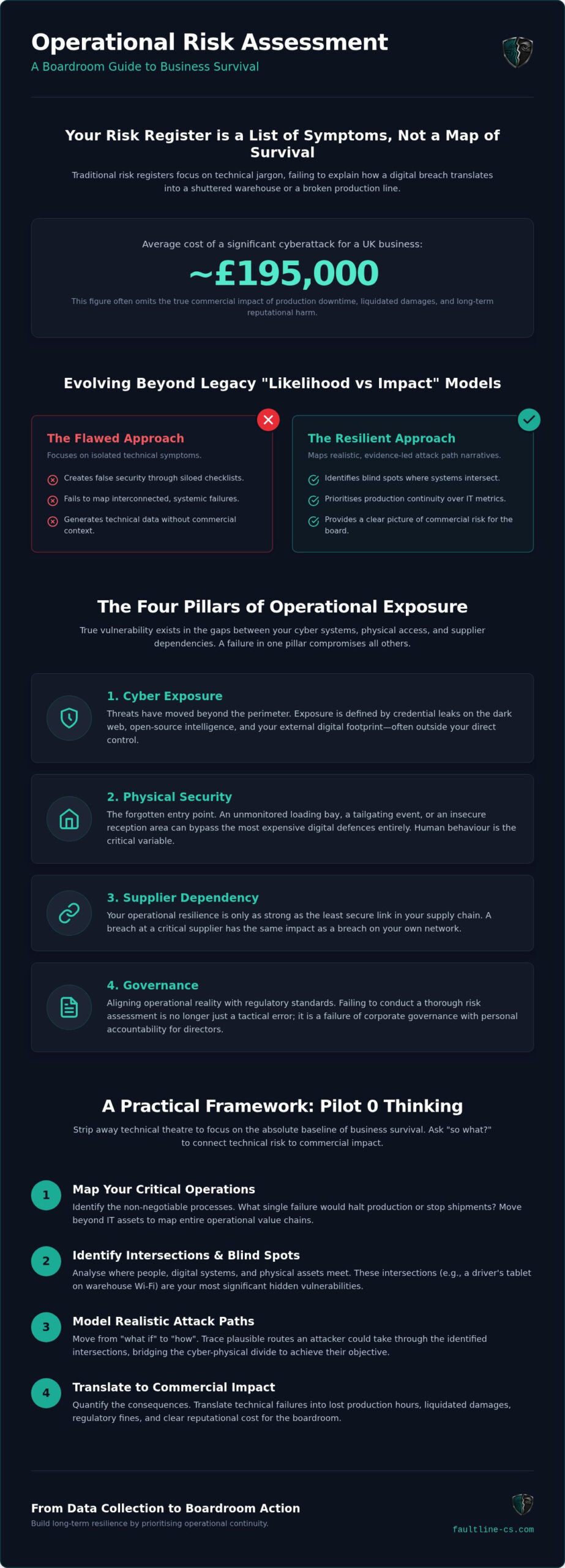
Isolation is the enemy of resilience. Most organisations treat their security departments like separate islands, yet an effective operational risk assessment business strategy recognises that a vulnerability in one pillar inevitably compromises the others. In 2026, the landscape is defined by four critical pillars: Cyber Exposure, Physical Security, Supplier Dependency, and Governance. Each must be examined with the same level of commercial scepticism to ensure that production and logistics remain uninterrupted.
Cyber exposure has evolved far beyond the perimeter. It’s no longer just about firewalls; it’s about identity and credential leaks that exist on the dark web, often entirely outside your direct control. Physical security, meanwhile, is frequently the forgotten entry point. An unmonitored loading bay or an insecure reception area is a digital vulnerability in waiting. Supplier dependency represents the third pillar, where your resilience is only as strong as the least secure link in your chain. Finally, governance ensures that your operational reality aligns with new regulatory standards, such as the Cyber Security and Resilience Bill introduced in November 2025, which mandates reporting harmful breaches within 24 hours. A failure in any one of these areas creates a systemic gap that can lead to total operational collapse.
Bridging the Cyber-Physical Divide
Physical breaches are often the precursor to catastrophic cyber incidents. A tailgating event at a regional distribution centre isn’t just a facility management issue; it is a direct threat to your network integrity. If an unauthorised individual gains access to a server room or even a networked printer, your digital defences are bypassed entirely. Human behaviour remains the most unpredictable variable in this equation. Cultivating a culture where staff understand that office access is a critical component of digital defence is essential for managing operational resilience effectively. Visibility into these crossover points allows for a more grounded perspective on your true exposure rather than relying on technical assumptions.
The Supplier Dependency Trap
Your business does not operate in a vacuum. With the July 2026 oversight regime for Critical Third Parties (CTPs) now in effect, the UK government has acknowledged the systemic risk posed by shared service providers. Relying on third parties without total visibility into their security protocols is a significant gamble. A supplier’s failure is, for all practical purposes, your failure, especially in manufacturing models where inventory buffers are slim. We recommend modernising third-party risk management to move beyond static questionnaires and towards active, evidence led assessments. If you are concerned about hidden vulnerabilities in your chain, consider reviewing your current exposure with a specialist partner who understands the logistics sector.
Why Traditional Risk Matrices Fail to Protect Manufacturing and Logistics
Traditional risk matrices are a security blanket for the boardroom. They offer a colourful, simplified view of the world that rarely survives first contact with a real incident. For manufacturing and logistics leaders, the standard “Likelihood vs Impact” heatmap is increasingly unfit for purpose. It relies on subjective guesses that often downplay high-impact events simply because they haven’t happened yet. This approach creates a dangerous complacency, where technical theatre, such as green dashboards and impressive-sounding jargon, obscures the actual operational risk assessment business gaps that could halt production.
Automated tools further complicate this by providing a false sense of security. Whilst a vulnerability scanner can find an unpatched server, it cannot understand the human logic or the physical crossover risks mentioned earlier. It doesn’t know that an insecure gate at a warehouse allows an intruder to plug a device directly into your network. Relying on software to do the thinking for you is a strategic mistake; it replaces genuine insight with a checklist that fails to account for the physical reality of your operations.
The Illusion of Compliance
A clean audit report is not a shield. Many organisations pride themselves on ISO 27001 certification, yet this often measures process adherence rather than operational resilience. You can be perfectly compliant whilst remaining entirely vulnerable to a targeted attack path. Security is an active, ongoing state of awareness, whereas compliance is a passive snapshot in time. To move beyond the paperwork, directors should consider an ISO 27001 gap assessment that looks specifically at how governance translates into shop-floor reality. The goal is to ensure that your processes actually protect your production lines, not just your insurance premiums.
Moving to Realistic Attack-Path Narratives
The board needs clarity, not spreadsheets. Instead of abstract percentages, leadership should demand realistic attack-path narratives. These narratives map exactly how a breach moves through your organisation, from an initial credential leak to a total system lockout. This evidence-led approach provides the “so what?” that technical reports lack. By focusing on how an incident impacts specific business functions, you can prioritise investments based on commercial exposure. A thorough operational risk assessment business process should provide a clear, plain-English story of your vulnerabilities, allowing you to build resilience where it actually matters for your bottom line.
A Practical Framework for Conducting an Operational Risk Assessment
Execution is the only metric that matters. A structured operational risk assessment business framework provides the necessary visibility to move from reactive firefighting to strategic resilience. This process is not about generating more paperwork; it’s about uncovering the specific vulnerabilities that threaten your core business functions. By following a methodical deconstruction of your estate, you can build a prioritised plan that the board can actually act upon. This avoids the technical theatre of green dashboards and focuses instead on the reality of your commercial exposure.
- Step 1: Define the operational scope. Identify your critical business functions, such as production lines or dispatch hubs. Focus on the processes that, if halted, would cause immediate financial or reputational collapse.
- Step 2: Map external visibility and open-source exposure signals. Use intelligence to see what an attacker sees. This includes leaked credentials, exposed digital assets, and information shared by employees on public platforms.
- Step 3: Evaluate third-party and supplier dependencies. Move beyond static questionnaires. Analyse the actual security posture of your critical suppliers and how their failure would cascade through your operations.
- Step 4: Analyse the crossover between physical access and digital assets. Identify how physical entry points, such as loading bays or reception areas, could be used to bypass your digital defences.
- Step 5: Translate findings into a prioritised board-level action plan. Convert technical data into a clear narrative that answers the “so what?” regarding production downtime and regulatory risk.
Navigating the 2026 Regulatory Landscape
The regulatory environment in 2026 is uncompromising. UK firms are now navigating the full implementation of PRA SS1/21 and, for those with EU exposure, the Digital Operational Resilience Act (DORA). These mandates require more than just a policy document; they demand evidence of continuous resilience testing and robust third party oversight. Additionally, the introduction of Martyn’s Law has placed new safety obligations on public-facing premises, further blurring the lines between physical security and operational risk. Utilising Governance, Risk & Compliance (GRC) consulting ensures that your resilience strategy meets these high bars whilst maintaining the trust of your stakeholders.
Identifying the “Gap” Where Risk Lives
Hidden vulnerabilities often reside in the logic of your business processes rather than just the software you use. Finding these gaps requires a specialist eye that understands the manufacturing and logistics sectors. The FaultLine Cyber Readiness Assessment, powered by IntelSensus, is designed to uncover these systemic weaknesses by focusing on realistic attack-path narratives. Rather than starting with a complex, multi-year overhaul, a fixed-price entry service provides an immediate, clear-eyed perspective on your reality. This structured operational risk assessment business approach allows you to address the most critical “Pilot 0” risks first, ensuring that your most vital assets are protected before you move on to broader technical fixes.
Building Long-Term Resilience: From Assessment to Boardroom Action
Resilience is not a project with a fixed end date; it is an active state of operational readiness. Once a business has concluded its operational risk assessment business process, the true work begins in converting that data into strategic commercial decisions. For manufacturing and logistics leaders, this means moving beyond technical remediation and into the realm of business continuity. Security should not be viewed as a cost centre but as a commercial enabler that protects production margins and secures supplier trust in a volatile market.
Incident response plans must be translated into the language of the shop floor. A non-technical operations manager needs to know exactly how to maintain production whilst a digital system is being restored. This requires a deconstruction of complex technical procedures into clear, actionable steps that prioritise business survival. Continuous monitoring through Managed Security Service Provider (MSSP) and SOC services ensures that this readiness is not just a snapshot in time. It provides the visibility needed to detect a breach before it cascades into a total operational failure.
Engaging the Board with Plain-English Insights
Board-level reporting must focus on exposure rather than technical metrics. Directors are responsible for the long term health of the organisation, and they require a clear picture of how vulnerabilities affect the bottom line. By using a cyber threats strategic guide, leadership can bridge the gap between IT jargon and commercial reality. This creates a culture of accountability where security is recognised as a shared responsibility rather than a problem for the IT department alone.
Next Steps: The FaultLine Exposure Assessment
Clarity is the first step towards resilience. A FaultLine Exposure Assessment provides a fixed price, high impact entry point for directors who need an objective view of their estate. At a cost of £5,000, this assessment moves away from generic testing and focuses on realistic attack-path narratives that reveal exactly how your business could be disrupted. You will receive a clear, evidence led report that identifies the gaps between your cyber, physical, and supplier dependencies, providing a pragmatic roadmap for the board. It’s time to move past assumptions and secure your operational resilience with a partner that values logic over technical theatre.
Secure your operational resilience today
Securing Strategic Resilience in an Interconnected Market
The landscape of 2026 does not permit complacency. Visibility is the only antidote to the hidden vulnerabilities that live in the gaps between your digital and physical assets. By prioritising a rigorous operational risk assessment business framework, directors can move past technical jargon and focus on the commercial reality of production risks and supplier dependencies. Resilience is not about avoiding every threat; it is about ensuring your core functions remain robust when the unexpected occurs.
FaultLine specialises in providing this clarity for the manufacturing and logistics sectors. Our fixed price entry service at £5,000 delivers a realistic attack path narrative and board level reporting in plain English. This ensures that your leadership team has the evidence needed to make informed, strategic decisions without needing to unpack complex technical theatre. We provide the grounded expertise required to turn systemic observations into a structured path forward.
Taking the first step towards resilience is a pragmatic investment in your company’s long term survival. Securing your operations today builds the trust and stability your stakeholders expect in a volatile environment. We look forward to acting as your strategic guide in building a more resilient future.
Frequently Asked Questions
What is the primary goal of an operational risk assessment for a business?
The primary goal is to achieve total visibility over the hidden gaps that threaten business continuity. An operational risk assessment business strategy identifies where technical systems, physical premises, and human behaviours intersect. This ensures that directors can move beyond technical theatre and focus on the realistic attack paths that could halt production or damage the balance sheet.
How does operational risk differ from financial or strategic risk?
Operational risk focuses on the practical failure of internal processes, people, and systems. Whilst financial risk concerns market volatility and strategic risk deals with long term market positioning, operational exposure is about the “here and now” of business survival. It addresses the commercial impact of downtime and the systemic gaps that lead to service collapse.
Why is supplier risk considered a major part of operational exposure in 2026?
Supplier risk is critical because modern businesses no longer operate in isolation. With the July 2026 oversight regime for Critical Third Parties (CTPs) in effect, the UK government has acknowledged that reliance on external partners creates systemic vulnerabilities. A failure in your supply chain is effectively your failure, particularly when inventory buffers are lean and production relies on just in time delivery.
Can a small business in Northern Ireland benefit from an operational risk assessment?
Small businesses in Northern Ireland are often the most vulnerable links in larger supply chains. An operational risk assessment business review allows these firms to demonstrate resilience to larger partners and regulators. For a small manufacturing or logistics entity, identifying a single hidden vulnerability can be the difference between long term survival and immediate liquidation following a breach.
How often should an organisation conduct an operational risk review?
Reviews should be conducted whenever there is a significant change in the regulatory landscape or business operations. With the introduction of the Cyber Security and Resilience Bill in late 2025 and new operational resilience rules from the FCA in March 2026, an annual review is now the bare minimum. Continuous monitoring is preferred to ensure that your resilience strategy evolves alongside emerging threats.
What is the difference between a penetration test and an exposure assessment?
A penetration test is a narrow technical exercise designed to find software vulnerabilities. In contrast, an exposure assessment is a strategic review that looks at how an attacker could move through your entire organisation. It identifies the “so what?” by mapping technical flaws to commercial impacts such as production downtime or supplier failure.
How do new UK regulations like Martyn’s Law impact operational risk planning?
Martyn’s Law requires public facing organisations to implement specific safety and security measures. This legislation forces a convergence between physical safety and operational risk planning. Directors must now account for public safety as a core component of their resilience strategy, ensuring that physical access points don’t become vulnerabilities that compromise the wider business.
What role does human behaviour play in operational security vulnerabilities?
Human behaviour is often the most significant variable in any security framework. Operational vulnerabilities frequently stem from established habits or a lack of awareness rather than technical flaws. Security is as much about human logic and operational culture as it is about firewalls; understanding how staff interact with systems is essential for building a truly resilient organisation.

Article by
Alex J Morgan
Alex Morgan writes and develops content for FaultLine Cyber & Security Ltd. Alex has worked across web development, organic SEO, digital marketing and content creation since 2009, with a particular focus on making complex subjects clear, useful and easy to navigate.
Leave a Reply