


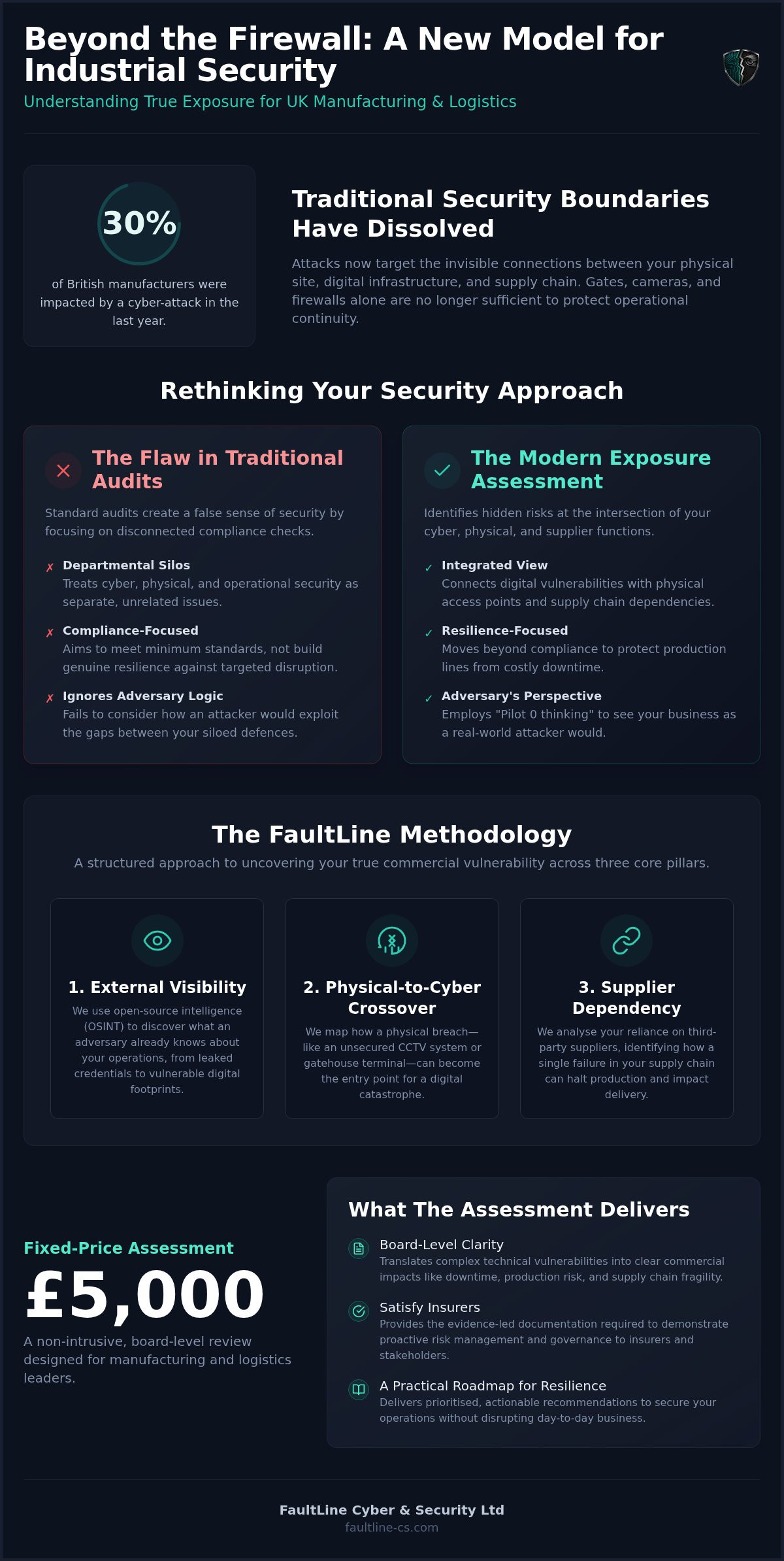
Thirty per cent of British manufacturers were impacted by a cyber-attack in the last year, often through a secondary supplier or a physical security gap they had previously dismissed as minor. For industrial leaders, these figures represent more than just data; they are a clear indication that traditional security boundaries have dissolved. You likely believe that your current gates, cameras, and firewalls provide a sufficient shield against disruption. However, the modern threat landscape targets the invisible connections between your physical site and your digital infrastructure.
This article outlines how to identify the hidden cyber, physical, and supplier risks that threaten operational continuity across the region. By conducting a formal exposure assessment Newry businesses can bridge the gap between technical silos and commercial reality. I will explain how a fixed-price £5,000 assessment provides the board-level clarity required to satisfy insurers and protect production lines. We will move beyond the technical theatre of standard audits to focus on genuine operational resilience and the prioritised actions needed to prevent costly downtime.
Key Takeaways
- Understand why traditional fire and safety audits leave industrial businesses vulnerable to modern threats that exploit the gaps between physical and digital security.
- Recognise the value of a modern exposure assessment Newry leaders can use to map risks across three pillars: external visibility, physical-to-cyber crossover, and supplier dependency.
- Learn why relying on compliance or penetration testing alone creates a false sense of security whilst ignoring the operational logic an adversary might use to disrupt production.
- Discover how a high-quality exposure report translates technical vulnerabilities into clear commercial impacts; such as downtime and supply chain risk; for senior directors.
- Gain strategic clarity through a non-intrusive, fixed-price £5,000 assessment designed to provide a roadmap for resilience without disrupting your daily manufacturing or logistics operations.
Defining Exposure Assessment within Newry’s Industrial Landscape
Security is often treated as a series of disconnected checkboxes. For a logistics manager in Carnbane or a factory owner on the Warrenpoint Road, this usually means separate folders for fire safety, health and safety, and perhaps a basic IT policy. An Exposure assessment challenges this fragmented view. It identifies the hidden risks that exist at the intersection of cyber, physical, and operational functions. In the context of an exposure assessment Newry firms require a shift in perspective; it’s about seeing the business through the eyes of an adversary who doesn’t care about your departmental silos.
This approach is built on “Pilot 0 thinking.” It moves away from internal assumptions and instead evaluates the reality of how your organisation is actually seen from the outside. It’s a strategic wake-up call that prioritises evidence over hope. By mapping how a physical breach can lead to a digital catastrophe, or how a single supplier failure can halt your production, you gain a clear-eyed view of your true commercial vulnerability.
To better understand this concept, watch this helpful video:
The Difference Between Exposure and Traditional Audits
A traditional fire audit is designed to ensure physical safety and regulatory compliance. Whilst essential, it does not address operational survival. You can have a building that is perfectly compliant with fire regulations yet remain entirely exposed to a cyber attack that enters through an unsecured CCTV system or an unmonitored gatehouse terminal. The real incidents often begin in the “gap” between these siloed security departments. The FaultLine £5,000 fixed-price Exposure Assessment is designed to find these gaps before they are exploited. Relying on standard compliance certificates often provides a false sense of security; it proves you’ve met a minimum standard, not that you are resilient against a targeted disruption.
Newry as a Strategic Risk Environment
Newry’s location on the Dublin-Belfast corridor makes it a critical logistics and manufacturing hub. This position brings specific pressures. High volumes of goods and heavy reliance on just-in-time delivery mean that supplier dependency increases your total exposure. Newry’s cross-border trade adds a layer of operational complexity to risk assessments, as businesses must manage differing regulatory expectations and diverse supply chains. Many local firms operate on “operational trust” assumptions that go untested until a crisis occurs. Understanding these dependencies is not a technical task; it is a fundamental requirement for commercial governance and long-term stability.
The FaultLine Methodology: Connecting Cyber, Physical, and Supplier Risks
Resilience is not achieved through isolated security measures. The FaultLine methodology rests on three core pillars: external visibility, physical-to-cyber crossover, and supplier dependency. This structured approach ensures that an exposure assessment Newry organisations undertake is grounded in commercial reality rather than technical theatre. We utilise open-source intelligence (OSINT) to reveal exactly what an adversary already knows about your operations. This includes everything from leaked staff credentials and vulnerable digital footprints to physical entry points that are visible from the public domain. Seeing your business through this lens provides the clarity needed to address systemic gaps before they are exploited.
Our evaluation is anchored by the FaultLine Cyber Readiness Assessment, powered by IntelSensus. This framework provides a data-driven evaluation of your security maturity, moving beyond the generic advice found in typical safety audits. For a fixed price of £5,000, we provide a non-intrusive review that identifies where your business is actually vulnerable. We often find that physical security, such as office access or gatehouse protocols, is the weakest link in a digital defence strategy. If an unauthorised individual can gain physical proximity to a networked device, your firewalls become irrelevant.
Mapping Realistic Attack Pathways
An adversary rarely takes a direct route; they exploit the path of least resistance. Our assessment maps the journey from a simple physical oversight to a full-scale operational shutdown. For instance, an unattended terminal in a Newry distribution centre or an unlocked server room in a manufacturing plant can serve as the primary entry point for a ransomware attack. By understanding how people, systems, and suppliers are exploited in sequence, directors can prioritise actions that offer the highest return on resilience. This methodology follows established principles found in the EPA Guidelines for Exposure Assessment, which emphasise the necessity of a comprehensive understanding of all potential exposure pathways.
Analysing Supplier and Third-Party Dependencies
Your operational continuity is only as strong as your weakest external link. This is why our methodology includes a review of up to five key suppliers to identify vulnerabilities that could halt your production. Many firms rely on contractual assumptions or “trust” that often crumble during a genuine crisis. By modernising your third-party risk management UK strategy, you move from blind faith to evidence-led governance. We identify where your suppliers’ security gaps become your business risks, ensuring you have a clear picture of your total exposure. If you are unsure where your supplier dependencies end and your risks begin, you can speak with our team to start the assessment process.
Why Traditional Audits Fail to Identify the Real Gaps
Compliance is not synonymous with security. Many industrial leaders in Newry operate under the misconception that meeting statutory fire or health and safety regulations provides a sufficient shield against operational disruption. These audits are essential for life safety and regulatory standing, but they are not designed to counter a human adversary. This creates a dangerous environment of “security theatre,” where businesses invest in visible, expensive tools that do not address the actual gaps in their operational logic. The sober reality is that many firms remain unaware of their true vulnerabilities until an incident forces a shutdown.
Penetration testing is often viewed as a silver bullet, yet it is frequently a wasted investment when conducted in a vacuum. A technical test might confirm that your software is patched, but it ignores the broader context of how your business functions. It won’t reveal that a delivery driver has unauthorised access to a sensitive terminal or that a disgruntled former employee still has active credentials. To be effective, an exposure assessment Newry businesses undertake must look beyond the digital perimeter. It must evaluate how physical oversights and digital weaknesses combine to create an open door for attackers.
The Limitation of Siloed Security Thinking
Internal silos are an attacker’s greatest asset. When physical security and IT departments operate with separate budgets and reporting lines, they create a “no-man’s land” that is easily exploited. A physical breach at a site gatehouse can quickly escalate into a full-scale ransomware event if the crossover risks are not understood. Directors need a single, unified picture of risk to make informed decisions. FaultLine acts as a strategic guide in this process, bridging these internal gaps through our £5,000 fixed-price assessment to provide a cohesive view of commercial exposure rather than a collection of disparate, technical reports.
Evidence Over Assumptions in Risk Management
The “it won’t happen here” mentality is a significant hurdle for many family-run Newry firms. There is often a misplaced sense of “operational trust” in long-term third-party service providers or internal systems that have never been rigorously tested. As Cris Martlew often advocates, effective risk management must be built on verifiability and factual accuracy rather than historical assumptions. If you cannot prove a control is working, you must assume it is failing. Transitioning from trust-based security to an evidence-led model is the only way to ensure long-term resilience in an increasingly complex industrial landscape.
Data without context is merely noise. For a director in a Newry logistics hub, a report filled with technical jargon is useless. A high-quality exposure assessment Newry leaders receive must be commercially focused and written in plain English. It must answer the “so what?” by explicitly linking vulnerabilities to production risk and potential downtime. Instead of a generic list of technical fixes, it provides a realistic attack-path narrative that illustrates how an adversary could move from a public signal to a core operational shutdown. This narrative approach helps leadership understand the sequence of events that leads to failure, making the risk tangible rather than abstract.
The FaultLine Exposure Assessment, delivered for a fixed price of £5,000, focuses on actionable insight. It provides prioritised actions based on the severity of the commercial impact rather than the technical complexity of the fix. This allows leadership to see the “visible exposure signals” that an attacker would use to target their specific site or supply chain. These signals often include leaked credentials or unsecured physical access points that traditional IT audits overlook. By identifying these early, you can close the gaps before they are discovered by external threats.
Translating Technical Risk into Business Decisions
Effective governance requires clarity. This report allows directors to allocate their limited security budgets where they will have the most significant impact on operational resilience. By understanding the intersection of physical and digital gaps, leadership can move away from reactive spending. This level of oversight is a core component of board-level responsibility, as detailed in our strategic guide for UK leadership. It ensures that security is treated as a business enabler rather than a technical burden.
Preparing for Compliance and Insurance Requirements
Evidence is the currency of modern risk management. An exposure assessment serves as a critical foundation for those seeking ISO/IEC 27001:2022 certification or Cyber Essentials Plus readiness. As of April 2026, the Cyber Essentials scheme (version 3.3) has introduced stricter requirements around multi-factor authentication and patch management. Having a detailed exposure report allows you to answer insurer questionnaires with confidence and provides documented proof of security maturity. This evidence model supports “working towards ISO alignment” statements, which are increasingly demanded by partners in the Newry industrial sector who require proof of resilience from their suppliers.
Actionable intelligence is often the missing component in industrial risk management. The FaultLine Exposure Assessment is delivered as a fixed-price entry service at £5,000, specifically designed for the manufacturing and logistics firms that define the Newry economy. This is a non-intrusive, research-led process that requires no software installation and causes zero disruption to your daily operations. By focusing on the intersection of physical and digital gaps, we provide a roadmap that traditional audits simply cannot match. We operate from the perspective of an external adversary, identifying the signals and pathways that are already visible to those who would do your business harm.
Our role is to act as a strategic sentinel rather than a distant service provider. When an exposure assessment Newry identifies deep technical vulnerabilities that require remediation, we collaborate with a network of trusted specialists. This partnership model ensures you receive the highest level of expertise for specific fixes, whilst FaultLine remains your steady hand for governance and strategic alignment. We provide the clarity you need to move from reactive patching to proactive resilience, ensuring your security investment is always tied to a commercial outcome.
The Value of a Fixed-Price Entry Point
Transparency is a core pillar of our engagement model. Many providers offer “free quotes” that frequently result in open-ended consultancy fees or the recommendation of unnecessary products. By setting a fixed price of £5,000, we provide Newry directors with total commercial clarity from the outset. The typical timeline from initial engagement to the delivery of your board-level report is approximately two to three weeks. This structured approach allows you to identify and stop wasted spend on irrelevant security tools that fail to address your actual vulnerabilities.
Taking the First Step Toward Operational Resilience
A frantic emergency response is the most expensive way to manage risk. A controlled wake-up call is always preferable to a crisis that halts production or compromises your supply chain. We invite Newry business owners to contact Cris Martlew or Paddy Hearty for a pragmatic, board-level discussion about their current risk profile. Our goal is to move your organisation from a position of misplaced trust to one of verified resilience. You can explore our full range of security and resilience services
Prioritising Resilience Over Compliance
Operational resilience is not a byproduct of standard safety compliance. It is a deliberate strategic choice. By integrating physical security, digital infrastructure, and supplier risk into a single, unified view, you move from reactive patching to proactive governance. An exposure assessment Newry businesses can rely on provides the evidence needed to satisfy stakeholders and secure production lines against unforeseen disruption.
The FaultLine methodology offers a fixed-price £5,000 entry point designed for the specific needs of Northern Ireland’s industrial and logistics corridor. You receive board-level, plain-English reporting that prioritises commercial outcomes over technical theatre. This NI-based expertise ensures your firm is prepared for the reality of modern threats rather than just the requirements of a checklist. Identifying your hidden gaps today prevents the frantic emergency responses of tomorrow. It’s time to replace assumptions with verifiability.
Taking this step ensures your organisation remains a steady hand in a complex environment, providing the clarity required for long-term stability.
Frequently Asked Questions
What is the difference between a cyber audit and an exposure assessment in Newry?
A cyber audit typically reviews internal controls against a specific checklist to ensure compliance. In contrast, an exposure assessment Newry firms utilise looks at the business from an adversary’s perspective. It identifies the hidden gaps between physical security, digital systems, and supplier dependencies. While an audit confirms you’ve met a standard, this assessment reveals the commercial reality of how a breach could actually occur.
How much does a professional exposure assessment cost for a Northern Ireland business?
A professional assessment from FaultLine is provided for a fixed price of £5,000. This transparent pricing model is specifically designed to give Northern Ireland businesses commercial certainty without the risk of hidden consultancy fees. It serves as a strategic entry point for leadership to understand their true risk profile before committing to more expensive or intrusive technical remediation projects that might not address the root cause.
Does an exposure assessment involve penetration testing or hacking our systems?
No, this process does not involve intrusive penetration testing or hacking into your live systems. It is a research-led, non-intrusive evaluation of your external visibility and operational logic. We use open-source intelligence and data-driven frameworks to identify vulnerabilities that are already visible to the public. This approach ensures there is zero disruption to your daily manufacturing or logistics operations whilst providing deep insight.
Why should a manufacturing firm in Newry care about supplier dependency risks?
Manufacturing firms rely on just-in-time delivery and complex supply chains where a single failure can halt production. If a key supplier suffers a cyber incident or a physical disruption, your own operational continuity is immediately at risk. Understanding these third-party dependencies allows you to move beyond contractual trust. It helps you build a resilience strategy based on verified evidence rather than misplaced assumptions.
Can an exposure assessment help us prepare for ISO 27001 certification?
Yes, it provides a foundational evidence base for ISO/IEC 27001:2022 readiness. The current standard requires organisations to identify and manage risks across their entire operational environment. By documenting your exposure signals and attack pathways, you create the board-level reporting and risk treatment plans necessary for certification. It demonstrates a high level of security maturity to auditors, stakeholders, and potential commercial partners.
How long does it take to complete the FaultLine Exposure Assessment?
The FaultLine Exposure Assessment is typically completed within two to three weeks from the initial engagement. This timeline includes the research phase, the evaluation of up to five key suppliers, and the final delivery of a board-level, plain-English report. It’s a methodical process designed to be efficient whilst providing the depth of insight required for informed commercial decision-making by directors and operational leaders.
Will this assessment satisfy our cyber insurance provider’s requirements?
It provides the data-driven evidence that insurers increasingly demand during renewal processes. As of 2026, many providers require proof of multi-factor authentication and proactive risk management before offering coverage. The report acts as a professional record of your security maturity. This helps you answer insurer questionnaires accurately and provides the verifiability needed to potentially influence the terms of your operational resilience cover.
Do we need to be a large corporation to benefit from an exposure assessment?
No, SMEs and family-run firms often have the highest exposure because they lack the siloed security departments of larger corporations. Small businesses are frequently targeted as entry points into larger supply chains. An exposure assessment Newry SMEs undertake ensures they aren’t the weak link that leads to a systemic failure. This protects both their own operations and their vital partnerships with larger industrial clients.

Article by
Alex J Morgan
Alex Morgan writes and develops content for FaultLine Cyber & Security Ltd. Alex has worked across web development, organic SEO, digital marketing and content creation since 2009, with a particular focus on making complex subjects clear, useful and easy to navigate.
Leave a Reply