


Most security audits are obsolete the moment the ink dries on the report. For UK directors, relying on a once-a-year snapshot of digital health is no longer a defensible strategy when vulnerability exploitation now accounts for 31 per cent of initial access in breaches. Adopting a framework for continuous threat exposure management UK is not merely a technical upgrade; it’s a necessary shift in corporate governance. This approach moves away from the theatre of periodic compliance and focuses instead on the actual operational risks that threaten production lines and supply chain integrity.
You likely feel the frustration of increasing security budgets that fail to provide a clear picture of your resilience or satisfy the growing demands of insurers and regulators. This article provides a pragmatic guide to bridging that gap, moving beyond opaque technical reporting toward a board-level understanding of systemic risk. We will explore how to map the overlap between cyber, physical, and supplier vulnerabilities to ensure your investments are prioritised by evidence rather than assumption. By the end, you’ll have a clear map for moving from a reactive posture to a state of demonstrable, active accountability.
Key Takeaways
- Recognise why annual audits are insufficient and how a framework for continuous threat exposure management UK provides a more resilient approach to corporate governance.
- Understand the five pillars of scoping, discovery, prioritisation, validation, and mobilisation as a structured way to manage operational risk.
- Move beyond simple patch management to focus on evidence-led prioritisation that protects production lines and critical logistics.
- Gain insights into managing the intersection of legacy systems and supply chain vulnerabilities under new UK regulations.
- Discover how to achieve immediate board-level clarity on systemic gaps through a fixed-price assessment focused on commercial exposure.
Beyond the Security Snapshot: Why UK Organisations are Shifting to CTEM
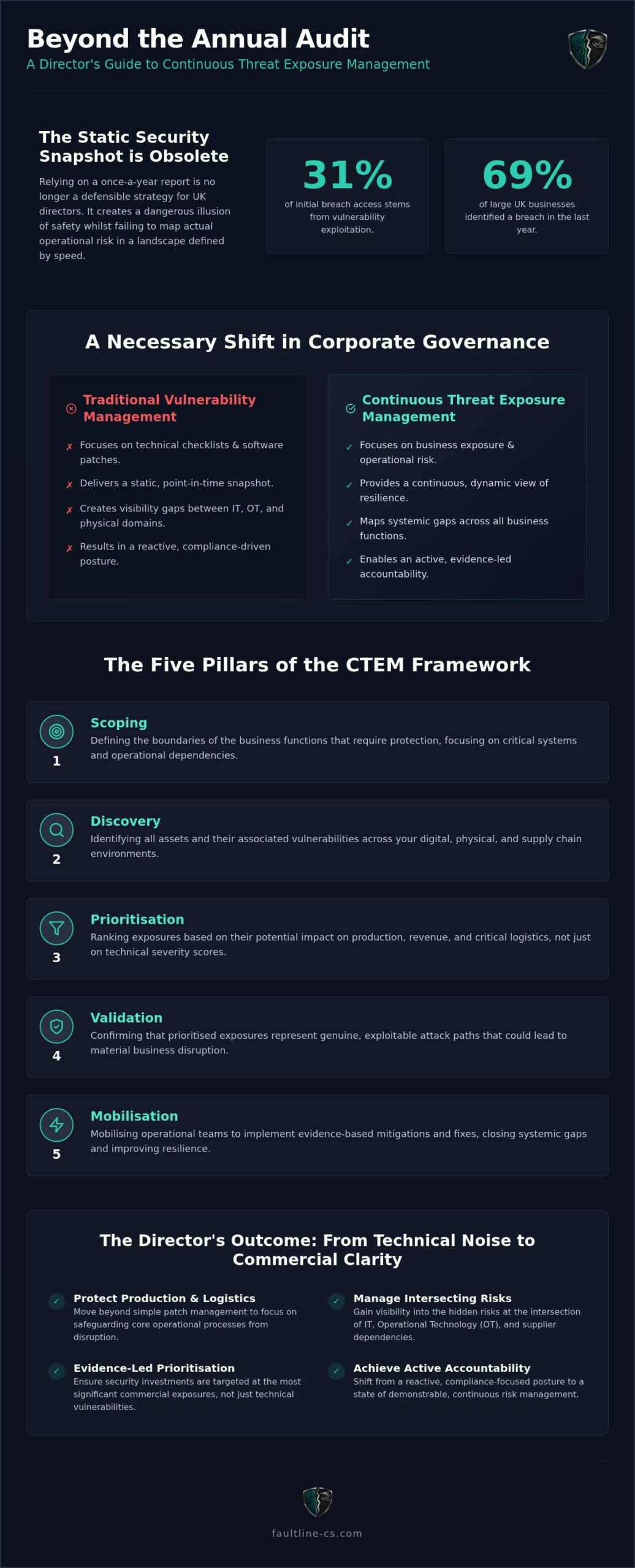
Point-in-time security assessments have become a commercial liability. In an environment where 69 per cent of large UK businesses identified a breach in the last year, relying on a static annual report is no longer a defensible strategy for directors. The 2026 threat landscape is defined by speed; vulnerability exploitation now accounts for 31 per cent of initial access routes. This shift has forced a move toward Continuous Threat Exposure Management (CTEM), a proactive framework designed to align security efforts with actual business risk rather than technical checklists.
To better understand how this framework functions in practice, watch this helpful video:
Traditional vulnerability management focuses almost exclusively on software patches. Whilst important, this narrow focus ignores the broader concept of business exposure. A server might be unpatched, but if it’s isolated from critical production lines, the risk is lower than a “perfectly” patched system that provides a single point of failure for your entire logistics chain. The FaultLine philosophy is built on the reality that real risk lives in the gaps between business functions, specifically where IT, physical security, and operational technology (OT) intersect. Managing this requires a strategic guide, not just another piece of software.
The Limitations of Traditional Penetration Testing
A clean penetration test report often creates a dangerous illusion of safety. These tests are snapshots; they reflect a single moment in time under specific, often limited, conditions. For directors in the manufacturing and logistics sectors, these reports fail to account for the fluid nature of modern operations. They don’t show how an attacker might move from a supplier’s compromised portal into your warehouse management system. Implementing continuous threat exposure management UK allows leadership to see a realistic, unfolding narrative of how their business is actually targeted, providing the evidence needed for meaningful prioritisation.
Managing the Visibility Gap in 2026
The core challenge for senior leadership has shifted from identifying what is vulnerable to understanding what is truly exposed. High-risk hidden cyber risks organisation-wide often stem from simple operational assumptions rather than complex technical flaws. A door left propped open in a loading bay or an overlooked legacy terminal in a regional office can be the catalyst for a systemic failure. CTEM closes this visibility gap by treating security as a continuous management discipline. It ensures that the board isn’t just looking at a list of technical bugs, but at a map of operational dependencies and systemic gaps that require strategic resolution.
The Five Pillars of a Continuous Threat Exposure Management Framework
Implementing a framework for continuous threat exposure management UK ensures that directors make decisions based on evidence rather than technical theatre. CTEM isn’t a linear project with a defined end date; it’s a recurring cycle designed to keep pace with operational reality. This approach to proactive security shifts the focus from merely identifying bugs to managing the systemic gaps that threaten business continuity. The framework is built on five core pillars:
- Scoping: Defining the boundaries of the business functions that require protection.
- Discovery: Identifying assets and their associated vulnerabilities across digital and physical environments.
- Prioritisation: Ranking exposures based on their potential impact on production and revenue.
- Validation: Confirming whether an identified exposure can actually be exploited by an attacker.
- Mobilisation: Ensuring that the organisation is prepared to act on the findings to reduce risk.
Scoping and Discovery: Defining the Operational Attack Surface
Scoping is frequently where traditional security programmes fail. They often start and end with a list of IP addresses provided by the IT department. For a director in manufacturing or logistics, this narrow view is insufficient. Effective scoping must involve operational leaders who understand which assets actually drive revenue. If a third-party maintenance contractor has remote access to a warehouse management system, that connection is part of your attack surface. Discovery must go beyond software to include physical access points and supplier dependencies. You cannot protect what you haven’t identified, and you cannot identify what matters without a clear understanding of your operational logic. If you’re unsure where your current scoping ends, it’s often helpful to discuss your operational environment with a strategic advisor.
Prioritisation and Validation: Proving What Matters
The prioritisation phase is designed to separate technical noise from genuine business risk. A standard vulnerability scan might return thousands of “critical” alerts, but many of these may have no viable attack path to your core operations. This is where “Pilot 0 thinking” becomes essential. It focuses on validating exposures by testing how an attacker would actually behave within your specific environment. Validation proves which risks require immediate investment by demonstrating their potential to cause downtime or data loss. Instead of chasing every theoretical threat, you focus your resources on the exposures that have been proven to matter. This evidence-led approach satisfies both internal governance requirements and the increasing scrutiny from insurers who demand proof of active risk management.
Evaluating CTEM Against Traditional Vulnerability Management
Traditional vulnerability management is a race you cannot win. It treats every security flaw as a priority, leading to wasted spend on technical theatre that doesn’t actually prevent downtime. In contrast, continuous threat exposure management UK focuses on the commercial consequences of a breach. As noted in IBM’s guide to CTEM, the shift is from a reactive “patch everything” mindset to a strategic “protect what matters” approach. This is particularly cost-effective for UK manufacturers with complex supply chains where technical vulnerabilities are inevitable but business exposure can be managed through visibility and logic.
Vulnerability Management vs Exposure Management
Vulnerability management focuses on the technical “hole” in the fence. CTEM focuses on the “path” the intruder takes once they are through it. Fixing every bug discovered by a scanner is a commercially flawed strategy that drains resources without necessarily improving resilience. It’s an impossible task that creates friction between IT and operational teams. Since vulnerability exploitation now accounts for 31 per cent of initial access routes, directors must ensure their security spend is evidence-led. This approach moves the organisation from technical remediation to strategic business mobilisation, where response is dictated by the potential impact on production lines and revenue.
The Role of Attack Surface Management in the UK
Effective exposure management requires a deep understanding of attack surface management UK wide. This involves mapping your organisation’s visibility from an attacker’s perspective, including overlooked digital assets, physical access points, and supplier dependencies. Continuous monitoring reduces attacker dwell time by identifying these gaps before they can be exploited. For directors, the “so what” is clear: this proactive stance satisfies the increasingly stringent requirements of cyber insurers and regulators. In an era of active accountability, insurers are less interested in your patch list and more interested in how you manage your actual business exposure. This shift ensures that security is treated as a core management discipline rather than an IT problem.
Implementing CTEM within UK Manufacturing and Logistics
Manufacturing and logistics present a unique challenge for continuous threat exposure management UK because they often rely on legacy systems that cannot be easily updated without risking production downtime. In these environments, security is not just about digital assets; it’s about physical operational resilience and “Pilot 0 thinking”. The Cyber Security and Resilience Bill, introduced to Parliament in November 2025, reinforces this by bringing UK infrastructure into closer alignment with NIS2 requirements. For directors, this means moving beyond the basic requirements of Cyber Essentials Plus, such as mandatory MFA and 14-day patching, toward a model that accounts for the specific risks of industrial control systems and warehouse automation.
Bridging the Operational Gap: Cyber and Physical Security
Physical security is often managed in a silo, yet it represents a significant digital vulnerability. A compromised gate system, CCTV network, or even a simple loading bay terminal can serve as a bridge for an attacker to enter your core production network. This is the “physical-to-cyber” crossover that traditional audits frequently miss. By treating physical access as a component of your attack surface, you gain a physical security cyber risk perspective that is grounded in operational logic rather than technical theatre. The 2025 Terrorism (Protection of Premises) Act, known as Martyn’s Law, further reinforces the need for this convergence by mandating specific physical security measures that are increasingly reliant on digital communication and access control systems. A breach of a perimeter sensor is not just a facilities issue; it is a potential entry point for ransomware.
Supply Chain Resilience and Supplier Dependency
The 2026 Verizon DBIR noted that third-party involvement was a factor in 48 per cent of breaches, representing a 60 per cent increase year-on-year. Despite this, the 2025/2026 Cyber Security Breaches Survey indicates that only 15 per cent of UK businesses have reviewed the cyber risks from their immediate suppliers. A survey by MakeUK in August 2026 found that 30 per cent of British manufacturers had experienced a cyber incident in the past 12 months, often via their supply chain. CTEM addresses this by including supplier dependencies in the initial scoping phase, focusing specifically on the top five partners that are critical to your daily operations. This moves the organisation away from checking boxes on a questionnaire and toward a real understanding of how a supplier’s failure could halt your production lines. Aligning your strategy with the broader third-party risk management UK pillar ensures that your resilience is not undermined by external systemic gaps.
Strategic Exposure Management: Bridging the Operational Gap with FaultLine
Managing business risk requires a steady hand and a clear-eyed perspective on reality. FaultLine Cyber & Security Ltd provides this clarity through a structured approach to continuous threat exposure management UK, moving beyond technical theatre to address the systemic gaps where risk actually lives. Our flagship Exposure Assessment is designed as a pragmatic entry point for directors who need board-level insight without the noise of traditional security reporting. At a fixed price of £5,000, it delivers a strategic wake-up call that connects cyber, physical, and governance risks into a single, actionable picture.
The Exposure Assessment: High Impact, Fixed Price
Clarity shouldn’t be cost-prohibitive or operationally disruptive. Unlike traditional penetration testing, which often focuses on technical vulnerabilities in isolation, our Exposure Assessment provides a narrative of how an attacker might navigate your specific operational environment. You receive a prioritised list of actions based on evidence rather than assumptions. This assessment identifies the 5 per cent of exposures that represent 90 per cent of your business risk, serving as the essential foundation for a long-term ISO/IEC 27001 programme. It’s a non-disruptive process that respects the sensitivity of manufacturing and logistics operations, ensuring your production lines remain stable whilst your resilience is strengthened.
Advancing Maturity with the Cyber Readiness Assessment
Resilience is a journey of continuous improvement rather than a one-off achievement. For organisations looking to quantify their security posture against industry benchmarks, our FaultLine Cyber Readiness Assessment, powered by IntelSensus, offers a path to maturity. It translates complex technical data into the language of corporate governance, allowing directors to make informed decisions about investment and accountability. By focusing on “Pilot 0 thinking”, we help you move away from reactive firefighting toward a proactive stance that satisfies regulators and insurers alike. The real risk to your organisation lives in the gap between systems, departments, and suppliers. Closing that gap is the only way to ensure long-term operational resilience.
Securing the Operational Future
Directors can no longer afford to treat security as a periodic IT exercise. The transition to continuous threat exposure management UK represents a fundamental shift in how manufacturing and logistics firms protect their core operations. By moving beyond static audits, leadership gains the visibility needed to manage the systemic gaps where cyber and physical risks intersect. This evidence-led approach ensures that capital is deployed where it actually reduces exposure rather than simply ticking boxes on a technical checklist.
FaultLine provides the strategic guidance required to navigate this complexity. Our fixed-price Exposure Assessment offers a controlled entry point for £5,000, delivering board-level reporting in plain English that focuses on production risk and supply chain resilience. It’s time to stop reacting to alerts and start managing your actual business risk with a steady, expert hand. Building long-term resilience begins with a clear-eyed understanding of where your vulnerabilities truly lie.
Frequently Asked Questions
What is the main difference between CTEM and a standard vulnerability scan?
A standard vulnerability scan identifies technical bugs at a single moment in time. In contrast, continuous threat exposure management UK is a recurring cycle that prioritises risks based on their potential impact on business continuity. Whilst a scan produces a list of unpatched software, CTEM identifies the specific attack paths that could lead to production downtime. It moves the focus from technical remediation to strategic mobilisation, ensuring resources protect critical revenue-generating assets.
How does Continuous Threat Exposure Management help with UK NIS2 compliance?
The UK’s Cyber Security and Resilience Bill, introduced in November 2025, requires organisations to demonstrate active accountability and resilience. CTEM supports this by providing continuous visibility into operational risks rather than relying on annual snapshots. By implementing this framework, directors gain the evidence-led reporting necessary to satisfy regulators and insurers. It ensures that security measures are not just theoretical but are validated against the real-world threats targeting critical national infrastructure and its supply chains.
Why is CTEM particularly important for the manufacturing and logistics sectors?
Manufacturing and logistics sectors are uniquely vulnerable due to their reliance on interconnected legacy systems and complex supply chains. A single compromised terminal in a regional warehouse can lead to systemic production cuts or delivery delays. CTEM identifies these hidden dependencies by mapping the intersection of IT, physical security, and operational technology. This approach is essential for preventing the 30 per cent of British manufacturers who experienced incidents in 2026 from suffering further operational downtime.
Can CTEM replace our annual penetration testing requirement?
CTEM does not replace the requirement for penetration testing but rather transforms how those tests are conducted and utilised. Instead of a generic annual audit, CTEM provides the attack-path narratives that make technical testing more targeted and commercially relevant. It ensures that penetration tests focus on the assets most critical to your operations. This continuous approach provides a more defensible position for governance, as it bridges the gaps that appear between traditional point-in-time assessments.
How much does a typical exposure management assessment cost for a UK SME?
Professional exposure assessments vary in cost depending on the scope and complexity of the organisation. At FaultLine, we offer a flagship Exposure Assessment at a fixed price of £5,000 to provide a low-friction entry point for UK directors. This service is designed to deliver immediate board-level clarity on systemic gaps without the need for expensive software or disruptive testing. It provides a pragmatic foundation for building long-term resilience through a structured, evidence-led programme.
What is the role of the board in a Continuous Threat Exposure Management programme?
The board’s role is to define the operational scope and take accountability for the mobilisation of resources. Under the updated regulatory landscape, directors are increasingly responsible for overseeing security measures and ensuring they align with business risk. A continuous threat exposure management UK programme provides leadership with plain-English reporting to facilitate these decisions. Boards must move beyond passive oversight and actively use exposure data to prioritise security investments that protect the organisation’s commercial viability.
How does CTEM address physical security risks in an organisation?
CTEM treats physical security as a critical component of the digital attack surface. For example, a compromised loading bay terminal or a faulty perimeter sensor can serve as an entry point for cyber intruders. By integrating physical vulnerabilities into the discovery phase, the framework identifies risks that traditional IT audits overlook. This alignment is particularly relevant following the 2025 Royal Assent of Martyn’s Law, which mandates physical security measures that are increasingly reliant on digital infrastructure.
How long does it take to implement a basic CTEM framework?
Establishing the initial foundations of a CTEM framework can be achieved within a few weeks through a targeted assessment. However, the full cycle of scoping, discovery, and mobilisation is an ongoing management discipline rather than a one-off project. Most organisations find that they can achieve significant visibility into their primary exposures within the first 30 days. The focus is on rapid, evidence-led prioritisation that allows for immediate risk reduction whilst building a sustainable model for long-term operational resilience.

Article by
Alex J Morgan
Alex Morgan writes and develops content for FaultLine Cyber & Security Ltd. Alex has worked across web development, organic SEO, digital marketing and content creation since 2009, with a particular focus on making complex subjects clear, useful and easy to navigate.
Leave a Reply