


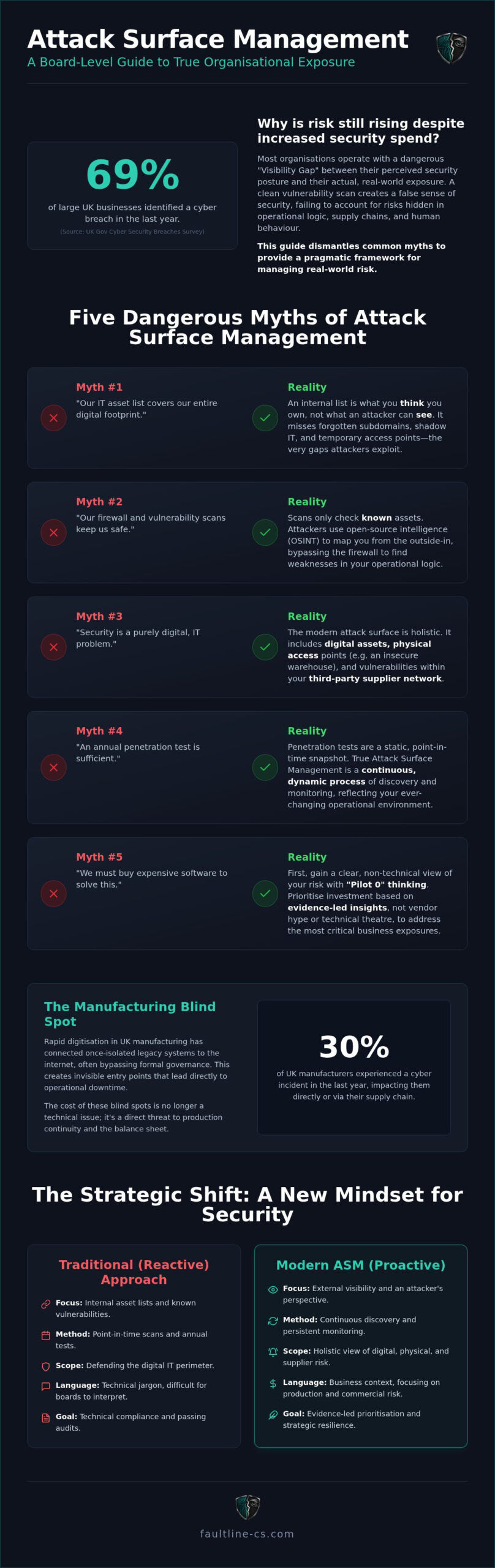
If you believe a clean vulnerability scan equates to a secure business, you are operating on a dangerous assumption. Most directors are rightly exhausted by technical jargon that fails to explain why, despite rising budgets, the risk of operational downtime remains. You’ve likely seen the data: 69% of large UK businesses identified a breach in the last year. It’s clear that standard approaches to attack surface management UK are failing to account for the real-world complexities of the supply chain and human behaviour.
It’s frustrating to authorise significant security spend only to feel you’re still blind to your organisation’s true exposure. This article provides a clear, non-technical roadmap for moving beyond superficial scans to identify hidden vulnerabilities in your operational logic. We will dismantle five common boardroom myths that lead to wasted investment and misplaced confidence. By the end, you’ll have a pragmatic framework to prioritise your security efforts based on evidence rather than technical theatre.
Key Takeaways
- Understand why an internal IT asset list rarely reflects your true exposure and how rapid digitisation creates invisible gaps in production environments.
- Learn to look beyond the firewall by integrating digital assets, physical security, and supplier risks into a unified strategy for attack surface management UK.
- Discover why annual penetration tests and standard scans fail to capture the dynamic nature of modern cyber threats and operational logic.
- Identify the “Pilot 0” steps required to gain a clear, non-technical view of organisational risk before committing to expensive software tools.
- Gain the confidence to prioritise security investment based on evidence-led insights rather than technical theatre or industry hype.
Beyond the Firewall: Why UK Organisations Lose Sight of Their Attack Surface
An asset list is not a security strategy. It’s a ledger of what you think you own, not what an attacker can see. In the context of attack surface management UK, this distinction is where resilience begins or fails. Many organisations rely on internal databases that are chronically out of date. This creates a “Visibility Gap” between the IT department’s map and the actual digital footprint of the business.
Rapid digitisation in UK manufacturing has accelerated this problem. Legacy systems, once isolated, are now connected to facilitate real-time data flow. This connectivity often bypasses formal governance, creating invisible entry points that lead to unexpected production downtime. According to research, 30% of UK manufacturers experienced a cyber incident within the last year, affecting them directly or through their supply chain. The cost of these blind spots is no longer a technical concern; it’s a direct threat to the balance sheet.
The Reality of Modern Operational Exposure
Shadow IT is no longer just about unsanctioned cloud applications. It includes forgotten subdomains, abandoned marketing microsites, and remote access points set up for temporary contractor use that were never decommissioned. These are not just technical oversights. They are systemic gaps in governance that provide a path of least resistance for an adversary. Standard security reports often focus on patch levels and firewall logs, failing to reach the boardroom because they lack commercial context. Directors need to understand how these exposures translate into production risk and supplier dependency. To move from reactive firefighting to a strategic stance, leaders must look at their Exposure Assessment options to bridge this gap.
Why Traditional Vulnerability Scans Are Not Enough
Traditional scans are inherently limited. They only check “known” assets that have already been identified and added to a list. Attackers do not follow your inventory. They use open-source intelligence (OSINT) to map your organisation from the outside in. This mirrors the behaviour of a sophisticated adversary who looks for the weakest link in your operational logic rather than the strongest part of your firewall. Relying on an internal list is like checking the front door whilst leaving the warehouse windows open. A realistic view of exposure requires an objective assessment of what is visible to the world, not just what is recorded in your internal systems.
Defining Attack Surface Management (ASM) for the Modern Enterprise
Attack surface management is the continuous process of identifying, monitoring, and reducing the total risk profile of an organisation. It’s often misunderstood as a digital-only exercise. In reality, effective attack surface management UK requires a holistic view that bridges the gap between technical infrastructure and operational reality. Unlike traditional penetration testing, which provides a point-in-time snapshot, ASM is a persistent effort. It moves beyond simply patching known servers to understanding the entire ecosystem that an adversary sees. Whilst vulnerability management focuses on the “what,” ASM focuses on the “how” an attacker might gain entry.
This approach is essential because the perimeter has effectively vanished. Security is no longer about defending a single point; it’s about managing a sprawling network of dependencies. True ASM requires a shift in mindset from internal compliance to external visibility. It demands that leadership looks at the business through the eyes of a motivated threat actor who prioritises logic gaps over technical strength. For directors seeking to embed this thinking into corporate governance, understanding continuous threat exposure management UK frameworks provides the strategic foundation needed to move beyond periodic compliance toward persistent operational resilience.
Digital Assets and Shadow IT
Forgotten assets are a primary target for modern adversaries. Rapid expansion into cloud environments often leaves a trail of abandoned instances, unmonitored subdomains, and expired security certificates. These are not just technical debt; they are open invitations. With a distributed workforce, the sprawl of internet-facing services has increased significantly. Managing this footprint requires moving away from static asset registers toward dynamic discovery. If you can’t see an asset, you can’t secure it. This visibility is the foundation of any Exposure Assessment designed to protect production continuity.
The Physical and Supplier Connection
Security does not end at the digital perimeter. Physical access points and third-party dependencies are frequently overlooked components of the attack surface. An insecure warehouse door or a supplier with unmonitored network access can be the catalyst for a total system compromise. The 2026 data shows that supply chain compromises are the costliest breach factor for UK firms, adding an average of £241,620 to the total cost of a data breach. This is where “operational trust” often fails. Organisations assume their partners are secure without verifying the evidence. True resilience comes from scrutinising these connections with the same rigour applied to internal firewalls. If you are concerned about your current visibility, you can speak with our consultants to understand your true exposure.
5 Dangerous Myths About Attack Surface Management in the UK
Assumptions at the board level often lead to a false sense of security. When leadership relies on outdated perspectives, they inadvertently create gaps that attackers are quick to exploit. Building true resilience requires us to dismantle the myths that cloud strategic decision making regarding attack surface management UK. These misconceptions often stem from a focus on compliance rather than reality.
- Myth 1: If an asset is not on our IT list, it is not a risk. An inventory is a record of what you manage; the attack surface is a map of what is visible. If a marketing team launches a microsite or a technician connects a legacy machine to the network without formal approval, that asset becomes an unmonitored entry point.
- Myth 2: Annual penetration testing provides a complete security picture. Testing is a snapshot. It validates a specific path at a specific moment but fails to account for the changes that occur every day between tests.
- Myth 3: ASM is purely a digital concern. Physical access and social engineering are part of the surface. A compromised badge reader or an unsecured warehouse gate is just as dangerous as a weak firewall.
- Myth 4: Investing in more security tools automatically reduces exposure. Tool sprawl creates complexity. Without a clear Exposure Assessment to guide investment, organisations often buy software that overlaps or leaves critical gaps untouched.
- Myth 5: Our suppliers are responsible for their own security risks. If a supplier’s breach causes your production line to stop, the risk is yours. You cannot outsource the impact of downtime.
Busting the Penetration Testing Fallacy
A clean penetration test report is often treated as a “pass” for the year. This is a dangerous misunderstanding of how modern threats evolve. Penetration testing is essentially testing the front door. It doesn’t find the window left open by a contractor or the forgotten subdomain created for a trade show. Attackers operate continuously, exploiting the gaps between scheduled testing windows. Relying solely on annual tests leaves your organisation vulnerable for the remaining 364 days of the year. Effective attack surface management UK demands a move toward continuous monitoring and real-world visibility. Directors looking to understand how to operationalise this shift should explore the principles of continuous threat exposure management UK as a governance-level response to the limitations of point-in-time testing.
The Supplier Dependency Trap
Supply chain security is no longer a peripheral issue. In 2026, a compromise originating in the supply chain is the costliest single factor for UK organisations, adding an average of £241,620 to the total cost of a data breach. Many leaders assume that because a partner is a large firm, their security is robust. However, 30% of UK manufacturers have been affected by incidents through their supply chain in the last year. Effective management requires verifying supplier security through evidence rather than assumptions, ensuring that your operational trust is backed by reality.
How to Identify Hidden Cyber Risks Within Your Organisation
Discovery is the foundation of risk mitigation. To manage what you cannot see is impossible. Effective attack surface management UK requires an objective audit of every signal your organisation emits to the public web. This process involves more than just listing servers. It requires a systematic deconstruction of your external visibility, physical access points, and the security maturity of your critical partners. By looking at the business from the outside in, you can identify the paths of least resistance that an adversary would prioritise.
The Importance of OSINT and External Visibility
Attackers begin their reconnaissance long before they attempt to breach your network. They use open-source intelligence (OSINT) to map your digital footprint as it appears to the outside world. This includes searching for leaked credentials, exposed identity signals, and abandoned subdomains that have fallen out of governance. By monitoring these external indicators, you can predict where an incident is likely to start. If an adversary can find a path to your data using only public information, your internal defences are already bypassed. Visibility is the only way to close these gaps before they are exploited.
Bridging the Gap Between IT and Operations
Data without context is merely noise. Directors don’t need a list of vulnerabilities; they need to understand the commercial impact of those risks. When presented with technical findings, leadership must ask “so what?” to ensure the focus remains on business outcomes. A vulnerability in a legacy system is a technical detail. That same vulnerability leading to three days of production downtime is a strategic crisis. Translating technical data into realistic attack-path narratives allows the board to prioritise security spend based on evidence rather than fear.
Mapping the intersection of physical and digital infrastructure is equally critical. A compromised warehouse badge reader or an unsecured site office can provide the initial access point for a catastrophic cyber event. True resilience is built when IT and operational leaders work together to verify every assumption. This culture of evidence-led security ensures that your investment is targeted where it will have the greatest impact on operational continuity. By moving away from technical theatre and toward a strategic understanding of attack surface management UK, organisations can gain a realistic view of their true risk profile.
Closing the Gap: The Strategic Value of a FaultLine Exposure Assessment
Security investment is often driven by a desire for compliance rather than a demand for clarity. This reactive approach leads to a fragmented architecture of tools that fail to stop actual incidents. At FaultLine, we focus on the “gap” where technical systems meet human behaviour and operational logic. Our approach to attack surface management UK is designed to provide a strategic wake-up call for leadership, moving beyond the superficiality of automated scans to reveal true organisational exposure.
We believe that security should be a partner to production, not a drain on resources. By revealing the hidden risks where business functions overlap, we provide a steady hand for directors who are tired of technical theatre. Our findings don’t hide behind jargon; they offer a clear-eyed perspective on reality that allows you to prioritise spend based on evidence rather than assumptions.
A Fixed-Price Entry Point for Real Clarity
Clarity shouldn’t be a luxury. We provide a fixed-price Exposure Assessment at £5,000 to give UK organisations a realistic baseline of their risk profile. This isn’t a generic vulnerability scan. It maps realistic attack paths that cut across cyber, physical, and supplier domains to show exactly how a breach could impact your operations. This assessment is a critical step for firms navigating the transition to ISO/IEC 27001:2022 or preparing for the stricter requirements of Cyber Essentials Plus. By identifying what is actually visible to an attacker, we help you avoid wasted spend on security tools that don’t address your specific systemic gaps.
Building Long-Term Operational Resilience
True resilience requires a move away from the “box-ticking” culture that dominates the industry. Our “Pilot 0” methodology ensures that you understand your exposure before committing to long-term managed services or expensive hardware. The FaultLine Cyber Readiness Assessment, powered by IntelSensus, provides the evidence needed to make informed, commercially sound decisions. We deliver board-level reports in plain English that focus on production risk and supplier dependency. This ensures that every pound spent on security is an investment in operational continuity rather than just another line item in the IT budget. To begin your journey toward a grounded perspective on risk, you should Book your fixed-price Exposure Assessment today.
Securing Operational Continuity through Evidence-Led Insight
Resilience isn’t achieved by accumulating security tools. It’s built by understanding the gap where digital assets, physical access, and supplier dependencies intersect. We’ve explored how standard vulnerability scans and annual tests leave UK organisations exposed to invisible risks. Effective attack surface management UK requires moving beyond these technical snapshots toward a continuous, strategic understanding of your true exposure.
FaultLine provides this clarity as specialists in manufacturing and logistics resilience. Our fixed-price Exposure Assessment at £5,000 removes the ambiguity of security spend by delivering board-level reporting in plain English. This Pilot 0 approach ensures that your investment is targeted at protecting production lines rather than satisfying technical theatre. You can now choose to move from reactive firefighting to a position of informed, strategic confidence.
Gaining a realistic view of your organisation’s exposure is the first step toward long-term resilience. We’re here to help you navigate that complexity with logic and evidence.
Frequently Asked Questions
What is the difference between attack surface management and a vulnerability scan?
Vulnerability scans check a known list of assets for technical weaknesses. In contrast, attack surface management UK focuses on discovering what is visible to an attacker from the outside in. It identifies assets your IT team might not even know exist, such as forgotten subdomains or shadow IT. Whilst a scan tells you if a door is locked, ASM tells you how many doors and windows actually exist across your entire footprint.
How does physical security impact our cyber attack surface?
Physical security is often the overlooked entry point for a digital breach. An unsecured warehouse door or a compromised badge reader allows an intruder to gain direct access to internal network ports. Once inside, they can bypass external firewalls entirely. Integrating physical and digital oversight ensures that your security strategy accounts for real-world human behaviour rather than just technical systems. This prevents technical theatre where the digital front door is bolted but the side gate is open.
Why should the board care about attack surface management?
The board must care because attack surface management is about business continuity rather than just IT maintenance. Unseen vulnerabilities lead directly to production downtime and financial loss. With the average cost of a UK data breach reaching £3.13 million in 2026, leadership needs a clear, non-technical understanding of their organisation’s true exposure. Effective management allows for the prioritisation of security spend based on evidence and commercial risk rather than fear or industry hype.
Can attack surface management help with ISO 27001 compliance?
ASM is a critical component for meeting the requirements of ISO/IEC 27001:2022. The updated standard places a greater emphasis on monitoring and threat intelligence. By maintaining a realistic view of your digital and physical footprint, you provide the evidence needed for Annex A controls related to asset management and information security. It moves the organisation from a box-ticking exercise toward a proactive stance that auditors value for its focus on operational reality.
How often should an organisation assess its attack surface?
Organisations should move toward continuous monitoring rather than relying on annual events. The digital footprint of a modern business changes daily as new services are launched or contractors are granted access. A formal strategic review should be triggered by major operational changes, such as facility expansions or new supplier integrations. This ensures that your view of the attack surface management UK remains accurate and that your defences evolve at the same pace as your business operations.
What are the most common hidden cyber risks in UK manufacturing?
UK manufacturers frequently overlook the risks posed by legacy operational technology (OT) that has been connected to the internet for data collection. These systems often lack modern security controls. Other common risks include unsecured remote access points for maintenance contractors and shadow cloud instances created by departments without IT oversight. These gaps create invisible paths for attackers to disrupt production lines, making them primary targets for ransomware groups seeking maximum financial leverage.
Is attack surface management only for large enterprises?
No, every organisation with a digital presence or physical assets has an attack surface. Smaller firms are increasingly targeted as a gateway to larger partners. Attackers recognise that mid-sized businesses often have less robust oversight but hold critical positions in the supply chain. Managing exposure is essential for businesses of all sizes to maintain operational resilience and protect their reputation with clients who are now scrutinising supplier security more closely than ever.
How does FaultLine’s Exposure Assessment differ from penetration testing?
Penetration testing is a point-in-time exercise that tests specific technical defences. FaultLine’s Exposure Assessment is a Pilot 0 step that reveals the hidden risks where business functions overlap. We map realistic attack paths across cyber, physical, and supplier domains. Our reporting is delivered in plain English, focusing on commercial impact rather than technical jargon. This provides directors with the clarity needed to make informed decisions about where to prioritise their security investment.

Article by
Alex J Morgan
Alex Morgan writes and develops content for FaultLine Cyber & Security Ltd. Alex has worked across web development, organic SEO, digital marketing and content creation since 2009, with a particular focus on making complex subjects clear, useful and easy to navigate.
Leave a Reply