


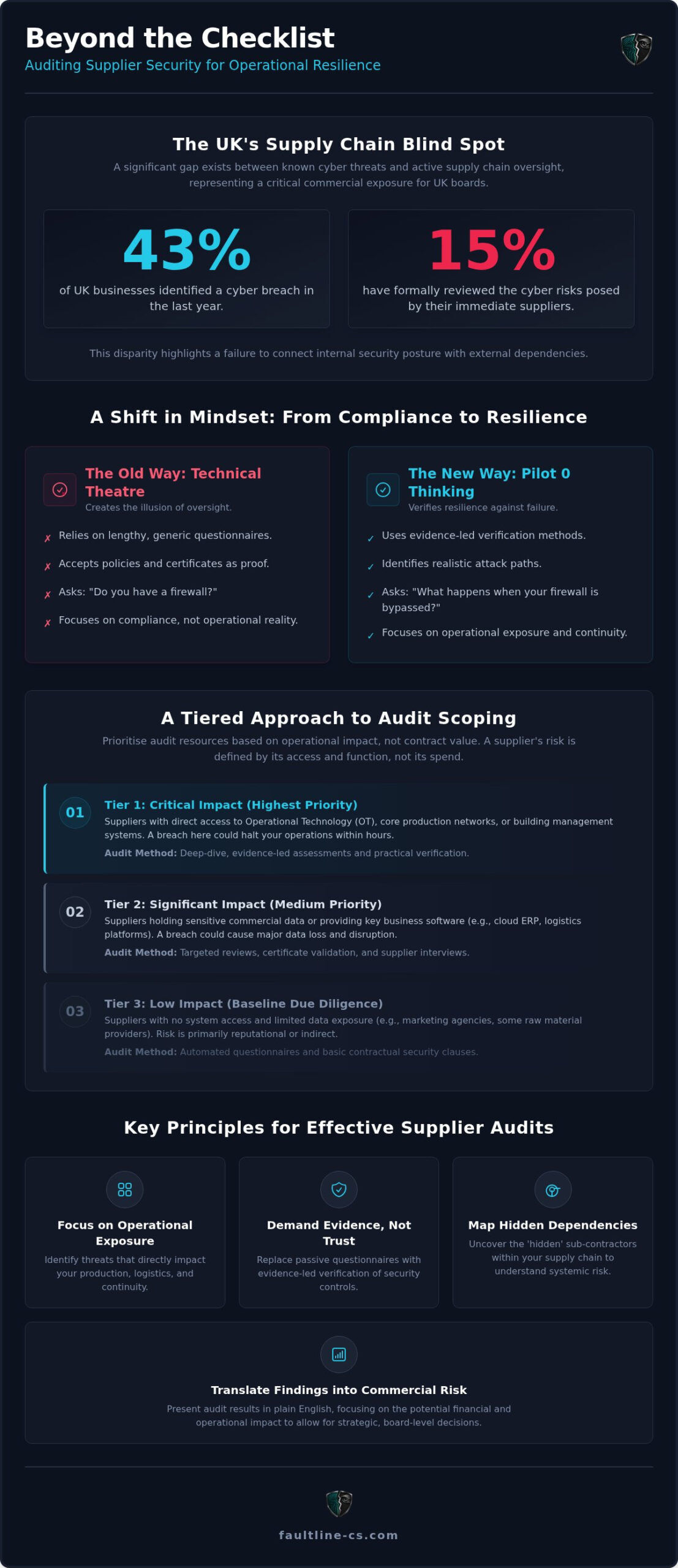
Most UK boards are operating with a blind spot that could halt their production lines tomorrow. Whilst 43% of UK businesses identified a cyber breach in the last year, the 2025/2026 Cyber Security Breaches Survey reveals that only 15% have formally reviewed the risks posed by their immediate suppliers. This gap between known threats and active oversight represents a significant commercial exposure. Understanding how to audit supplier security is no longer a niche IT task; it is a fundamental requirement of corporate governance and operational resilience.
You’re likely familiar with the frustration of issuing complex security questionnaires that return vague, unhelpful data. These documents often fail to address the core concern: will a third party breach cause your operations to grind to a halt? This article provides a strategic framework to move beyond technical checklists, allowing you to identify the real operational risks and hidden dependencies within your supply chain. We will explore how to prioritise your audits based on business impact and how to translate these findings into board-level reporting that explains risk in plain English.
Key Takeaways
- Move beyond technical checklists to identify the operational exposure that directly threatens your production and logistics continuity.
- Implement a tiered scoping framework to categorise suppliers by their system access and prioritise audits where the risk is highest.
- Learn how to audit supplier security by using verification methods that replace passive trust with evidence led insight.
- Translate complex audit findings into plain English reports that allow the board to assess commercial risk and financial impact.
- Build a foundation for long term resilience by mapping hidden dependencies and systemic gaps across your entire supply chain.
Beyond the Checklist: Why Supplier Security Audits Must Focus on Operational Exposure
Security auditing is often reduced to a bureaucratic endurance test. For many UK directors, the process involves sending a 50 page questionnaire to a vendor and filing the response once it returns. This is technical theatre. It creates the illusion of oversight whilst leaving the actual operational risks untouched. To understand how to audit supplier security effectively, we must first redefine the objective. It is not about confirming that a supplier has a policy. It is about verifying the operational logic that keeps your production line moving.
Effective auditing identifies exposure gaps where cyber, physical, and human risks overlap. We advocate for “Pilot 0 thinking” across all our services. This mindset assumes that existing controls will eventually fail. Instead of asking if a supplier has a firewall, we ask what happens to your deliveries when that firewall is bypassed. It is a shift from blind trust to verified resilience. It requires a move away from generic testing toward identifying realistic attack paths that threaten your business continuity.
The Reality of Third-Party Dependency in 2026
Modern manufacturing relies on an intricate web of digital connections. In 2026, the legislative landscape has shifted with the UK Cyber Security and Resilience Bill, reflecting the reality that managed service providers are now viewed as critical infrastructure. A single point of failure in a secondary software provider can halt your entire logistics chain. The danger often lies with “hidden” sub-contractors. These are the vendors your primary suppliers use, creating a systemic supply chain security risk that remains invisible until a breach occurs. You cannot manage what you cannot see.
Why Compliance Does Not Equal Security
A certificate is a baseline, not a guarantee. Whilst ISO 27001:2022 provides a structured framework for information security, it does not account for the specific operational pressures of a high volume warehouse or a just-in-time manufacturing plant. Paper based security often crumbles during a real world incident because it lacks the grit of practical implementation. When considering how to audit supplier security, directors must demand evidence led verification. We need to see how a supplier actually behaves under pressure, not just how they describe their idealised processes in a PDF. Resilience is built on evidence, not assumptions.
Identifying Your Critical Dependencies: A Tiered Approach to Audit Scoping
Spend is a poor proxy for risk. Many UK organisations mistakenly prioritise their auditing schedule based on the size of a supplier’s contract. This logic is flawed. A small maintenance firm with remote access to your building management system represents a far greater threat than a high-spend marketing agency with no system connectivity. Understanding how to audit supplier security requires a shift from accounting logic to risk logic. You cannot audit every vendor with equal intensity. Doing so dilutes your focus and exhausts your resources.
We advocate for a data-driven prioritisation model that focuses on operational impact. The goal is to identify the top five critical dependencies that could, if compromised, halt your production or logistics within hours. By concentrating your efforts on these high-stakes partnerships, you build a more resilient foundation than by performing superficial checks on a hundred low-risk vendors.
Mapping Your Supplier Ecosystem
A comprehensive supplier register must extend beyond the IT department’s list of software vendors. It should include any entity with a digital or physical footprint in your organisation. This includes maintenance firms, third-party logistics providers, and facility management services. These invisible dependencies often bypass standard procurement security checks. For a detailed framework on updating these processes, read our guide on Modernising Third-Party Risk Management for UK Directors. Visibility is the first step toward control.
Defining Audit Tiers Based on Risk
This tiered approach clarifies how to audit supplier security whilst ensuring your team is not bogged down in technical theatre. Once your ecosystem is mapped, you must categorise suppliers into distinct tiers to determine the depth of your investigation. This allows you to scale your efforts appropriately:
- Tier 1: High-Impact Partners. These entities have direct network access, handle sensitive intellectual property, or are single points of failure in your manufacturing process. They require deep, evidence-led audits.
- Tier 2: Essential Service Providers. These vendors have limited visibility into your systems, but their failure would cause significant operational friction within 48 hours. They require periodic verification of core security controls.
- Tier 3: Commodity Suppliers. These are easily replaceable vendors with minimal operational impact. A basic self-assessment or proof of Cyber Essentials certification is often sufficient.
If you are struggling to identify which of your partners belong in Tier 1, you may benefit from a specialist review of your critical dependencies to gain clarity.
Executing the Audit: Practical Methods to Verify Supplier Claims
An audit is a collaborative investigation, not an interrogation. When you determine how to audit supplier security, the process must begin with a formal notification that clearly defines the scope and the evidence required. This transparency prevents the audit from being perceived as a hostile act, maintaining the professional trust necessary for long term partnerships. A successful audit lifecycle moves from this initial scoping through to evidence gathering, verification, and a final board-level report that focuses on commercial impact.
Verification is the stage where technical theatre is dismantled. Instead of accepting a written policy on password complexity, ask for configuration screenshots of their multi factor authentication settings. Request redacted incident logs from the last six months to see how they actually handle anomalies. This evidence led approach allows you to identify realistic attack paths through the supplier’s network. You are looking for the gap between what their documentation claims and how their systems actually behave under operational pressure.
The Physical-to-Cyber Crossover
Digital breaches often begin with a physical oversight. A robust audit must examine the crossover points where physical access could lead to a system compromise. Verify exactly who holds keys or fobs to your facility and how that access is revoked when a contractor’s project ends. Many organisations overlook the risk posed by on-site contractors who bring their own devices into your environment. Examine their internal protocols for device management and credential storage. If a contractor can plug an unmanaged laptop into your shop floor network, your digital perimeter is effectively non existent.
Verifying Operational Resilience
Resilience is a muscle that must be exercised to remain effective. When you are assessing how to audit supplier security, you must demand proof of recent testing. Ask for the results of their most recent business continuity test and verify that the scenarios included a total loss of digital services. A plan that has not been tested in the last 12 months is merely a theory. You should also check their incident response escalation routes specifically for your contract. Knowing who to call at 3:00 AM on a Sunday is more valuable than a 100 page response manual. For more on the regulatory expectations surrounding these checks, see our analysis of Supply Chain Due Diligence in the UK. Practical resilience is built on verified evidence, not optimistic assumptions.
Translating Audit Findings into Strategic Board Decisions
Technical data is a liability if it cannot be understood by those holding the budget. For a board of directors, a list of unpatched servers at a logistics partner is merely noise. To provide genuine value, you must translate these findings into the language of commercial risk and operational impact. When considering how to audit supplier security, the final output must be a strategic document that answers the “so what?” for every identified gap. This approach moves the conversation from IT maintenance to business resilience.
Audit findings should also serve as leverage during contract renewals. If a Tier 1 supplier fails to meet agreed security standards, this data provides the evidence required to negotiate stricter service level agreements or penalty clauses for downtime. Rather than a static list of grievances, the board requires a remediation roadmap. This document should outline a clear path from current exposure to a state of verified security, ensuring that suppliers are held accountable for their role in your operational stability.
Reporting on Commercial Exposure
Effective reporting links a supplier’s failure to a specific production risk. For example, understanding how to audit supplier security involves explaining how a weak password policy at a facility management firm could lead to the unauthorised shutdown of a climate-controlled warehouse. We use attack-path narratives to help directors visualise these risks. Instead of discussing encryption protocols, we describe how a compromised vendor credential could allow an intruder to halt a specific production line. This clarity allows the board to make informed decisions about where to allocate resources for risk mitigation.
Prioritising Remediation Efforts
Not all vulnerabilities require the same urgency. You must differentiate between “easy wins” that can be fixed in a week and long-term strategic investments that require a shift in the supplier’s culture. Holding suppliers accountable requires a structured approach to follow-up. High-risk gaps should have non-negotiable deadlines, whilst lower-risk observations can be rolled into a continuous improvement plan. For a deeper look at structuring these ongoing relationships, refer to our guide on A Practical Third Party Risk Management Framework. This ensures your oversight is methodical rather than reactive.
Strengthening Your Supply Chain with FaultLine Exposure Assessments
Internal audits often suffer from a proximity bias. When your own team reviews a long term partner, they may overlook systemic flaws due to established relationships or a lack of specialised attack path knowledge. Determining how to audit supplier security effectively requires the objective eye of an independent partner. We provide the clarity needed to see through technical theatre and identify the vulnerabilities that actually threaten your commercial stability. By mapping the overlap between cyber, physical, and third party risks, we offer a unified perspective on your organisation’s true resilience.
Our approach values evidence over assumptions. We don’t act as a distant service provider but as a strategic guide that deconstructs complex operational dependencies. This independent oversight ensures that the findings are not filtered by internal politics or vendor pressure. It provides the board with a steady hand and a clear eyed perspective on reality, ensuring that security investments are aligned with actual business outcomes rather than superficial compliance metrics.
The Fixed-Price Exposure Assessment
We provide a structured entry point for organisations looking to secure their most critical dependencies. Our Exposure Assessment is a fixed price service at £5,000, designed to audit up to five of your highest risk suppliers. This is not a generic scan or a paper based compliance exercise. Powered by the IntelSensus data framework, the assessment identifies realistic attack paths that an adversary could take through your supply chain to reach your core operations. The primary deliverable is a board level report written in plain English, stripping away jargon to focus on prioritised actions and financial risk mitigation.
Next Steps for UK Operational Leaders
The legislative environment in 2026 leaves no room for complacency. With the UK Cyber Security and Resilience Bill increasing the burden of proof for supply chain oversight, waiting for a breach is a high stakes gamble with your reputation and production continuity. Securing your external dependencies is a strategic investment in the longevity of your business. The process begins with visibility; once you understand where the gaps exist, you can move toward a state of verified security. Protecting your logistics and manufacturing lines requires proactive governance rather than reactive crisis management. Book a consultation with the team at FaultLine Cyber & Security Ltd to begin your assessment and secure your operational future.
Securing the Operational Future of Your Supply Chain
Operational resilience is built on evidence, not assumptions. Directors who understand how to audit supplier security recognise that a certification is merely a baseline. It’s essential to identify the realistic attack paths that bypass standard defences to protect production lines and logistics networks. By categorising your ecosystem into risk tiers and focusing on your top five critical dependencies, you move from reactive crisis management to proactive governance.
FaultLine specialise in providing this clarity for the UK manufacturing and logistics sectors. Our fixed price Exposure Assessments, starting at £5,000, provide a logical first step for auditing your most vital partners. We deliver bespoke board level reporting in plain English, ensuring that you have the insight needed to make strategic decisions without needing technical expertise.
Taking control of your external exposure today ensures that your organisation remains resilient against the systemic vulnerabilities of tomorrow.
Frequently Asked Questions
How often should we audit our most critical suppliers?
Critical Tier 1 suppliers should undergo a formal security audit at least once every 12 months. You should also trigger an immediate review following any significant change to their infrastructure, a merger, or a known breach within their specific industry. High stakes dependencies require constant vigilance rather than a set and forget approach to ensure operational continuity remains intact.
What are the most common security gaps found in UK supply chains?
The most frequent vulnerabilities include a lack of multi factor authentication and legacy systems that are no longer receiving security patches. Data from the August 2026 Make UK report shows that 30% of manufacturers experienced a cyber incident via their supply chain in the last year. These gaps often exist because suppliers prioritise production speed over the rigorous access controls required for modern resilience.
Can we audit a supplier if it is not explicitly mentioned in our contract?
You can request a voluntary audit, but you cannot compel a supplier to provide evidence without a “right to audit” clause. If a vendor refuses, it highlights a lack of transparency that should be addressed during the next contract renewal. Directors must ensure that all future agreements include clear provisions on how to audit supplier security to maintain necessary oversight.
What should we do if a supplier fails their security audit?
A failed audit should result in a formal remediation roadmap with non negotiable deadlines for high risk vulnerabilities. You must hold the supplier accountable for fixing these gaps whilst simultaneously reviewing your contingency plans. If the supplier cannot or will not improve their security posture, you must begin the process of identifying a more resilient partner to protect your production lines.
How do we audit small suppliers who do not have dedicated IT teams?
Focus your review on the core controls outlined in the UK Cyber Essentials scheme. Rather than demanding complex enterprise policies, verify that they have implemented basic protections like secure configuration, firewalls, and user access management. This pragmatic approach ensures that smaller vendors are secure enough to interact with your systems without being overwhelmed by excessive bureaucratic requirements.
Is a questionnaire enough to satisfy supply chain due diligence requirements?
A questionnaire is rarely sufficient as it often encourages technical theatre where vendors provide the expected answers without operational proof. True due diligence requires evidence led verification, such as reviewing system logs or configuration screenshots. Relying solely on self reported data leaves your organisation exposed to hidden vulnerabilities that a simple tick box exercise will never uncover.
What is the difference between a security audit and an exposure assessment?
A security audit checks a supplier against a static list of compliance rules or standards. An exposure assessment is a more strategic review that identifies realistic attack paths an adversary could take to disrupt your specific operations. FaultLine focus on these assessments to reveal the crossover between cyber and physical risks, providing a clearer picture of commercial risk than traditional auditing.
How do we handle sub-contractors that our main supplier uses?
Manage sub-contractor risk by implementing contractual flow down clauses that require your primary supplier to audit their own vendors. These “hidden” dependencies are often the weakest link in a logistics chain. You should demand visibility into how your Tier 1 partners manage their own third party risks to ensure that a breach two or three levels down doesn’t halt your deliveries.

Article by
Alex J Morgan
Alex Morgan writes and develops content for FaultLine Cyber & Security Ltd. Alex has worked across web development, organic SEO, digital marketing and content creation since 2009, with a particular focus on making complex subjects clear, useful and easy to navigate.
Leave a Reply