


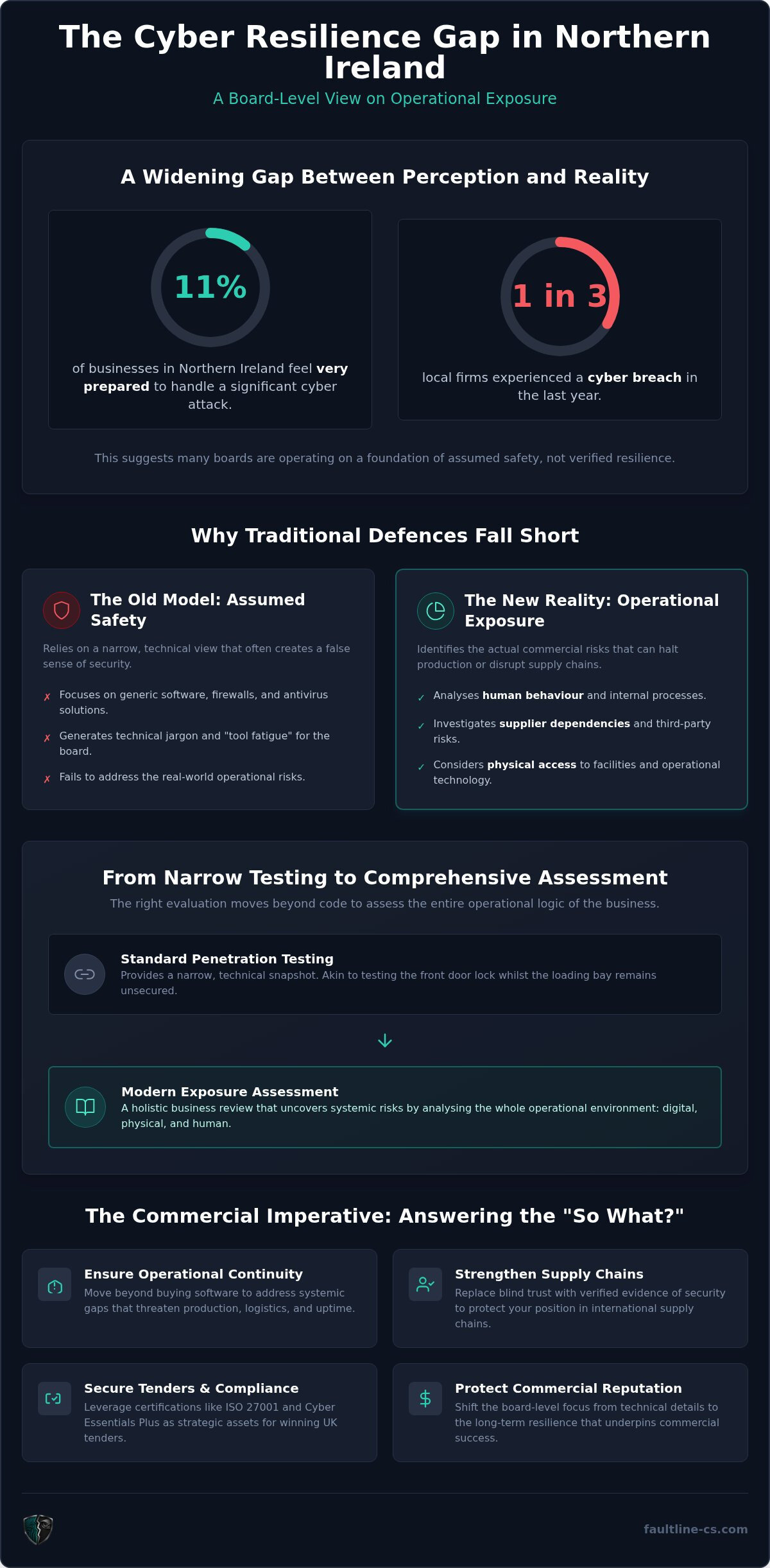
Only 11% of businesses in Northern Ireland feel very prepared to handle a significant cyber attack, despite a third of local firms experiencing a breach in the last year. This gap suggests that many boards are operating on a foundation of assumed safety rather than verified resilience. You likely find that the conversation surrounding cyber security services in Belfast is often cluttered with technical jargon that fails to translate into clear operational risk. It’s a valid concern for directors who need to know exactly how a digital failure might halt a production line or disrupt a critical supply chain.
We understand that true security is rooted in human behaviour and operational logic. This article explains why traditional security models often miss the real risks to your business and how an exposure assessment provides the strategic clarity that board members require. You’ll gain a clear understanding of your actual commercial exposure, from ISO 27001 compliance to surviving a supplier breach. We’ll move past the technical theatre to focus on the pragmatic steps that ensure your business remains resilient in an increasingly complex environment.
Key Takeaways
- Understand why operational exposure is the critical metric for directors, identifying the gap between assumed safety and the reality of your production environment.
- Discover why traditional penetration testing often fails to uncover the physical and supplier-based vulnerabilities that pose the greatest risk to your business.
- Learn how specialised cyber security services Belfast consultancies provide can help you secure your position in international supply chains by replacing blind trust with verified evidence.
- Gain insights into how Cyber Essentials Plus and ISO 27001 function as strategic assets for securing UK tenders and ensuring long-term resilience.
- Shift the board-level focus from buying software to addressing systemic gaps that threaten your operational continuity and commercial reputation.
The Belfast Cyber Security Landscape: Why Traditional Defences Leave Gaps
Belfast has cemented its reputation as a global security hub, attracting significant investment from international technology firms and research centres. Whilst the city hosts over 120 firms in the sector, this prestige doesn’t always translate into protection for local businesses. There is a widening gap between what a board assumes is secure and the reality of its actual exposure. This discrepancy, often termed operational exposure, represents the hidden vulnerabilities that standard firewalls and antivirus software simply cannot address. It’s the difference between having a lock on the front door and knowing if the warehouse windows are left open at night.
Relying on generic technical solutions creates a false sense of security whilst leaving complex supply chains exposed. For directors, the challenge isn’t just about digital hygiene; it’s about integrated operational risk management that accounts for physical access, human behaviour, and supplier dependencies. Many providers of cyber security services Belfast offers focus heavily on technical theatre, deploying impressive-looking tools that provide little insight into how a system failure would actually halt production or disrupt logistics. Genuine business resilience requires looking past the software dashboard to the operational logic of the firm.
To better understand the commercial dynamics behind these security offerings, watch this brief discussion on the industry’s sales-led approach:
The Reality of Cyber Threats in Northern Ireland
Recent data from July 2026 confirms that 33.3% of businesses in Northern Ireland experienced a cyber security breach or data protection issue in the preceding 12 months. Local manufacturing and logistics firms are primary targets because they are often perceived as the soft entry point into larger international supply chains. Attackers have shifted from opportunistic attempts to targeted operational disruption. Geographic proximity and tight-knit supplier clusters in the region mean that a single breach in a Belfast facility can quickly ripple through to global partners, turning a local incident into a systemic crisis that threatens long-term contracts.
Why Technical Solutions Often Fail the Board
Tool fatigue has become a significant boardroom burden. Boards are frequently asked to sign off on additional software layers without a clear explanation of the “so what?” behind the investment. This lack of alignment between IT departments and senior leadership often stems from a reliance on technical assumptions rather than commercial evidence. Directors must demand transparency. If a technical solution cannot be explained in terms of downtime hours or financial impact, it’s likely a distraction from real systemic gaps. Genuine resilience is found in operational resilience services that prioritise business outcomes over technical hype.
Evaluating Cyber Security Services: Why Exposure Assessments Outperform Simple Testing
Standard penetration testing often provides a narrow, technical snapshot of a digital perimeter. It’s akin to testing the front door lock whilst the loading bay remains unsecured. For a board member, this digital door focus misses the systemic reality of how a business actually functions. Most cyber security services Belfast offers will sell you a scan, but few will analyse the operational logic that keeps your facility running. Exposure assessments move beyond the code to look at the whole building, including the physical and human variables that attackers frequently exploit.
The Components of a Modern Exposure Assessment
A robust assessment starts with external visibility. We use open-source intelligence (OSINT) to see what an adversary sees before they even launch an attack. This includes mapping supplier and third-party dependencies that could halt your production lines. In Belfast’s manufacturing and logistics sectors, the crossover between physical security and digital systems is a common blind spot. If a physical access point is compromised, your digital firewalls become irrelevant. We integrate these elements into a single, cohesive picture of risk through our Exposure Assessments.
Exposure Assessment vs Penetration Testing
An exposure assessment is a strategic review of all risk pathways, including human and physical factors, designed to provide a comprehensive view of operational vulnerability.
Penetration testing is a tactical exercise; it tells you if a specific exploit works. In contrast, an exposure assessment is a strategic tool. It answers the “so what?” by linking vulnerabilities to business impacts like downtime or supply chain failure. Whilst testing can be a recurring technical cost, an assessment serves as a foundational investment. It aligns with Pilot 0 thinking, where you identify the actual problem before spending capital on unnecessary software tools. This approach ensures that your pursuit of certifications like Cyber Essentials Plus is grounded in reality rather than just a box-ticking exercise.
By choosing a fixed-price model, boards gain clarity without the risk of open-ended consulting fees. It’s a pragmatic first step for any Northern Ireland firm looking to validate their resilience. You can start by discussing your operational profile with our team to identify where your hidden gaps might lie.
Securing Northern Ireland’s Supply Chains: Managing Third-Party and Physical Risks
Trust is a dangerous proxy for security in a modern supply chain. Whilst Belfast has grown into a significant industrial hub, many local firms now find themselves positioned as critical, yet under-protected, links in vast international networks. Data from July 2026 indicates that third-party involvement was a factor in 48% of all recorded breaches, representing a 60% increase over the previous year. For a board director, this means your operational continuity is no longer entirely within your own control. It depends on the resilience of every vendor with access to your systems or facilities.
The assumption of “operational trust” often prevents leadership from asking the difficult questions required for true governance. If a supplier suffers a ransomware attack, does your contract guarantee a recovery time, or does it merely offer an apology? Relying on generic NI Cyber Security Centre Guidance is a helpful baseline, but it doesn’t address the specific dependencies of a high-output manufacturing plant or a logistics centre. You need evidence, not just assurances, to manage these systemic gaps effectively.
The Supplier Dependency Trap
Your security is only as strong as your least secure critical supplier. Many Belfast businesses inadvertently create “backdoors” for attackers by granting permanent, unmonitored access to maintenance contractors or software vendors. Auditing these relationships doesn’t have to damage commercial rapport; it’s a matter of establishing shared standards for resilience. By moving towards a model of verified access, you protect both your own operations and your standing as a reliable partner in the global market. You can read more about modernising third-party risk management to understand how this fits into a broader corporate strategy.
Physical Security as a Cyber Entry Point
Digital firewalls are useless if an unauthorised person can walk into your server room. In the pursuit of digital transformation, many firms have overlooked the physical-to-cyber crossover risks inherent in local facilities. Simple social engineering tactics, such as tailgating or impersonating delivery staff, remain highly effective methods for bypassing technical defences. This is particularly relevant as we move through 2026, with businesses now required to meet the enhanced security and preparedness standards of Martyn’s Law for public-facing premises.
Integrating physical and digital monitoring is a pragmatic necessity. Boards should prioritise cyber security services Belfast consultants who understand that a broken gate or an unmonitored terminal is just as much of a cyber risk as an unpatched server. Practical steps, such as hardware locking and stricter visitor protocols, provide immediate, low-cost improvements to your overall risk profile. These measures ensure that your operational infrastructure remains secure from the ground up, protecting your production capacity from both digital and physical interference.
Governance and Compliance: Navigating Cyber Essentials Plus and ISO 27001 in Belfast
Compliance is frequently dismissed as a bureaucratic hurdle, yet for Northern Ireland’s manufacturing and engineering sectors, it’s becoming a non-negotiable commercial asset. The shift is particularly evident in UK public sector procurement, where Cyber Essentials Plus has transitioned from a recommendation to a mandatory requirement for most tenders. For directors, the “so what?” is simple: without verified compliance, you’re excluded from significant contract opportunities. Integrating these standards into your broader cyber security services Belfast strategy ensures that security isn’t just a cost centre but a facilitator of growth.
Effective governance requires moving beyond the “tick-box” mentality that often plagues corporate risk management. A certificate on the wall provides little protection if the underlying operational logic is flawed. Our GRC consulting focuses on aligning these technical standards with your specific business objectives, ensuring that every control implemented serves a pragmatic purpose. This evidence-led approach replaces technical theatre with a robust framework that supports long-term resilience and board-level visibility.
Achieving Cyber Essentials Plus in Northern Ireland
Belfast SMEs often stumble during the certification process due to poor device inventory and a lack of clarity regarding core controls. As the threat landscape evolves, the requirements for these government-backed schemes have become more stringent, making a first-time pass essential for maintaining momentum. Failing an audit isn’t just a financial loss; it disrupts operations and delays contract bids. Readiness assessments are a logical first step, identifying gaps in your environment before the official assessor arrives. It’s a calculated investment that prevents the embarrassment and expense of a failed certification attempt.
The Roadmap to ISO 27001 Alignment
For larger firms or those with complex international supply chains, ISO 27001 offers a more comprehensive Information Security Management System (ISMS). In 2026, industry data shows that auditor day rates have seen a 20% increase over the previous year, reflecting the growing demand for verified security standards. Success depends on creating bespoke policies rather than relying on generic templates that fail to reflect your operational reality. You can explore our GRC and ISO 27001 support services to see how we help firms build a staged, manageable roadmap to compliance.
Strategic Resilience: How FaultLine Secures Local Operational Infrastructure
Resilience is not a commodity. It is a strategic posture that requires constant validation against an evolving threat landscape. Whilst large international firms often provide a distant, scale-driven service, FaultLine acts as a pragmatic sentinel for Belfast leadership. We prioritise commercial reality over technical theatre, ensuring that your security investments are directly proportional to your operational risks. This partnership model replaces the traditional vendor-client relationship with a collaborative approach focused on long-term business survival.
Our role is to provide the steady hand and clear-eyed perspective required to manage complex environments. By focusing on evidence over assumptions, we help you strip away unnecessary technical fluff and concentrate on the systemic gaps that truly matter. Choosing the right cyber security services Belfast offers means selecting a partner that understands the specific pressures of Northern Ireland’s industrial and logistics sectors, from local supplier dependencies to international compliance demands.
MSSP and SOC Services for Belfast Businesses
Continuous visibility is the only way to effectively manage operational risk. Our Managed Security Service Provider (MSSP) solutions, including managed SOC and SIEM, provide 24/7 monitoring of your digital and physical crossover points. The primary goal is the reduction of dwell time, the period an adversary remains undetected within your network. For critical infrastructure, every minute of dwell time increases the risk of catastrophic production failure. We move beyond reactive incident response to proactive threat hunting, identifying and neutralising vulnerabilities before they can be exploited to halt your operations.
The FaultLine Cyber Readiness Assessment
Data-driven maturity scoring is essential for board-level governance. The FaultLine Cyber Readiness Assessment, powered by the IntelSensus framework, provides a rigorous evaluation of your current security posture. It moves past subjective opinions to deliver a quantifiable maturity score that directors can use to track progress and justify investment. This assessment translates complex technical findings into a prioritised action plan, ensuring that your team focuses on the most critical exposures first.
This methodology is built on Pilot 0 thinking, identifying the actual commercial problem before committing to expensive software tools. It ensures that your roadmap to resilience is both cost-effective and strategically aligned. For firms based at Castle Lane or across the wider region, a fixed-price Exposure Assessment serves as the logical point of entry for securing your operational future. It provides the clarity and evidence-led insight required to move from a state of assumed safety to one of verified resilience.
You can learn more about our specific operational resilience services and how they integrate into your existing governance framework. Taking a proactive step today prevents the operational paralysis that follows a major breach tomorrow.
Securing Your Operational Future
Operational resilience is a strategic choice, not a technical inevitability. It requires moving beyond the comfort of technical assumptions to embrace a culture of verified evidence. Traditional defences often leave systemic gaps, particularly within the complex supply chains that define Northern Ireland’s industrial landscape. By prioritising exposure assessments over generic testing, directors gain the strategic clarity needed to protect production continuity and commercial reputation. This shift ensures that your investment in cyber security services Belfast remains focused on real-world business outcomes rather than technical theatre.
FaultLine provides the sober, jargon-free expertise required to navigate these challenges. As Belfast-based specialists in manufacturing and logistics resilience, we offer a pragmatic path forward that aligns security with your corporate governance objectives. Our fixed-price entry service provides immediate board-level clarity, ensuring you understand your actual risk profile before committing to further capital expenditure.
Building a resilient business is a methodical and deliberate process. By addressing your hidden vulnerabilities today, you ensure that your operations remain a stable and trusted link in the global supply chain for years to come.
Frequently Asked Questions
What are the most common cyber security threats for businesses in Belfast?
Ransomware and targeted supply chain attacks are the most prevalent threats currently facing local firms. Verified data from July 2026 shows that 33.3% of Northern Ireland businesses experienced a breach or data protection issue in the preceding twelve months. These incidents often exploit the operational trust between local partners to gain a foothold in larger international networks.
How much does a professional cyber security exposure assessment cost in Northern Ireland?
Costs for a professional assessment vary depending on the complexity of your operational infrastructure and the depth of the review. Many traditional firms charge open-ended consulting fees that can lead to significant budget creep. Selecting a partner with a fixed-price model ensures board-level clarity and provides a clear, prioritised action plan without the risk of escalating costs.
Does my Belfast-based business really need Cyber Essentials Plus certification?
Most organisations targeting UK public sector contracts will find that Cyber Essentials Plus is now a mandatory requirement for tenders. As of July 2026, the certification cost for a firm with 1-9 users is approximately £1,350 plus VAT. It serves as a critical baseline for your cyber security services Belfast strategy, proving to global partners that your digital hygiene meets government-backed standards.
What is the difference between an IT provider and a cyber security consultancy?
An IT provider manages your technical availability and software tools, whilst a consultancy manages your commercial risk and strategic posture. Your IT team ensures that systems remain operational; a consultant acts as a pragmatic sentinel to identify where those systems create hidden vulnerabilities. It’s the difference between maintaining a lock and evaluating if the lock is placed on the correct door.
How does Martyn’s Law affect the security requirements for my premises in Belfast?
Martyn’s Law mandates that public-facing premises must implement specific preparedness and security measures by 2026. This legislation forces a shift from purely digital security to a model that includes physical resilience. Belfast businesses must now demonstrate that they’ve assessed how their facilities could be compromised, making integrated physical and digital planning a legal and operational necessity.
Can a cyber security assessment help reduce my business insurance premiums?
Demonstrating a robust, evidence-led security posture often allows firms to negotiate more favourable terms on their insurance. Insurers are increasingly skeptical of businesses that lack verified resilience. By providing a detailed assessment of your exposure, you present a lower risk profile, which can help justify a reduction in premiums during your next renewal cycle.
How long does it take to achieve ISO 27001 alignment for a manufacturing firm?
Achieving ISO 27001 alignment typically requires between six and twelve months for a manufacturing firm. The timeline depends on the current maturity of your systems and the complexity of your production environment. A staged approach ensures that you build a bespoke Information Security Management System without causing unnecessary disruption to your daily operations.
What happens if one of my critical suppliers in Northern Ireland is breached?
A breach at a critical supplier can lead to immediate production downtime or a complete halt in your logistics chain. This dependency trap is why third-party risk analysis is a vital part of operational resilience. You must have a clear understanding of your suppliers’ security standards to ensure that a failure in their environment doesn’t result in a terminal event for your own business.

Article by
Alex J Morgan
Alex Morgan writes and develops content for FaultLine Cyber & Security Ltd. Alex has worked across web development, organic SEO, digital marketing and content creation since 2009, with a particular focus on making complex subjects clear, useful and easy to navigate.
Leave a Reply