


If your primary supplier suffered a total system failure today, would your board know exactly how long your operations could survive before the production line stopped? Most directors find themselves buried under layers of technical noise, struggling to see the commercial reality behind the dashboards. You likely suspect that despite your current security spend, the real business exposure to cyber threats lies in the gaps between your physical, digital, and operational systems. It’s a common frustration for leadership teams who are expected to manage systemic risk without a clear map of their own dependencies.
This strategic guide provides the clarity you need to move beyond technical theatre and identify the hidden vulnerabilities that threaten your regulatory standing. We will deconstruct how to evaluate your true risk profile, align security investments with commercial outcomes, and ensure your business remains resilient in an increasingly complex UK regulatory environment. By the end of this article, you’ll have a structured framework to turn overwhelming data into actionable board-level insight.
Key Takeaways
- Understand why business exposure to cyber threats is a measure of total organisational risk rather than just a list of technical vulnerabilities.
- Identify the hidden dependencies within your UK supply chain where a single point of failure could halt your entire production or logistics operation.
- Learn to distinguish between routine vulnerability management and strategic exposure assessments that prioritise business continuity over technical data volume.
- Discover how a structured lifecycle of exposure management, supported by 24/7 monitoring, builds long-term operational resilience against evolving threats.
- Recognise how the IntelSensus framework provides directors with a clear-eyed perspective on risk, moving beyond technical theatre to informed commercial decision-making.
What is Business Exposure to Cyber Threats?
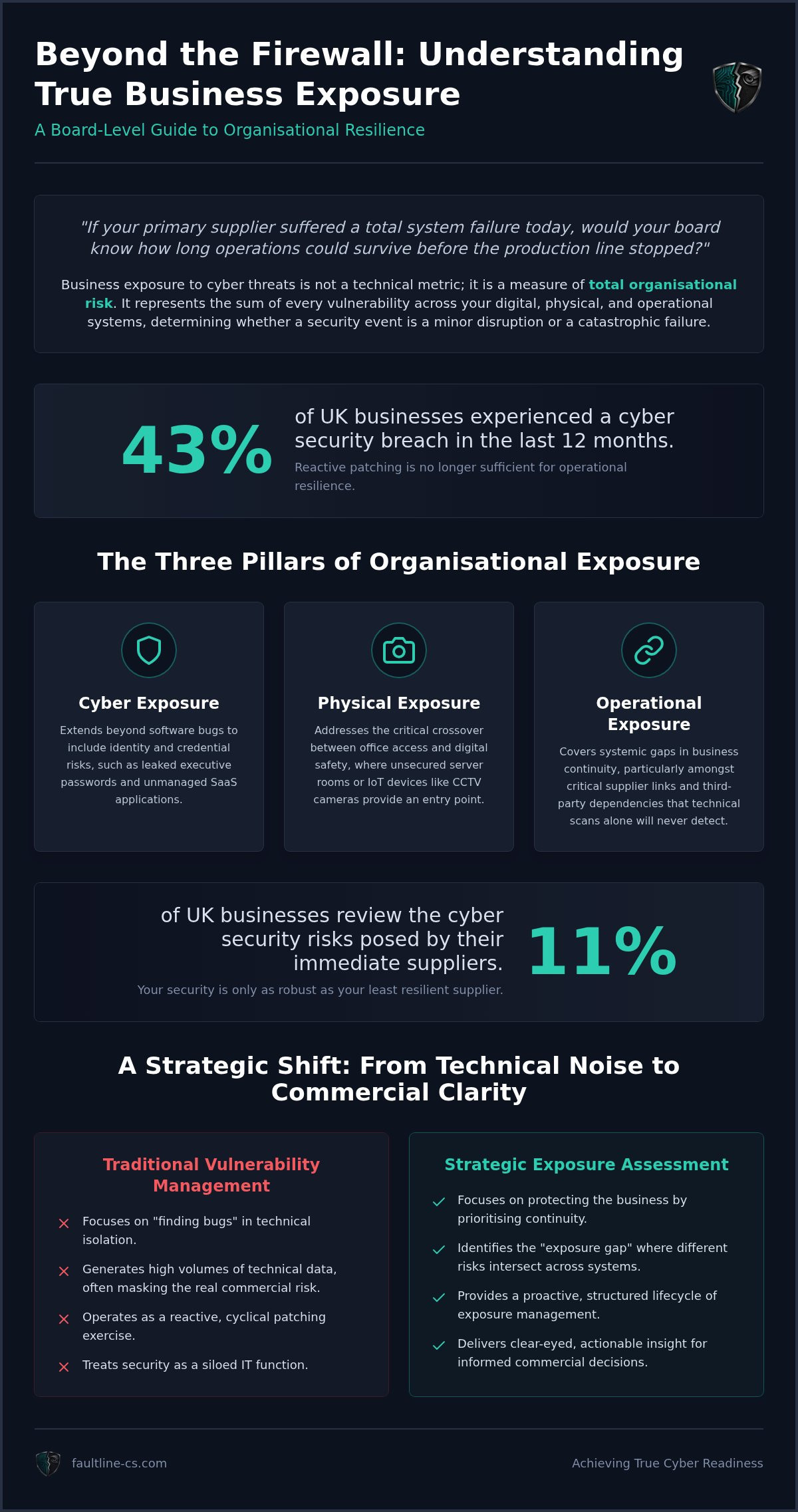
Business exposure to cyber threats is not a technical metric; it is a measure of total organisational risk. Whilst many directors view security through the narrow lens of IT patches and firewalls, true exposure represents the sum of every vulnerability across your digital, physical, and human systems. It is the commercial “so what” that determines whether a security event remains a minor disruption or escalates into a catastrophic failure of business continuity.
Visibility is the primary requirement for modern UK corporate governance. Directors cannot manage what they cannot see, and reliance on siloed technical reports often masks the systemic gaps where real incidents begin. Developing a comprehensive understanding of cybercrime is essential for leadership teams to recognise that threat actors don’t just look for software bugs; they look for operational logic flaws and human dependencies. In this context, business exposure to cyber threats becomes a strategic calculation of how vulnerable your revenue streams and regulatory standing are to external interference.
To better understand the strategic mindset required for modern business resilience, watch this helpful video:
Traditional vulnerability management often fails because it focuses on “finding bugs” in isolation. A holistic exposure assessment, by contrast, focuses on protecting the business. It identifies the “exposure gap” where different risks intersect. For example, a minor software flaw in a supplier’s portal might seem insignificant until it is combined with a lack of multi-factor authentication and a physical access point in a remote logistics hub. These overlapping vulnerabilities create a path of least resistance for attackers that technical scans alone will never detect.
The Three Pillars of Organisational Exposure
Effective risk management requires categorising vulnerabilities into three distinct areas. Cyber Exposure extends beyond software bugs to include identity and credential risks, such as leaked executive passwords. Physical Exposure addresses the crossover between office access and digital safety, where unsecured server rooms or IoT devices like CCTV cameras provide an entry point. Finally, Operational Exposure covers systemic gaps in business continuity, particularly amongst your critical supplier links and third-party dependencies.
Why 2026 Requires a Strategic Shift
The traditional security perimeter has effectively vanished. In a distributed work environment, hidden risks accumulate rapidly amongst siloed departments and unmanaged SaaS applications. The 2025 Cyber Security Breaches Survey indicates that 43% of UK businesses experienced a breach in the last 12 months, a figure that highlights the inadequacy of reactive patching. Moving to a proactive model of exposure reduction is no longer optional; it is a fundamental requirement for maintaining operational resilience and meeting the rising expectations of UK regulators.
Uncovering Hidden Risks within the UK Supply Chain
Your security is only as robust as your least resilient supplier. For UK manufacturing and logistics firms, supplier dependency isn’t just an operational detail; it’s a critical vulnerability. The 2024 Cyber Security Breaches Survey revealed that a mere 11% of UK businesses review the risks posed by their immediate suppliers. This lack of oversight creates a profound business exposure to cyber threats, as attackers increasingly target the “weakest link” to gain entry into larger, more secure organisations. When a critical logistics partner or component supplier goes offline, the commercial impact is immediate, often resulting in halted production lines and broken delivery promises.
Relying on “check-box” compliance or simple contractual clauses is a dangerous assumption. A contract might provide legal recourse after a breach, but it does nothing to prevent the operational paralysis caused by a supplier-driven outage. Boards must move towards the standards outlined in the Cyber Governance Code of Practice, which emphasises that directors are responsible for the resilience of their entire ecosystem, not just their internal servers. True oversight requires a shift from trusting a signature to verifying evidence.
Supplier and Third-Party Risk Analysis
Mapping your operational reliance on external technology is the first step toward true resilience. You need to know which service providers have access to your data and which would cause an immediate halt in production if they went offline. Moving beyond contractual assumptions requires evidence-based assessments that validate a supplier’s actual security posture. This process secures your external attack surface by ensuring that your partners meet the same rigorous standards you set for your own team. Conducting a thorough Supplier & Third-Party Risk Analysis is essential for identifying these systemic dependencies before they are exploited.
Physical-to-Cyber Crossover Points
Operational trust assumptions often fail at the junction of facilities and IT. In logistics environments, unauthorised physical access to a warehouse or distribution centre can lead to an immediate digital compromise. Whether it’s an unmanaged IoT device on the factory floor or an open network port in a loading bay, the crossover points are numerous. A unified assessment bridges this gap, treating physical security and digital safety as two sides of the same coin. By identifying where shared access or contractor behaviour creates a path into your core systems, you can close the loop on vulnerabilities that technical scans frequently overlook. This holistic view ensures that a physical breach doesn’t become a digital catastrophe.
Exposure Assessment vs Vulnerability Management
Vulnerability management is a technical exercise; exposure assessment is a commercial one. Whilst technical teams often focus on the exhaustive task of patching every known software bug, directors must focus on the specific vulnerabilities that actually jeopardise revenue. Chasing a “zero-vulnerability” state is a form of security theatre that consumes vast resources without necessarily improving resilience. It prioritises the volume of technical data over the quality of strategic insight, often leaving the most critical business assets undefended whilst teams fixate on low-risk issues.
The primary flaw in traditional scanning is the lack of risk context. A “critical” software bug on a disconnected test machine is an IT footnote, yet a “low-severity” flaw on the server controlling your main production line represents a catastrophic business exposure to cyber threats. Understanding this distinction is vital for moving beyond technical theatre. Exposure assessment deconstructs these systemic failures by looking at how an attacker could move through your organisation, regardless of how “severe” a single bug might be on paper. It shifts the conversation from technical perfection to operational survival.
Moving from “How Many” to “Which Ones”
Relying solely on CVSS scores for board reporting is a significant limitation. These scores provide a universal technical severity, but they don’t account for your specific production risk or commercial dependencies. If your security team is presented with 5,000 “high-priority” alerts, they’re naturally overstretched. Strategic exposure assessment reduces this noise by identifying the handful of vulnerabilities that could actually halt operations. By prioritising remediation based on business impact, you ensure that your internal resources are focused on protecting the production line rather than just ticking boxes on a technical spreadsheet.
The Role of GRC in Exposure
Meaningful board-level risk conversations require aligning technical findings with Governance, Risk, and Compliance (GRC) frameworks. This alignment ensures that security investments remain proportionate to the actual threat landscape your business faces. The UK government’s guidance on managing security risks in government supply chains highlights that risk is systemic and requires a unified approach. By integrating exposure assessments into your GRC strategy, you move from a reactive posture to a proactive one. This evidence-led approach allows directors to justify security spend based on clear commercial outcomes, ensuring that every pound spent is a direct investment in your organisation’s long-term operational resilience.
The Lifecycle of Cyber Exposure Management
Resilience is not a static state; it is a moving target that requires a methodical lifecycle. Managing your business exposure to cyber threats demands more than an annual audit or a periodic vulnerability scan. It requires a continuous loop of discovery, prioritisation, and validation that matures alongside your operational footprint. Without a documented response plan for identified exposures, technical findings remain as nothing more than a list of problems without a commercial resolution. A structured lifecycle ensures that every vulnerability is assessed for its potential impact on production before resources are committed to remediation.
Continuous monitoring through Managed Security Service Provider (MSSP) and SOC services is the only way to maintain this momentum. Threat actors operate 24/7, and your visibility must match their persistence. Adversarial validation, where your defences are tested against real-world attack logic, provides the evidence needed to confirm that your security spend is actually delivering resilience. This proactive approach moves the organisation away from “hope-based” security towards a model of verified readiness.
Discovery and Asset Inventory
You cannot secure what you do not know exists. In a distributed organisation, the accumulation of unmanaged “shadow IT” creates blind spots that bypass traditional security controls. Identifying every organisational asset, from cloud instances to forgotten physical servers in a remote warehouse, is a prerequisite for any risk assessment. Comprehensive asset discovery serves as the indispensable foundation of organisational visibility. By creating a definitive inventory, you eliminate the hidden gaps where attackers often find their first foothold.
Regulatory Alignment: NIS2 and DORA
The UK regulatory landscape is shifting towards mandatory operational resilience. The introduction of the Cyber Security and Resilience Bill in 2025 signals a move towards stricter reporting requirements and broader oversight. Exposure assessments are critical for meeting these standards, particularly for firms impacted by NIS2 and DORA. These frameworks require more than just technical compliance; they demand evidence of proactive risk management and a clear link between exposure and incident reporting. Preparing for external audits with an evidence-led readiness model ensures that your board can demonstrate due diligence to regulators whilst safeguarding commercial growth.
FaultLine: Achieving True Cyber Readiness
Technical theatre often provides a false sense of security whilst leaving the most critical business assets undefended. Achieving true readiness requires a methodology that bridges the gap between digital vulnerabilities and operational logic. The FaultLine Cyber & Security Ltd’s Cyber Readiness Assessment, powered by IntelSensus, is designed specifically to provide this board-level clarity. It acts as a strategic guide for senior leadership, stripping away the noise to reveal the commercial reality of your security posture. This process moves the organisation beyond simple compliance toward a state of verified resilience.
Directors often struggle to find a clear starting point for evaluating their risk. Our fixed-price £5,000 Exposure Assessment serves as an accessible entry point for leadership teams to begin identifying their true business exposure to cyber threats. This is not a generic technical scan; it is a targeted analysis of the systemic gaps that could halt your production or compromise your regulatory standing. By choosing an evidence-led approach, you move from a state of unexposed exposure to one of informed commercial decision-making.
The IntelSensus Advantage
The IntelSensus framework provides a controlled wake-up call for boards who have previously relied on technical assumptions. It translates complex technical data into the precise language of corporate governance and risk management, allowing directors to understand the “so what” behind every vulnerability. This data-driven approach is particularly effective for manufacturing and logistics firms, where the focus must remain on production continuity and supplier dependencies. We customise every assessment to the specific operational needs of your industry, ensuring the insights gained are directly applicable to your commercial objectives.
Resilience as a Competitive Advantage
Operational resilience is no longer just a defensive necessity; it is a requirement for growth. Robust security governance is increasingly demanded during major UK tenders, with clients requiring proof of systemic risk management before awarding contracts. Demonstrating this level of maturity, supported by 24/7 monitoring through a managed SOC and SIEM solution, positions your organisation as a stable and reliable partner in the supply chain. Investing in visibility today ensures that your business remains competitive and compliant in the face of evolving regulatory pressures.
Secure your organisation with a FaultLine Cyber & Security Ltd Exposure Assessment
Transitioning from Technical Theatre to Operational Resilience
Resilience is a strategic choice made by boards, not an automated output of IT departments. To move beyond the limitations of technical theatre, directors must look past the volume of technical noise and understand their actual business exposure to cyber threats. This requires a fundamental shift from reactive vulnerability management to a structured lifecycle of exposure reduction that prioritises commercial survival over technical perfection. By aligning security investments with operational logic, leadership teams can ensure their organisation remains robust in an increasingly complex UK regulatory landscape.
FaultLine provides the specialist UK GRC and operational resilience expertise needed to navigate this transition with confidence. Our fixed-price entry service, powered by the IntelSensus framework, offers the board-level clarity required to meet evolving standards whilst safeguarding your production continuity. Evidence-led security is the only way to transform hidden systemic gaps into a verified foundation for long-term growth. Taking proactive steps today ensures that your business is prepared for the challenges of tomorrow.
Book your Cyber Readiness Assessment today
Frequently Asked Questions
What is the difference between a vulnerability scan and an exposure assessment?
A vulnerability scan is an automated technical inventory of software bugs; an exposure assessment is a strategic evaluation of how those bugs impact your specific commercial operations. Whilst a scan produces a list of technical fixes, an assessment identifies the path an attacker would take to disrupt your production line or compromise sensitive data. It shifts the focus from technical volume to the quality of strategic insight.
Does a cyber exposure assessment include physical security risks?
Yes, a comprehensive assessment identifies the crossover points where physical access leads to digital compromise. In manufacturing and logistics environments, an unsecured server room or an unmanaged network port in a loading bay can be the primary entry point for a wider breach. Visibility across both physical and digital systems is essential for true operational resilience.
How often should a UK business conduct a full exposure assessment?
Most UK businesses should conduct a full assessment annually or whenever there is a significant change to their operational infrastructure or supplier base. However, the threat landscape evolves daily, which is why we recommend moving towards a model of continuous monitoring to ensure your business exposure to cyber threats is managed in real time rather than just at a single point in the year.
Can an exposure assessment help with NIS2 or DORA compliance?
Exposure assessments provide the evidence-led documentation required to demonstrate proactive risk management under frameworks like NIS2 and DORA. These regulations demand more than simple technical compliance; they require boards to prove they have identified their systemic dependencies and established robust incident response plans. An assessment ensures your board can demonstrate due diligence to regulators whilst safeguarding growth.
How does exposure assessment handle third-party and supplier risks?
Our assessment moves beyond contractual assumptions to validate the actual security posture of your critical suppliers. We identify the weakest link in your supply chain by mapping how a failure at a third-party provider would impact your internal business continuity. This process transforms “check-box” compliance into a verified understanding of your external attack surface.
What is the IntelSensus framework used by FaultLine?
IntelSensus is a data-driven framework designed to translate technical vulnerabilities into the language of corporate governance. It provides directors with a controlled wake-up call by highlighting overlooked gaps in physical, digital, and operational systems. This ensures that security investments are aligned with actual commercial outcomes rather than just technical metrics.
Is an exposure assessment suitable for SMEs or only large corporations?
Exposure assessments are critical for SMEs, as these organisations are often targeted by attackers looking for entry points into larger supply chains. Smaller businesses often have less room for error following a breach, making board-level clarity on risk a fundamental requirement for survival. Our assessments are tailored to the specific operational scale of the organisation being reviewed.
How long does a typical cyber readiness assessment take to complete?
The timeframe depends on the complexity of your organisation, but a focused entry-level assessment typically takes between two to four weeks to deliver actionable results. This process is designed to be efficient, stripping away technical fluff to deliver a clear picture of your risk profile without disrupting your daily production or logistics operations.
Leave a Reply