


Most boards mistake a recovery plan for a resilience strategy. They invest in technical backups whilst leaving the physical and supplier dependencies that actually stop production invisible. This creates a dangerous gap where real incidents begin. A recent UK government survey found that 82% of UK businesses have experienced a cyber incident, yet many leaders still treat security as an isolated IT problem. Understanding how to improve operational resilience requires a fundamental shift from protecting systems to safeguarding the logic of your entire operation.
You are likely already feeling the pressure of regulatory frameworks like DORA or the upcoming Martyn’s Law requirements in 2027. The fear of production downtime or hidden supplier vulnerabilities is a rational commercial concern that demands board-level clarity. This article provides a practical, evidence-led approach to closing the exposure gaps between your cyber, physical, and supplier risks. We will outline a strategic framework that moves beyond technical theatre to deliver actionable insights, reduced downtime, and improved supplier trust.
Key Takeaways
- Shift your focus from traditional business continuity plans that merely manage recovery to a strategy of endurance that allows your organisation to absorb and adapt to shocks.
- Identify the hidden exposure gaps that exist at the intersection of cyber, physical, and supplier dependencies where most systemic failures actually originate.
- Follow a practical five-step framework on how to improve operational resilience by mapping critical business services and conducting evidence-led exposure assessments.
- Replace technical theatre with data-driven maturity metrics to provide the board with a clear, commercially focused view of real operational risk.
- Establish resilience as a continuous governance lifecycle rather than a one-off project to ensure long-term alignment with commercial goals and regulatory requirements.
Defining Operational Resilience Beyond Business Continuity
Operational resilience is not a synonym for disaster recovery. Most boards mistake a documented Business Continuity Plan (BCP) for a resilient operation; however, the two are fundamentally different disciplines. Whilst a BCP focuses on how to recover after a failure, operational resilience is the ability of an organisation to absorb and adapt to shocks whilst maintaining core functions without interruption. It’s the difference between planning for a recovery and building for endurance.
The shift from “if” an incident occurs to “when” it happens requires a sober assessment of systemic vulnerabilities. A recent UK government survey indicated that 82% of UK businesses have experienced a cyber incident, making the “if” mindset a historical relic. For directors in manufacturing and logistics, resilience must be viewed as a commercial priority that protects production lines and corporate reputation from the “gap” where real incidents begin. Understanding how to improve operational resilience starts with moving beyond the server room and into the logic of the entire operation.
The Difference Between Continuity and Resilience
Continuity is about getting back to normal. Resilience is about functioning during the disruption. For a manufacturing director, a backup server is a continuity tool; a diversified, multi-pathed supply chain is a resilience asset. Traditional backups are often insufficient in a modern, interconnected environment because they don’t account for the “crossover” risks where a cyber failure stops a physical production line. Resilience is an active governance discipline, not a tick-box compliance exercise. It demands “Pilot 0 thinking” where assumptions are replaced by evidence-led strategies that ensure the business logic remains intact even when individual systems fail.
Why UK Directors Must Lead the Resilience Agenda
Regulatory pressures are moving resilience from the IT department to the boardroom. Frameworks such as the Digital Operational Resilience Act (DORA) and the impending requirements of Martyn’s Law, expected in 2027, demand that leaders demonstrate real endurance. Directors have a fiduciary duty to manage operational risk; ignorance of hidden supplier dependencies or cyber-physical gaps is no longer a valid defence. In the 2026 market, resilience directly impacts business valuation and insurance premiums. Boards that fail to oversee operational resilience services as a core governance function risk more than just downtime; they risk the long-term viability of the enterprise. By taking ownership of this agenda, leaders can translate technical vulnerabilities into commercial decisions that improve supplier trust and reduce production risk.
Identifying the Exposure Gaps: Where Resilience Fails
Visibility is the board’s greatest vulnerability. Most directors view risk through siloed reporting lines; however, actual systemic failure thrives in the unmonitored spaces between departments. These exposure gaps are where resilience fails. Incidents rarely occur in isolation. They manifest at the intersection of cyber, physical, and supplier dependencies. Identifying how to improve operational resilience requires a shift from auditing individual systems to mapping the connections between them. If you don’t understand where your digital and physical worlds collide, you don’t understand your exposure.
The Intersection of Physical and Cyber Security
Physical security is frequently the overlooked precursor to a digital operational collapse. A compromised key card or an unsecured gate provides direct access to the hardware that powers your digital estate. In manufacturing, Operational Technology (OT) remains particularly vulnerable to physical tampering because these systems often lack the encryption layers found in traditional IT. A modern, secure operational centre should reflect a charcoal-and-teal aesthetic; a calm, controlled environment where physical access is as strictly monitored as network traffic. When a physical breach can lead directly to a server room failure, the distinction between “cyber” and “physical” becomes irrelevant to the bottom line.
Supplier Dependency and Third-Party Risk
Your organisation’s resilience is only as robust as its most vulnerable critical supplier. Many boards rely on contractual assumptions, believing that a signed agreement equates to actual recovery capability. These assumptions often hide a lack of technical evidence. According to the Bank of England’s operational resilience framework, firms must look beyond their own perimeter to understand how third-party disruptions impact their critical services. Recent data from the Cyber Essentials scheme indicates that 32% of Cyber Essentials Plus assessments require remediation on the first attempt. This suggests that even basic certifications often mask common gaps in baseline security controls amongst your supply chain partners.
Unmonitored supplier access points and shadow IT are common entry paths for disruption. When a third party has persistent access to your systems without rigorous oversight, they become an extension of your attack surface. Transitioning to a more proactive stance involves modernising third-party risk management for UK directors to ensure that resilience is a demonstrable technical reality rather than a legal promise. Applying these principles is fundamental to how to improve operational resilience across the wider supply chain. If you are concerned about your current visibility, you can speak with one of our consultants for a practical assessment of your operational resilience services needs.
Measuring Resilience: Moving from Assumptions to Evidence
Assumptions are the silent killers of operational logic. Many UK directors rely on ‘technical theatre’, periodic compliance audits and surface-level penetration tests that provide a false sense of security whilst leaving systemic gaps unaddressed. To understand how to improve operational resilience, boards must shift towards ‘Pilot 0 thinking’. This mindset prioritises the underlying logic of the operation over the performance of individual technical systems. It’s an approach that demands evidence-led assessments to replace gut feelings with verifiable, board-level reporting. By utilising the FaultLine Cyber Readiness Assessment, powered by IntelSensus, organisations move beyond checklists to obtain data-driven maturity metrics that reflect their actual defensive posture in real-world scenarios.
The Exposure Assessment vs. Penetration Testing
Traditional penetration testing is a snapshot of a single door; it tests whether a specific technical control can be bypassed at a specific moment. In contrast, an Exposure Assessment looks at the whole building and the street it sits on. It incorporates open-source intelligence (OSINT) and deep supplier dependency analysis to identify the visible signals that attackers use to map your disruption path. This methodology identifies natural attack paths that combine physical and digital vulnerabilities, offering a far more realistic view of how a systemic failure might unfold. This broader perspective aligns with the FCA rules on operational resilience, which increasingly require firms to look beyond internal IT controls and consider the broader ecosystem of critical business services. By identifying these paths early, directors can close the exposure gaps before they lead to production downtime.
Quantifying Operational Trust
Trust is a necessary component of business, but unverified trust is a vulnerability. Many operational failures stem from ‘trusted’ employees or partners inadvertently creating gaps through leaked credentials or unmonitored identity exposure. Quantifying operational trust involves using identity exposure analysis to find leaked access points before they’re exploited by external actors. This proactive approach highlights the strategic necessity of Exposure Assessments for any leader serious about how to improve operational resilience and reducing production risk. By moving from a posture of assumed safety to one of evidenced resilience, directors can make more informed commercial decisions about where to allocate resources. This evidence-led approach ensures that your operational resilience services are targeted at real-world exposure rather than theoretical threats.
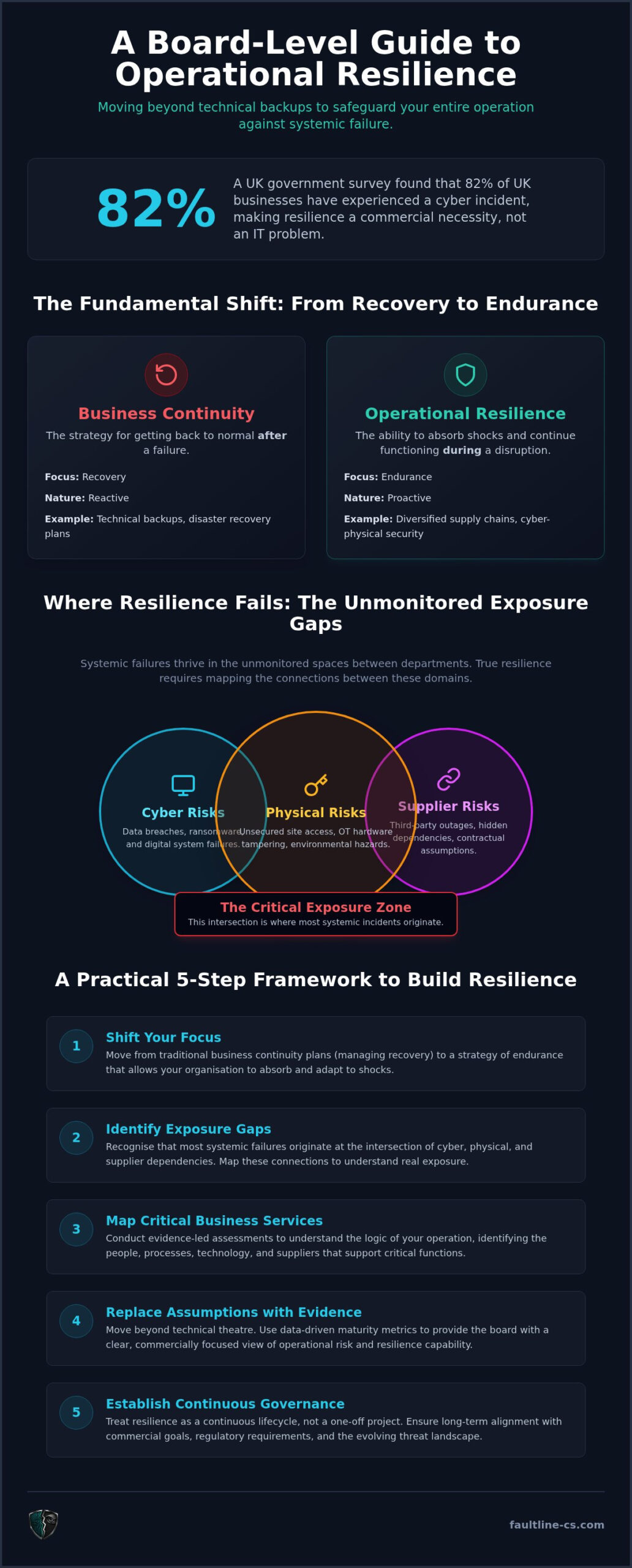
Five Steps to Improve Your Operational Resilience Framework
Resilience is not a project with a fixed end date; it is a continuous governance discipline. To understand how to improve operational resilience, directors must follow a structured path that moves from broad visibility to specific, data-driven actions. This five-step framework provides the board with a clear-eyed perspective on their actual exposure gaps whilst aligning security investments with commercial priorities.
Mapping Critical Assets and Dependencies
Identification is the foundation of endurance. You must map your critical business services and the specific assets that support them, identifying the “crown jewels” of your production or logistics lines. This process must look beyond your own four walls to include the utilities and third-party suppliers your operation relies upon. In a modern, secure operational centre, this mapping provides the visibility needed to manage the charcoal-and-teal reality of complex, interconnected systems. Utilising professional Operational Resilience Services ensures that hidden dependencies are identified before they become points of failure.
The second step is to conduct a fixed-price Exposure Assessment. This identifies hidden vulnerabilities across both cyber and physical domains, revealing the visible signals that attackers use to map your disruption path. This is “Pilot 0 thinking” in action, where assumptions are discarded in favour of hard evidence regarding how an intruder might actually navigate your infrastructure.
Defining Impact Tolerances for Senior Leadership
Impact tolerance is not a technical metric; it is a commercial decision. Step three requires senior leadership to determine the point at which disruption causes irreparable harm to customers, market integrity, or the business’s own viability. Determining these tolerances allows the board to prioritise security spend where it actually matters. It moves the conversation away from preventing all attacks to ensuring the business survives the ones that succeed, protecting both production and reputation.
The final stages of the framework involve active validation and long-term management. Step four requires you to stress test your incident response plans with realistic, cross-functional scenarios that include your physical and supplier dependencies. Finally, step five is the implementation of a continuous GRC framework. This ensures that resilience is not a one-off audit but an ongoing cycle of maturity that adapts as your operational landscape evolves.
Governance and Leadership: Managing the Resilience Lifecycle
Resilience is a moving target. It is a continuous governance cycle that demands constant oversight rather than a one-off compliance exercise. For the board, the primary challenge lies in translating technical signals into commercial logic. This shift is the core of the philosophy advocated by Cris Martlew and Paddy Hearty: a commitment to evidence over assumptions in every layer of the governance framework. Understanding how to improve operational resilience requires directors to move beyond the technical theatre of the server room and take ownership of the systemic risks that threaten production and reputation. When a vulnerability is identified, the board’s role is to ask “so what?” in terms of production risk and supplier dependency.
Integrating Martyn’s Law and Public Safety
For UK businesses, the resilience agenda now explicitly includes the Terrorism (Protection of Premises) Act 2025, commonly known as Martyn’s Law. With full requirements expected to come into force in Spring 2027, operational resilience must encompass public safety alongside digital uptime. Statutory guidance for compliance was published by the Home Office on 15 April 2026, providing a clear framework for organisations to prepare. Directors in manufacturing and logistics must ensure that their GRC strategies are integrated, addressing physical premises security with the same rigour applied to cyber defences. This is not just about compliance; it is about protecting the human lives and physical assets that sustain the operation.
Building a Culture of Operational Realism
True endurance is built on a culture of operational realism. This approach avoids the frantic alarmism often found in the security industry, opting instead for the calm, credible language of “Pilot 0 thinking”. When staff are trained to identify risks before they manifest as incidents, the organisation gains a layer of human resilience that technical systems alone cannot replicate. FaultLine’s 12-month ISO/IEC 27001 support programme provides a structured roadmap for this systemic improvement, moving the business through a methodical progression of maturity. This ensures that governance remains aligned with commercial outcomes rather than just technical fixes. For a deeper look at these leadership responsibilities and how to organise your defensive posture, consult our UK Operational Resilience: Strategic Guide for Directors.
By treating resilience as a continuous lifecycle, directors can move from a posture of reactive recovery to one of proactive endurance. This requires a steady hand and a clear-eyed perspective on the “gap” where real incidents begin. With the right governance framework, based on evidence rather than assumptions, UK organisations can navigate the complex regulatory and operational landscape of 2026 with confidence.
Securing the Logic of Your Operation
Operational resilience is a governance discipline that requires moving beyond the technical theatre of backups. It demands a clear-eyed understanding of the gap where cyber, physical, and supplier risks intersect. By shifting to Pilot 0 thinking, directors can replace assumptions with evidence-led insights that protect production lines and corporate reputation. This strategic shift ensures that your organisation remains functional during disruption rather than merely planning for a long recovery.
Mapping critical assets and defining commercial impact tolerances are the essential steps in understanding how to improve operational resilience across the entire lifecycle. FaultLine provides board-level reporting in plain English, ensuring that security investments are always aligned with business outcomes. Based in Belfast and serving the wider UK, our specialist team helps you navigate regulatory pressures with a pragmatic approach. Closing these exposure gaps starts with a transparent view of your current reality via our fixed-price Exposure Assessment at £5,000, which offers clarity with no hidden costs.
Take the first step towards a more resilient and predictable operational future today.
Frequently Asked Questions
What is the difference between operational resilience and business continuity?
Operational resilience is the ability of an organisation to absorb and adapt to shocks whilst maintaining core functions, whereas business continuity focuses on recovering systems after a failure. While continuity plans are often compliance-driven exercises, resilience is an active governance discipline. For directors in Belfast and across the UK, this means moving beyond backups to ensure the logic of the operation remains intact during a disruption. It is about endurance rather than just recovery.
How much does a professional operational resilience assessment cost?
A professional Exposure Assessment from FaultLine is offered at a fixed price of £5,000. This entry-level service provides board-level clarity without the hidden costs often associated with complex technical audits. Other operational resilience services are priced based on the specific scope and complexity of the organisation. This fixed-price model allows UK directors to obtain a realistic attack-path narrative and prioritised actions without an open-ended financial commitment or technical jargon.
Is operational resilience mandatory for UK businesses in 2026?
Regulatory requirements depend on your sector, but frameworks like DORA and the FCA rules are already in effect for financial firms. For broader UK industries, Martyn’s Law requirements are expected to be mandatory from Spring 2027, following statutory guidance published in April 2026. Directors must understand how to improve operational resilience to meet these evolving fiduciary duties and ensure compliance with public safety and data protection legislation across Northern Ireland and the UK.
How can manufacturing firms improve resilience without stopping production?
Manufacturing firms can improve resilience by mapping critical business services and identifying crossover risks between physical and digital domains without intrusive testing. An Exposure Assessment uses open-source intelligence and supplier analysis to find vulnerabilities without impacting the production line. This allows leaders in Craigavon or Ballymena to see their real exposure and implement “Pilot 0 thinking” without the risk of operational downtime or system interference. It focuses on the logic of the operation first.
What are the common hidden risks in a typical UK supply chain?
Hidden risks often reside in the gap between your internal controls and your suppliers’ actual technical recovery evidence. Typical UK supply chains suffer from unmonitored access points, leaked credentials, and over-reliance on third-party IT providers who lack demonstrable resilience. Many businesses rely on contractual promises rather than evidence. Identifying these dependencies is a core part of how to improve operational resilience and protecting your logistics or production flow from systemic failures.
Can an Exposure Assessment replace a standard cyber security audit?
An Exposure Assessment does not replace a standard audit; it complements it by providing a realistic, forward-looking view of attack paths. Whilst an audit checks for compliance against a fixed checklist, an assessment reveals the visible signals that an attacker would use to disrupt your business. It identifies the intersection of cyber, physical, and supplier risks that traditional technical audits frequently overlook, providing a more practical and commercially relevant picture of operational exposure.
How does physical security impact my digital operational resilience?
Physical security is a critical component of digital resilience because a breach of your premises can lead directly to a server room or OT system failure. Compromised key cards or unsecured access points provide an entry path for intruders to bypass digital firewalls entirely. In operationally sensitive sectors across Northern Ireland, physical-to-cyber crossover risks are often the most overlooked vulnerability in a board’s current security posture and demand urgent attention.
What role does the board play in managing operational resilience?
The board is responsible for setting impact tolerances and translating technical risks into commercial decisions. Directors must move beyond technical theatre to ensure that resilience is integrated into the broader governance framework. This involves defining how much downtime the business can survive and ensuring that accountability structures are in place. Leadership must advocate for evidence-over-assumptions to safeguard the long-term viability, reputation, and commercial trust of the organisation.

Article by
Alex J Morgan
Alex Morgan writes and develops content for FaultLine Cyber & Security Ltd. Alex has worked across web development, organic SEO, digital marketing and content creation since 2009, with a particular focus on making complex subjects clear, useful and easy to navigate.
Leave a Reply