


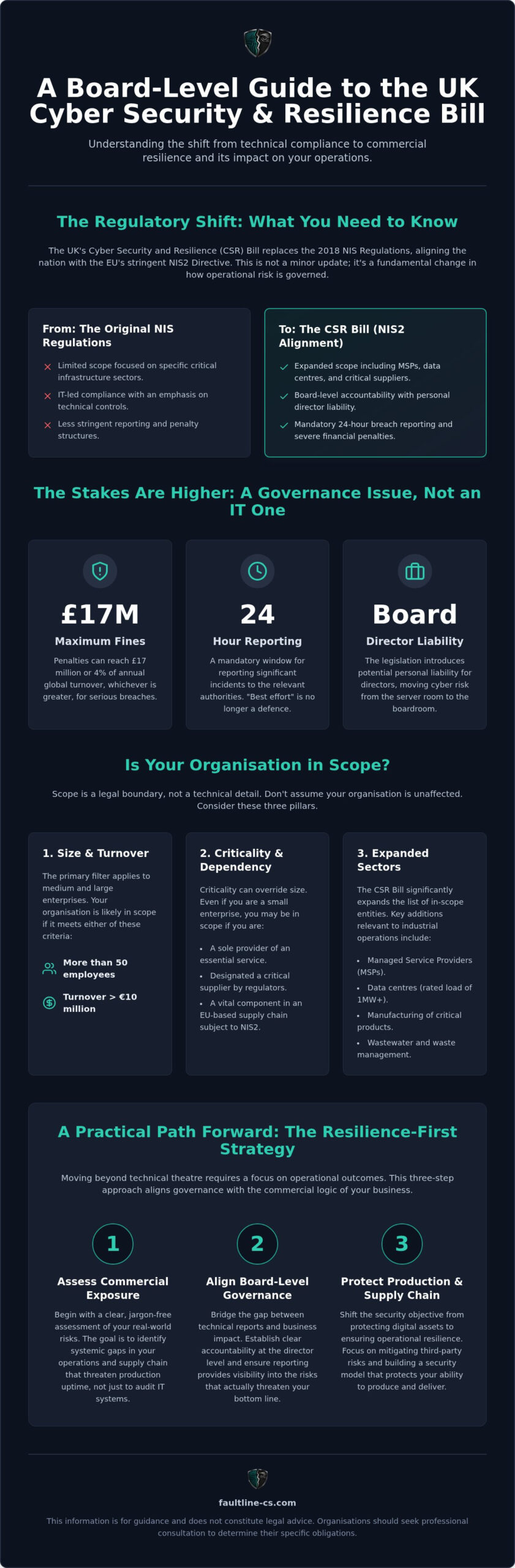
What if the greatest threat to your 2026 production targets isn’t a lack of orders, but a regulatory blind spot you’ve delegated to the server room? Many directors view the transition from the original NIS Regulations to the new Cyber Security and Resilience (CSR) Bill as a purely technical hurdle. This perspective is a dangerous oversight. At FaultLine, our NIS2 compliance consulting UK services focus on the commercial reality that resilience is a governance issue, not an IT one. The shift in UK law aligns us with the EU’s NIS2 standards, bringing mandatory reporting within 24 hours and fines that can reach £17 million or 4% of global turnover.
You’re likely exhausted by the constant stream of technical jargon and the confusion surrounding post-Brexit alignment. It’s frustrating to manage supplier risk when the goalposts seem to move every quarter. This guide offers a clear, board-level framework designed to move your organisation beyond technical theatre and towards genuine operational stability. We’ll examine your legal obligations under the CSR Bill, provide a practical roadmap for governance, and show you how to close the exposure gaps in your supply chain. By the end, you’ll have the clarity needed to lead with evidence rather than assumptions.
Key Takeaways
- Understand how the UK’s Cyber Security and Resilience (CSR) Bill replaces the original NIS framework and why your firm may still be in scope through EU supply chain contracts.
- Recognise the shift from IT-led security to board-level accountability, including the potential for personal director liability under the new regulations.
- Access a practical roadmap for governance that prioritises operational resilience and learn how NIS2 compliance consulting UK can help bridge the gap between technical systems and business logic.
- Identify hidden vulnerabilities within your third-party dependencies and move towards a security model that protects production uptime rather than just digital assets.
- Discover why a fixed-price Exposure Assessment is the most effective starting point for identifying systemic gaps without the need for overwhelming technical jargon.
Beyond the EU Border: Why NIS2 Matters for UK Operational Leaders
Geography is no longer a shield against regulatory gravity. Many UK directors mistakenly believe that the NIS2 Directive is a distant Brussels concern that stopped at the English Channel. In reality, the UK government is currently finalising the Cyber Security and Resilience (CSR) Bill, which mirrors the EU’s stringent standards to protect national infrastructure. For manufacturing and logistics firms, compliance isn’t just about following the law; it’s about maintaining the right to operate within international supply chains that now demand these higher levels of transparency.
To better understand the foundational principles of this framework, watch this summary:
The UK Regulatory Landscape in 2026
As of late 2026, the CSR Bill has moved through the House of Commons and is nearing Royal Assent. This legislation fundamentally expands the 2018 NIS Regulations to include Managed Service Providers (MSPs) and data centres with a rated load of 1MW or higher. Whether your operations are centred in a major hub like Belfast or distributed across the North of England, you cannot opt out of these standards. Regulators now have the power to designate critical suppliers, meaning your business might be legally bound by these rules simply because of the essential role you play in another firm’s production cycle.
Commercial Exposure vs Technical Compliance
There is a significant difference between holding a security certificate and being operationally resilient. Technical theatre often masks systemic gaps that lead to production downtime. Under the new UK regime, “best effort” is no longer a valid legal defence for leadership. Directors face personal accountability for oversight failures, with potential fines reaching £17 million or 4% of annual global turnover for serious breaches. This shift moves cyber risk from the server room to the boardroom, requiring a level of visibility that most current IT reporting fails to provide.
This is where the “so what?” becomes clear for senior leadership. A security breach in a secondary supplier can halt your entire production line, leading to immediate contract loss and reputational damage. Our NIS2 compliance consulting UK services focus on closing this exposure gap by aligning your governance with actual operational logic. We move beyond the IT department’s jargon to provide visibility into the risks that actually threaten your bottom line, ensuring that your compliance strategy serves your business outcomes rather than just satisfying a regulator.
Determining Your Scope: Is Your Organisation an Essential or Important Entity?
Scope is not a technical detail; it is a legal boundary. Many directors assume their firm is too small or too far removed from critical infrastructure to be affected. This assumption is a significant risk. The UK’s Cyber Security and Resilience Bill establishes a clear tiered system based on the criticality of your service and the size of your organisation. You cannot manage your exposure if you haven’t first categorised your legal standing.
The size-cap rule serves as the primary filter for the new framework. Generally, the regulations apply to medium and large enterprises. This means any firm with more than 50 employees or an annual turnover exceeding €10 million is now within the regulatory net. However, the concept of “criticality” can override size. If your business is the sole provider of a service or is vital to national stability, you may be in scope regardless of your headcount. For logistics and manufacturing leaders, this often means your status is determined by the sensitivity of the goods you move or produce.
The Essential Entity Checklist
Essential Entities (EE) represent the sectors most vital to the nation’s survival. This category includes energy, transport, health, and water, alongside digital infrastructure like data centres. If you are classified as an EE, you are subject to “ex-ante” supervision. This means the regulator will proactively audit your governance and risk management policies before an incident occurs. For a director, this status implies the highest level of personal liability and a requirement for constant, evidence-led reporting to the relevant authorities.
The Important Entity Checklist
Important Entities (IE) cover sectors that are critical but not foundational to the state’s immediate survival. This includes waste management, food production, and chemical manufacturing. The key difference here is “ex-post” supervision. Regulators will typically only investigate your governance after a breach or a significant incident has taken place. While this might seem less intensive, the penalties for being found unprepared are just as severe. Many firms seek NIS2 compliance consulting UK to align themselves with Essential standards even if they are classified as Important. This proactive approach is often a commercial necessity, as Tier 1 customers now frequently demand the higher standard as a baseline for supplier contracts. If you are unsure where your firm sits within these categories, it is often useful to discuss your specific operational profile with a specialist to avoid a misclassification that could lead to systemic downtime.
The NIS2 Compliance Checklist: Focusing on Operational Gaps and Supplier Risk
Compliance checklists are frequently treated as administrative burdens to be delegated and forgotten. This is a mistake. Under the UK’s Cyber Security and Resilience Bill, the checklist is the baseline for your legal defence. Effective governance requires policies that reflect the messy reality of your shop floor or warehouse, not a sanitised version of your IT environment. Our NIS2 compliance consulting UK services prioritise this operational truth over technical theatre by focusing on five core pillars.
- Governance and Risk Management: Policies must be actionable and understood by those on the front line. If a policy exists only in a PDF that no one reads, it provides no protection during a regulator’s audit.
- Incident Handling: You need a structured process for detecting, categorising, and reporting significant incidents within the 24-hour window mandated by the new regulations.
- Cyber Hygiene and Training: Security awareness shouldn’t be a once-a-year video. It must be a continuous effort to change behaviour amongst staff who handle critical systems.
- Technical Controls: Use of multi-factor authentication and cryptography is expected where appropriate, particularly for remote access to operational technology (OT) environments.
- Supply Chain Security: Identifying and managing the risks resulting from your organisation’s relationships with direct suppliers.
Securing the Supply Chain
Your resilience is only as strong as your most vulnerable partner. A deep-dive dependency analysis of your top five suppliers often reveals that your biggest risks are not within your own four walls. There is frequently a gap between what a supplier promises in a contract and their actual technical reality. Auditing these partners shouldn’t be about creating friction; it’s about mutual survival. By verifying their security posture, you protect your own production schedules from third-party failures that could lead to systemic downtime.
Operational Continuity and Resilience
Real-world resilience accounts for the physical-to-cyber crossover. If a cyber incident shuts down your automated sorting system or production line, your business continuity plan must address the physical bottleneck, not just the server recovery. Testing your recovery evidence is vital. Many firms assume their backups work, only to discover during a crisis that the data is corrupted or the restore time is commercially unviable. A structured resilience strategy ensures that your recovery plans are backed by evidence rather than assumptions. This move from “best effort” to proven recovery is what separates compliant firms from those merely performing technical theatre.
Board-Level Governance: Moving from Technical Theatre to Real Accountability
The delegation of cyber risk to the IT department is a legacy behaviour that is no longer legally or commercially defensible. Under the UK’s Cyber Security and Resilience Bill, the “I didn’t know” defence has been dismantled. Directors are now explicitly required to approve and oversee the implementation of risk management measures. This shift moves cyber security from a technical footnote to a core governance duty, where senior leaders can be held personally accountable for systemic failures in oversight.
Governance, Risk, and Compliance (GRC) shouldn’t be an exercise in collecting certificates to satisfy an auditor. It’s about establishing a clear-eyed perspective on reality. Many boards are currently blinded by technical theatre; they receive reports filled with green checkboxes that mask deep-seated operational vulnerabilities. Specialised NIS2 compliance consulting UK provides the necessary bridge between technical data and board-level decision-making, ensuring that leadership has the visibility required to lead with evidence rather than assumptions.
Reporting for Senior Leadership
Effective reporting must strip away the jargon and focus on commercial exposure. When a director asks “so what?”, the answer shouldn’t be a list of firewall logs; it should be a calculation of potential production downtime or the risk of losing a primary supplier contract. Integrating these insights into the standard corporate risk register ensures that cyber risk is treated with the same gravitas as financial or health and safety risks. For a deeper look at how to structure these insights, see our guide on board level cyber risk reporting.
Training and Culture
Resilience is as much about human behaviour as it is about technical systems. Security awareness must start at the top to be effective. If the board treats compliance as a “tick-box” exercise, that attitude will permeate through every level of the organisation. Promoting a culture of transparency is vital. You need to create an environment where staff feel safe identifying gaps or reporting incidents immediately, rather than hiding them for fear of blame. A culture of silence is the greatest ally of systemic downtime, whilst a culture of evidence-led transparency is your strongest defence.
Implementing a Resilience-First Strategy with FaultLine
Leadership often stalls because the perceived cost of compliance feels like an open-ended liability. This hesitation creates the very exposure gap that regulators are now targeting. At FaultLine, we advocate for a resilience-first strategy that begins with evidence rather than assumptions. Our methodology connects the dots between cyber vulnerabilities, physical security, and supplier dependencies, ensuring your compliance journey supports your operational continuity. We focus on business outcomes, moving away from the technical theatre that often distracts from real-world vulnerabilities.
The £5,000 Exposure Assessment
Visibility is the prerequisite for compliance. We provide a fixed-price Exposure Assessment at £5,000, designed to act as a controlled wake-up call for senior leadership without the prohibitive cost of a full-scale audit. Unlike a traditional technical assessment that produces a list of software patches, this service delivers realistic attack-path narratives. It demonstrates exactly how a breach could navigate through your specific environment to halt production or compromise sensitive logistics data. This provides the board with a prioritised action plan based on commercial risk, allowing you to allocate resources where they will have the greatest impact on your stability.
Your Partner in GRC and Resilience
Compliance is not a one-off event; it is a state of constant readiness. We specialise in helping manufacturing and logistics firms in Belfast and across the UK navigate these complex requirements with a steady hand. Our stage-based security programme supports long-term ISO 27001 alignment, providing a structured path toward maturity that grows with your organisation. This includes bespoke policy creation that reflects the actual behaviour of your staff and the operational logic of your business. By integrating our GRC consulting services, you ensure that your governance framework is a living part of your business strategy rather than a forgotten PDF.
Moving from a state of uncertainty to one of controlled resilience requires a methodical approach. The FaultLine Cyber Readiness Assessment, powered by IntelSensus, serves as the foundation for this transition. From this initial report, we lead board-level workshops that strip away the technical jargon and focus on strategic alignment. Our NIS2 compliance consulting UK ensures you understand your legal obligations whilst building a firm that is inherently more resilient to the systemic risks of 2026. The goal is simple: to provide the clarity you need to lead your organisation with confidence.
Moving Beyond Compliance to Operational Certainty
Compliance with the UK’s Cyber Security and Resilience Bill is not a box-ticking exercise; it’s a strategic necessity for maintaining your position in the global supply chain. By shifting focus from technical theatre to real-world accountability, directors can protect their firms from the systemic downtime that often follows a regulatory breach. Our NIS2 compliance consulting UK services help you identify the specific exposure gaps where your digital, physical, and supplier risks overlap.
Using the FaultLine Cyber Readiness Assessment, powered by IntelSensus, our Northern Ireland based consultants provide a clear roadmap for governance. We prioritise practical business outcomes over technical jargon; this ensures that your resilience strategy is grounded in evidence rather than assumptions. Visibility is the first step toward long-term stability.
You have the opportunity to turn a regulatory mandate into a distinct commercial advantage. By acting now, you ensure your organisation is not just compliant, but fundamentally more resilient for the challenges of 2026 and beyond.
Frequently Asked Questions
Does NIS2 apply to UK companies after Brexit?
Indirectly, yes, via the UK’s Cyber Security and Resilience (CSR) Bill which mirrors the EU’s standards. If your organisation operates within the EU or provides services to EU customers, you must comply with the NIS2 Directive directly. For firms in Belfast or Derry/Londonderry, this means alignment is a commercial necessity to maintain access to international markets and satisfy the security requirements of global supply chain partners.
What are the fines for non-compliance with NIS2-style regulations in the UK?
Under the UK’s Cyber Security and Resilience Bill, serious breaches carry fines of up to £17 million or 4% of annual global turnover. Less serious failures, such as failing to register with the regulator, can result in fines up to £10 million or 2%. Daily penalties of up to £100,000 may also apply for ongoing non-compliance. These figures align the UK with the most stringent EU standards to ensure national infrastructure resilience.
What is the difference between an Essential Entity and an Important Entity?
Essential Entities operate in foundational sectors like energy, transport, and health, and are subject to proactive supervision. This means regulators will audit your governance before an incident occurs. Important Entities cover sectors like food production and waste management, typically facing “ex-post” supervision only after a breach is reported. Whilst the supervisory intensity differs, both categories must implement the same high standards of risk management and incident reporting to remain compliant.
Can directors be held personally liable for NIS2 failures?
Yes, the new UK legislation makes cybersecurity a clear board-level governance issue. Directors are responsible for overseeing risk management measures and can be held personally accountable for systemic failures in oversight. This marks a significant shift from delegating security to technical departments. Leadership must now lead with evidence, ensuring they have the visibility required to make informed decisions about operational risk and the stability of their business functions.
How does NIS2 affect my relationship with my suppliers?
The regulations require a fundamental shift in how you manage third-party dependencies. You must conduct thorough supplier risk analysis to identify vulnerabilities within your external chain. This requirement is a central pillar of NIS2 compliance consulting UK, as it forces organisations to look beyond their own perimeter. By auditing the security posture of your key partners, you reduce the risk of a supplier breach causing systemic downtime in your own operations.
Do I need ISO 27001 to be NIS2 compliant?
ISO 27001 is not a legal requirement, but it provides an excellent framework for achieving compliance. The standards overlap significantly, particularly regarding risk management, asset control, and incident response. Implementing an Information Security Management System (ISMS) aligned with ISO 27001 creates the evidence model and policy suite that regulators expect to see. Our stage-based programmes use these international standards to build a robust foundation for meeting your UK regulatory obligations.
What is the first step a UK director should take for NIS2 readiness?
The first step is identifying your real risk profile through a controlled Exposure Assessment. For directors in Belfast or Lisburn, this reveals the hidden gaps where cyber, physical, and supplier risks intersect. This assessment provides a board-level narrative of potential attack paths without the jargon of a technical audit. It allows leadership to prioritise investment based on commercial impact rather than technical theatre, ensuring resources are allocated to protect the bottom line.
How often should we review our NIS2 compliance status?
Compliance requires continual improvement rather than a single check. You should review your status annually at a minimum, or whenever significant changes occur in your operational technology or supplier base. Regular board-level workshops ensure that governance remains aligned with the evolving threat landscape in Northern Ireland and the wider UK. Professional NIS2 compliance consulting UK services can provide the independent oversight needed to verify that your resilience measures remain effective and evidence-led.

Article by
Alex J Morgan
Alex Morgan writes and develops content for FaultLine Cyber & Security Ltd. Alex has worked across web development, organic SEO, digital marketing and content creation since 2009, with a particular focus on making complex subjects clear, useful and easy to navigate.
Leave a Reply