


Most security audits are expensive exercises in technical theatre that leave the board no better informed about their actual commercial exposure. You are likely tired of technical reports that fail to explain how a breach actually halts production or compromises a critical supplier. This disconnect is why a strategic security gap analysis UK is no longer optional; it’s the only way to identify the invisible intersections between your physical premises and digital assets.
We will show you how to move beyond simple box-ticking to build a prioritised roadmap for genuine operational resilience. By adopting “Pilot 0” thinking, you can align your organisation with ISO 27001:2022 and the latest Cyber Essentials v3.3 requirements without wasting spend on unnecessary tools. This article explores a methodology that strips away the jargon to reveal a clear, evidence-led view of your business risk, ensuring your security investments finally answer the “so what?” for the leadership team.
Key Takeaways
- Understand why traditional IT audits often fail by adopting “Pilot 0” thinking to challenge your baseline security assumptions.
- Learn how a comprehensive security gap analysis UK identifies hidden vulnerabilities where cyber, physical, and supplier risks intersect.
- Discover why an Exposure Assessment provides a strategic roadmap for production continuity instead of a generic shopping list of technical tools.
- Gain a clear framework for translating complex findings into plain-English reports that support board-level decision-making and ISO 27001 alignment.
- Explore a practical 12-month roadmap for building operational resilience based on real-world manufacturing and logistics case studies.
Why Traditional Security Audits Often Miss the Real Exposure
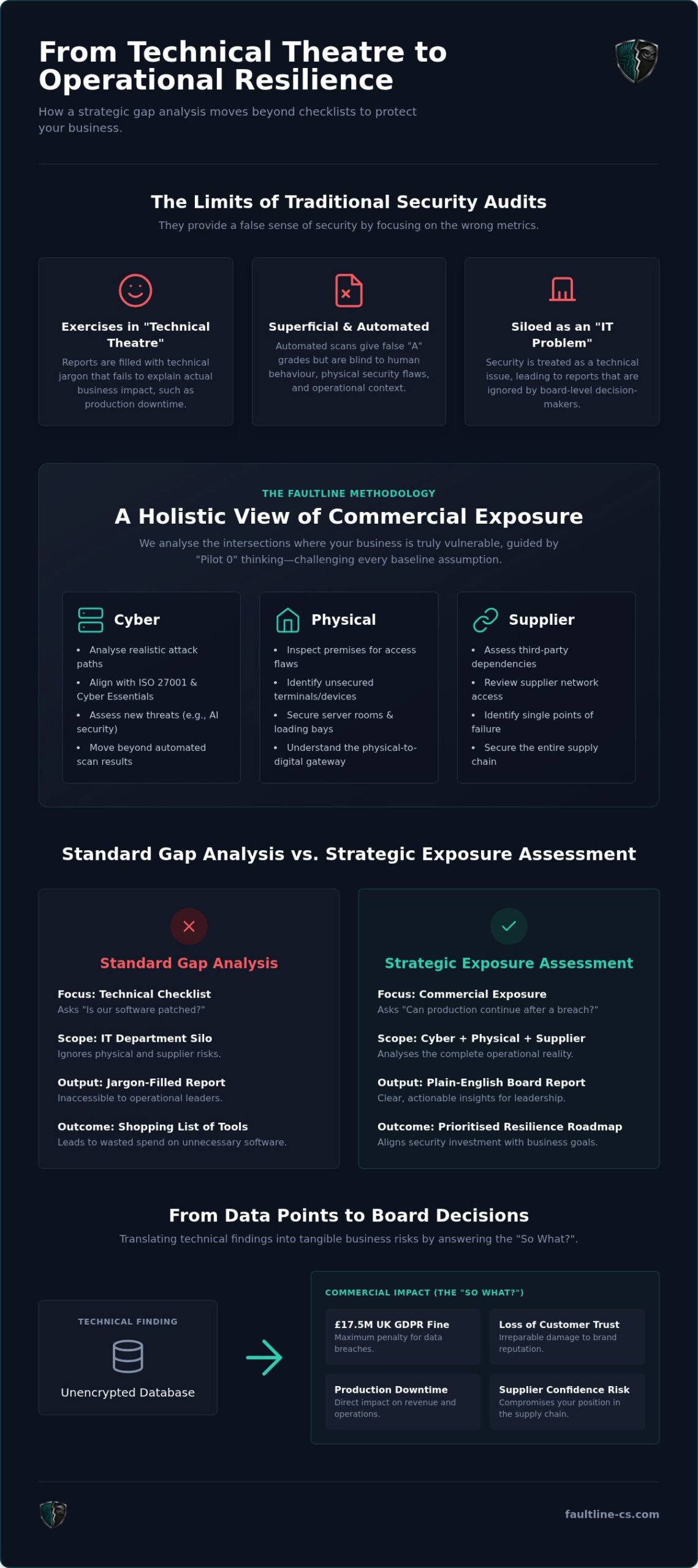
Traditional security audits are often exercises in technical theatre. They provide a snapshot of software versions and patch levels but fail to address how a business actually functions. This superficial approach creates a dangerous disconnect between a technical gap analysis and the operational reality of the shop floor. For a director in a UK logistics or manufacturing firm, a report full of jargon does not explain why a single compromised terminal could halt a production line for days.
We advocate for “Pilot 0” thinking. This approach requires us to discard the initial assumptions provided by internal teams, which are often the weakest point in a security strategy. By questioning the baseline, a professional security gap analysis UK uncovers vulnerabilities that have been hidden by years of habit or operational logic. It moves the conversation away from software and towards commercial exposure.
To better understand the fundamental principles of identifying these discrepancies, watch this helpful video:
The Limitations of Automated Vulnerability Scans
Automated tools are efficient at identifying known software bugs, yet they are blind to human behaviour and operational context. You might receive a report showing an “A” grade for your external perimeter, but this provides a false sense of security. A scan cannot see that your staff leave back doors propped open for ventilation or that a critical supplier has unrestricted access to your internal network.
The distinction between a vulnerability and a realistic attack path is critical. A technical bug is only a risk if it can be reached and exploited to cause business harm. Without this context, directors end up with a long list of technical fixes that don’t actually protect production or prevent downtime. Our focus remains on the charcoal-and-teal reality of modern manufacturing, where physical and digital risks are inseparable.
Moving Beyond the IT Department
Security is a board-level governance issue. When it’s treated as a siloed IT problem, the resulting reports are often ignored by those who make the commercial decisions. Effective security services must bridge this gap by translating technical data into plain English that resonates with operational leaders.
Every finding in an assessment must answer the “so what?” question. If a database is unencrypted, the risk isn’t just a compliance failure; it’s the potential for a £17.5 million UK GDPR fine or a total loss of customer trust. By removing technical silos, you ensure that security investments are aligned with business outcomes rather than just buying more software.
The FaultLine Methodology: Analysing Gaps Across Cyber, Physical, and Supplier Domains
Security is not a series of isolated technical hurdles. True resilience exists at the intersection of your digital infrastructure, your physical premises, and your third-party dependencies. We define this as the exposure gap. It is the space where a broken lock on a server room door or a compromised supplier login becomes a catastrophic business failure. A robust security gap analysis UK must look beyond the screen to account for these systemic overlaps.
Our approach prioritises evidence over speculative, fear-based marketing. Whilst many firms focus on basic patching, the landscape is shifting towards more complex threats. For instance, the UK government’s recent AI security gap analysis highlights how emerging technologies are already creating new vectors for exploitation that traditional audits simply ignore. We replace these blind spots with a clear-eyed assessment of your operational reality.
The Intersection of Physical and Digital Security
Physical access is often the path of least resistance for a determined intruder. In modern operational environments, a visitor’s unattended laptop or an unsecured terminal in a loading bay is a direct gateway to your core network. This is why we integrate physical assessments with digital governance. With Martyn’s Law (the Terrorism Protection of Premises Act 2025) expected to begin enforcement in Spring 2027, UK businesses must now consider physical security as a statutory requirement rather than an operational afterthought. We assess the “operational trust” assumptions that often leave your physical infrastructure vulnerable to digital compromise.
Supplier and Third-Party Risk Analysis
Supply chains are the modern Trojan Horse. Research indicates that third-party involvement was a factor in 48% of breaches globally in 2026. Despite this, only 15% of UK businesses have reviewed the cyber risks posed by their immediate suppliers. Contractual clauses are not the same as security controls. Many logistics and manufacturing firms rely on the assumption that their partners are secure, yet rarely verify the evidence. The FaultLine Exposure Assessment provides a practical solution by evaluating up to five key suppliers to identify where their vulnerabilities become your liabilities. This ensures your resilience strategy isn’t undermined by a single weak link in the chain.
If you are uncertain where your supplier risks end and your internal responsibilities begin, you may wish to speak with our team for a clearer perspective on your current exposure.
Exposure Assessment vs Standard Gap Analysis: A Commercial Comparison
A standard gap analysis often serves as little more than a preamble to a sales pitch. It typically results in a generic shopping list of expensive security tools that may not address your specific operational risks. In contrast, an exposure assessment prioritises realistic attack paths and business continuity. It asks how a failure in one area impacts the whole, moving beyond the technical theatre that often characterises a security gap analysis UK.
This distinction is vital for manufacturing and logistics leaders who need to protect production lines rather than just collect certificates. Whilst a standard audit might identify a missing patch, an exposure assessment explains how that vulnerability could be used to halt your entire distribution network. It provides a narrative that directors understand; it focuses on commercial survival rather than technical compliance.
Fixed-Price Clarity vs Open-Ended Consulting
Budgetary uncertainty is a major deterrent for senior leadership when commissioning security work. We address this by offering a fixed-price Exposure Assessment at £5,000. This entry-level service provides UK businesses with absolute clarity on costs from the outset, avoiding the “open-ended consulting” trap that often leads to scope creep and spiralling fees.
The output is a plain-English, board-level report that details realistic attack narratives. We explicitly avoid the “penetration testing” trap at this initial stage. Whilst penetration testing has its place, jumping straight to it before understanding your broader exposure is inefficient. Our assessment identifies where the real risks lie, ensuring that any subsequent technical testing is targeted and purposeful. This approach also helps address the widening cyber security skills gap by providing your existing team with a clear, prioritised roadmap they can actually execute.
IntelSensus: Data-Driven Readiness
The FaultLine Cyber Readiness Assessment, powered by IntelSensus, takes this clarity a step further. It provides a structured maturity framework that moves away from subjective opinions. By using data-driven insights, you can justify every penny of security spend to the board, showing exactly how each investment reduces your commercial exposure and improves operational resilience.
This framework ensures that your governance, risk, and compliance (GRC) efforts are not just box-ticking exercises. Instead, they become a strategic tool for growth. For organisations looking to move towards a more robust posture, our FaultLine Services provide the expertise needed to navigate complex standards like ISO 27001:2022 without the usual friction. By aligning technical maturity with business goals, we help you build a resilient organisation that is prepared for reality, not just an audit.
Interpreting the Findings: Moving from Data Points to Board Decisions
Technical findings are frequently presented as a wall of noise. For a director, a list of fifty unpatched servers is a data point without a destination. To be effective, a security gap analysis UK must translate these vulnerabilities into commercial risks that impact the bottom line. We move beyond technical theatre by categorising every finding through the lens of production risk and potential downtime.
Prioritisation is the core of this process. If a vulnerability in your warehouse management system could realistically halt distribution for forty-eight hours, it demands immediate attention regardless of its technical complexity. This approach allows leadership to see security as a contributor to operational resilience rather than a drain on the budget. It shifts the focus from fixing software to protecting the flow of goods and services.
Board-Level Reporting for Senior Leadership
Directors don’t need a list of patches; they need a decision-making matrix. This matrix should clearly outline which gaps represent a systemic threat and which are merely technical debt. Our reporting uses calm, credible language to unpack these risks, ensuring that the “so what?” is answered for every observation. This clarity is essential for effective governance, as outlined in our guide on Cybersecurity for Directors in the UK. When the board understands the commercial exposure, they can make informed decisions about resource allocation and risk appetite.
Aligning with UK Regulatory Standards
A structured gap analysis is the most efficient way to prepare for evolving regulations. With the UK Cyber Security and Resilience Bill progressing through Parliament in 2026, firms in critical sectors must demonstrate a higher standard of oversight. This assessment also provides the evidence dossier required for Cyber Essentials Plus and smoother cyber insurance renewals. By following a Cyber Security Due Diligence Checklist, you ensure that your organisation is not only compliant but genuinely resilient. This evidence-led approach serves as the perfect springboard for a full ISO/IEC 27001 implementation, providing a clear roadmap for the next twelve months of your security journey.
Implementing Resilience: The FaultLine Cyber Readiness Assessment in Practice
Real-world implementation is the final validation of any security gap analysis UK. For a mid-sized logistics firm we recently partnered with, the assessment revealed that their primary risk wasn’t a lack of firewalls, but a lack of visibility over their third-party maintenance portal. By shifting their focus from generic IT fixes to this specific operational dependency, they were able to secure their distribution chain without the need for excessive capital expenditure.
Operational resilience is not a single event; it is a journey of continual improvement. This firm used the findings as the foundation for a 12-month programme toward ISO/IEC 27001:2022 certification. This methodical approach allowed them to embed security into their daily workflows rather than treating it as a burdensome layer of compliance. It moved the organisation away from “box-ticking” and towards a culture where security is understood at every level of the warehouse and office.
Step-by-Step Implementation of Security Controls
The first step in any successful rollout is defining a clear scope that identifies your most critical business assets. We work with leadership to create bespoke policies that reflect the actual behaviour of staff on the shop floor. For our logistics client, this meant revising access protocols for shared terminals in loading bays. We conduct mid-point test audits throughout the year to catch weak evidence early, ensuring that when the final certification audit arrives, there are no surprises. This proactive stance turns security from a defensive cost into a predictable operational standard.
Securing the Future: AI Governance and Beyond
As we move through 2026, the challenge of responsible AI use is becoming a central concern for UK manufacturing. With the ICO’s legally binding Code of Practice on AI expected to influence every sector by the end of the year, businesses must ensure their automated systems are transparent and secure. A comprehensive Cyber Resilience Planning UK framework must now account for these algorithmic risks. The “gap” in your security is often where the greatest risk lives, but it is also precisely where your resilience begins. By identifying these systemic overlaps today, you prepare your organisation for the technological shifts of tomorrow.
Building a Resilient Operational Future
Security is no longer a peripheral IT concern; it’s a fundamental pillar of operational continuity. By moving beyond technical theatre and embracing “Pilot 0” thinking, you can identify the systemic vulnerabilities that generic audits miss. A professional security gap analysis UK provides the visibility needed to align your physical premises, digital assets, and supplier dependencies into a single, resilient framework.
This methodology replaces speculative fear with evidence-led insight. We deliver board-level, plain-English reporting that focuses on realistic attack-path narratives rather than endless lists of software patches. This clarity ensures that your investments are prioritised by their impact on production and downtime. Whether you require specialist GRC and ISO 27001 support or simply need to understand your current commercial exposure, we provide the steady hand necessary to navigate these complex environments.
Taking the first step towards resilience ensures that your business remains robust and prepared for the reality of modern threats. We look forward to helping you secure your operational future.
Frequently Asked Questions
What is the difference between a security gap analysis and an exposure assessment?
A standard gap analysis compares your current controls against a specific framework like ISO 27001. In contrast, an exposure assessment identifies realistic attack paths across cyber, physical, and supplier domains. FaultLine focuses on the “exposure gap” where these functions overlap, revealing risks that a checklist might miss. This approach provides a practical picture of commercial risk rather than just technical compliance, helping directors in Belfast and across the UK make informed decisions.
How much does a professional security gap analysis cost in the UK?
Pricing for a security gap analysis UK varies based on the size of the organisation and the depth of the review. FaultLine provides a fixed-price Exposure Assessment at £5,000 to offer senior leadership absolute budgetary clarity. This entry-level service includes board-level reporting and a realistic attack-path narrative. It avoids the open-ended costs often associated with technical consulting, allowing manufacturing and logistics firms to understand their risks before committing to heavy investment in tools.
How long does it take to conduct a full cyber readiness assessment?
The duration of an assessment depends on the desired outcome. A comprehensive FaultLine Cyber Readiness Assessment is often the first stage in a wider 12-month ISO 27001 implementation programme. Whilst the initial exposure report is delivered relatively quickly, building true operational resilience is a journey of continual improvement. For businesses in Northern Ireland, we prioritise a staged delivery that matches your commercial pressures, ensuring that findings are both manageable and actionable for your team.
Do we need a gap analysis if we already have Cyber Essentials?
Cyber Essentials is a vital baseline, yet it rarely covers the complex operational risks found in manufacturing or logistics. A dedicated gap analysis explores the intersections of physical security and supplier dependency that baseline certifications overlook. It answers the “so what?” for directors by explaining how technical failures impact production. Relying solely on basic certificates can leave significant blind spots in your governance, especially as UK regulatory requirements for supply chain oversight continue to evolve.
Can a gap analysis help our business with cyber insurance renewals?
Insurers now require more than just a completed questionnaire; they demand evidence of proactive risk management. A gap analysis provides a structured evidence dossier that demonstrates you understand and are managing your commercial exposure. This transparency often leads to smoother renewals and more favourable terms. By documenting your controls and remediation roadmaps, you show insurers that your organisation is a lower risk, which is critical for logistics and engineering firms facing rising premiums.
What industries in the UK benefit most from an exposure assessment?
Operationally-sensitive sectors such as manufacturing, logistics, engineering, and infrastructure benefit most from this approach. These industries rely on a complex mix of physical assets, digital systems, and third-party suppliers. In regions like Belfast and the wider UK, where supply chain integration is high, understanding where these functions overlap is essential. An assessment identifies the gaps where real incidents begin, protecting production lines and distribution networks from the catastrophic impact of downtime.
Is a gap analysis the same as a penetration test?
They are distinct but complementary. A penetration test is a technical deep-dive into specific software vulnerabilities, whilst a gap analysis evaluates your broader governance, supplier risks, and physical controls. We don’t perform penetration testing directly; instead, we partner with specialists when deep technical testing is required. Our role is to provide the strategic context, ensuring that any subsequent technical testing is targeted at the areas that pose the greatest risk to your business.
How does physical security impact our cyber security gap analysis?
Physical security is often the weakest link in a digital defence strategy. Unsecured terminals in loading bays or unmonitored visitor access can provide a direct pathway into your core network. We evaluate these “operational trust” assumptions to see how physical breaches lead to cyber compromise. This is particularly relevant with the upcoming Martyn’s Law requirements, as UK businesses must now integrate physical safety and digital resilience into a single, cohesive governance framework.

Article by
Alex J Morgan
Alex Morgan writes and develops content for FaultLine Cyber & Security Ltd. Alex has worked across web development, organic SEO, digital marketing and content creation since 2009, with a particular focus on making complex subjects clear, useful and easy to navigate.
Leave a Reply