


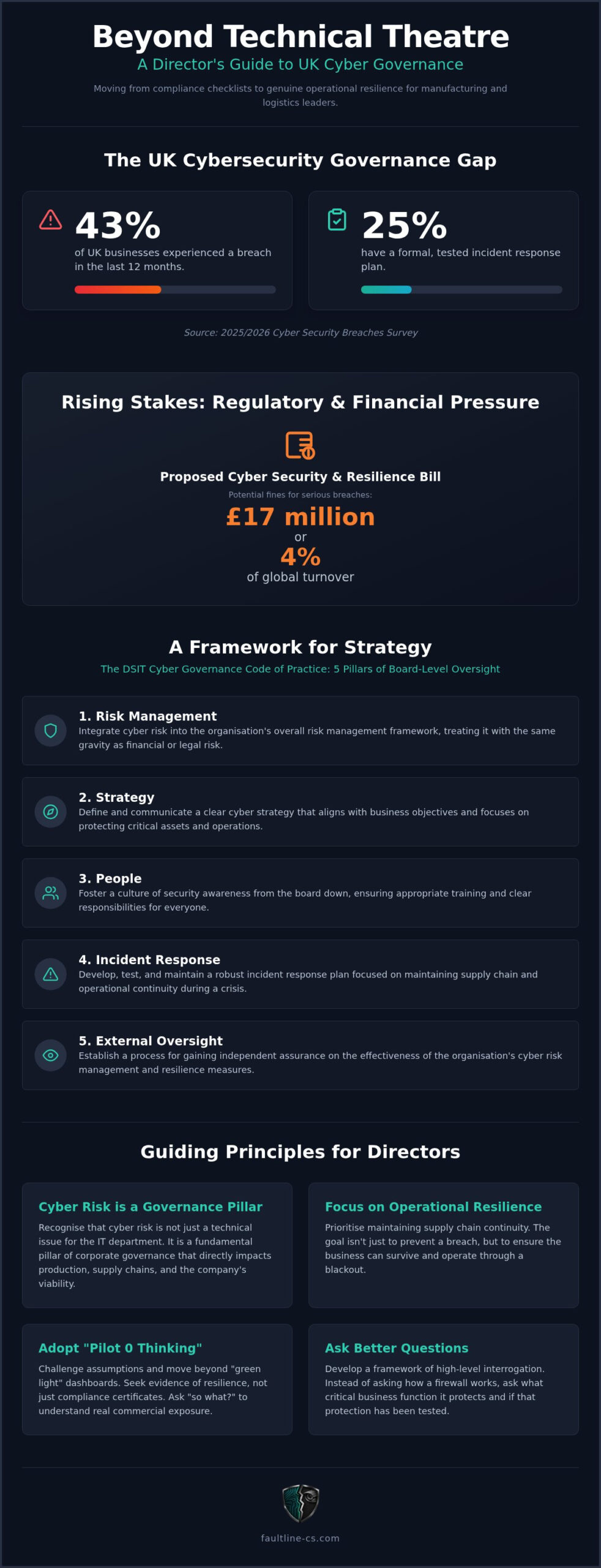
Technical theatre is not a strategy. For many UK boards, the flurry of IT updates and “green” compliance dashboards provides a false sense of security whilst leaving systemic vulnerabilities untouched. This gap in cybersecurity for directors UK is stark; 43% of UK businesses experienced a breach in the last 12 months, yet only 25% have a formal, tested incident response plan according to the 2025/2026 Cyber Security Breaches Survey.
You’re likely feeling the weight of this gap. Between the 2025 Cyber Governance Code of Practice and the new Cyber Security and Resilience Bill, the pressure to demonstrate genuine oversight has never been higher. It’s exhausting to balance these mandates whilst deciphering technical jargon that obscures real business risk. This handbook provides a clear path through the complexity of cybersecurity for directors UK. We move beyond the hype to offer a pragmatic guide for mastering the governance of operational exposure. You’ll learn how to ask the right questions in board meetings, understand your specific legal accountabilities, and ensure security spend aligns with actual commercial risks in manufacturing and logistics.
Key Takeaways
- Recognise that cyber risk is a fundamental pillar of corporate governance rather than a technical issue relegated to the IT department.
- Understand your obligations under the DSIT Cyber Governance Code of Practice to ensure your strategy aligns with current UK regulatory expectations.
- Identify hidden vulnerabilities where physical security and digital access intersect, a critical focus for effective cybersecurity for directors UK.
- Develop a framework of high-level interrogation techniques to measure real business exposure and production risk during board meetings.
- Prioritise operational resilience by ensuring incident response plans are tested for their ability to maintain supply chain continuity during a crisis.
Beyond the Server Room: Why Cyber Governance is a Director Duty
Cybersecurity is no longer a technical footnote managed by the IT department. It has evolved into a fundamental pillar of corporate governance. For directors in manufacturing and logistics, the oversight of systemic risks is now a primary responsibility. A breach isn’t just a data leak; it’s a production halt or a supply chain collapse that threatens the company’s viability. Directors are responsible for the oversight of these systemic risks that could effectively stop the business in its tracks.
Regulators are increasing the pressure. The Department for Science, Innovation and Technology (DSIT) and the National Cyber Security Centre (NCSC) expect boards to move beyond passive reporting. With 43% of UK businesses reporting a breach in the 2025/2026 Cyber Security Breaches Survey, the shift from technical protection to business-wide exposure management is the defining challenge of 2026. The proposed Cyber Security and Resilience Bill, introduced in late 2025, underscores this by proposing fines for serious breaches of up to £17 million or 4% of global turnover.
To better understand how these partnerships function at a strategic level, watch this helpful video:
Defining Cyber Governance for the Modern Board
Managing IT systems is about keeping the lights on; governing cyber risk is about ensuring the business survives a blackout. Effective cybersecurity for directors UK requires understanding how digital vulnerabilities translate into commercial exposure. Under UK company law, specifically the duty to promote the success of the company, directors must exercise reasonable care, skill, and diligence in risk oversight. This includes identifying where production dependencies rely on vulnerable digital infrastructure.
Failure to demonstrate active engagement can impact director liability and professional indemnity insurance. Insurers are increasingly scrutinising board-level involvement before renewing policies. Governance isn’t about knowing how a firewall works; it’s about knowing if that firewall protects the specific server that controls your entire logistics fleet. It’s about visibility into the gaps that IT teams might overlook whilst focusing on technical maintenance.
The Commercially Skeptical Perspective: Avoiding Technical Theatre
Many boards are lulled into a false sense of security by “green light” dashboards. This is technical theatre. These metrics often hide fundamental operational gaps that a determined adversary can exploit. Whilst the Cyber Essentials scheme provides a necessary baseline for security, it is not a complete strategy for a complex organisation. Compliance does not equal resilience.
We advocate for “Pilot 0 thinking”. This involves stripping away assumptions of trust and starting with the most basic operational realities. Directors should look for evidence of resilience rather than just compliance certificates. At FaultLine, our services focus on revealing these hidden risks at the intersection of business functions, ensuring that security spend aligns with actual commercial exposure rather than just ticking a box. This strategic approach to cybersecurity for directors UK ensures that the board is governing the business, not just the technology.
The UK Cyber Governance Code of Practice: A Framework for Strategy
The DSIT Cyber Governance Code of Practice, published on 8 April 2025, is the definitive benchmark for 2026. It moves away from technical checklists and focuses on five pillars: Risk Management, Strategy, People, Incident Response, and External Oversight. This framework is essential for cybersecurity for directors UK, as it translates technical complexity into a structured governance model that boards can lead. It ensures that cyber risk is treated with the same commercial gravity as financial or legal risk.
The Code organises oversight to ensure accountability sits with the board rather than being delegated to technical departments. Whilst frameworks like ISO 27001:2022 provide the management system, the Code demands that directors define the risk appetite and monitor its execution. Aligning your board’s strategy with these pillars is the most effective way to master cybersecurity for directors UK in an increasingly regulated environment. This approach moves the conversation from “are we secure?” to “how resilient is our business model?”
Pillar A: Risk Management and Strategy
Cyber risk must be integrated into the general corporate risk register to receive appropriate strategic attention. A long-term strategy is vital; it must survive changes in IT leadership or the adoption of new technologies. Directors should use a Cyber Security Due Diligence: A Strategic Checklist for UK Directors to verify that goals are based on evidence. This ensures security investments protect critical business functions rather than providing broad, unfocused technical protection.
Pillar B: People and Culture
Culture starts at the top. Moving beyond basic awareness training means fostering a culture of security ownership where every employee understands their role. The board’s role is to model secure behaviour and provide the CISO with the authority to drive change. Using an Insider Threat Risk Assessment: UK Leadership Guide 2026 helps directors understand the human factors behind systemic gaps. This collective responsibility makes the firm more resilient to the social engineering tactics that account for 38% of identified breaches.
If you are unsure how these pillars apply to your specific operational environment, you can speak with our advisors for a tailored perspective on governance alignment.
Identifying the Exposure Gap: Where Crossovers Create Risk
Real business exposure often hides in the gaps between traditional departments. In manufacturing and logistics, the boundary between physical operations and digital systems is increasingly blurred. Directors must recognise that a failure in physical access control can lead directly to a catastrophic network breach. This crossover is a primary area of concern when governing cybersecurity for directors UK, as it bypasses many traditional digital-only defences that IT departments focus on exclusively.
To help boards bridge these departmental silos, the NCSC Cybersecurity Toolkit for Boards provides a structured framework for identifying where operational gaps might be creating overlooked vulnerabilities. Relying on “operational trust” is a dangerous assumption; internal systems are often left unprotected under the belief that the perimeter is secure, yet an intruder with physical access to a warehouse terminal can circumvent these layers in seconds.
Physical Security and Cyber Crossover
Unauthorised physical access to a terminal or an unsecured network port in a distribution centre leads to immediate compromise. This is the “crack” in the shield that we identify during our assessments. The implementation of Martyn’s Law (The Terrorism (Protection of Premises) Act 2025) has further highlighted this link. Public-facing businesses must now plan for physical incidents that rely heavily on digital infrastructure for communication and response. Directors need to ensure their physical and cyber security plans are integrated rather than managed through separate, uncoordinated budgets.
Supplier and Third-Party Dependency Analysis
Your organisation’s security is only as strong as its least secure third-party partner. A single failure in a critical supplier’s system can cause a total operational halt for your own production lines. The board holds the ultimate responsibility for auditing supplier security access and challenging the contractual assumptions that often hide systemic risks. You cannot delegate the consequences of a supplier breach to your IT team.
Our Exposure Assessment is designed specifically to address these external dependencies. For a fixed price of £5,000, we provide a deep-dive analysis of your operational resilience, including an audit of up to five key suppliers. This gives the board the visibility needed to move beyond assumptions and base their strategy on hard evidence. Mastering cybersecurity for directors UK means knowing exactly where your supply chain is vulnerable before a disruption occurs.
Practical Oversight: Five Questions for the Boardroom
Directors do not need to be technical experts. They must, however, be expert interrogators of risk. Effective cybersecurity for directors UK relies on the ability to challenge assumptions and demand evidence-based answers. Whilst IT teams focus on technical maintenance, directors must ensure that these efforts align with the commercial reality of production schedules and delivery promises. To bridge this gap, the board should focus on five critical areas of inquiry.
- Question 1: What are our top three critical operational processes and how are they protected? This identifies whether security spend is protecting the heart of the business or just its perimeter.
- Question 2: If our primary supplier was breached today, how long could we maintain production? This forces a discussion on supplier dependency and contingency planning.
- Question 3: How do we know our security controls are actually working: where is the evidence? This moves the board away from blind trust and towards verified assurance.
- Question 4: What is our “dwell time” and how are we actively reducing it? Understanding how long an intruder can remain undetected is a key metric for visibility.
- Question 5: When did the board last participate in a simulated incident response test? Only 25% of UK businesses have a formal, tested incident response plan; directors must ensure they are part of that process.
Evidence-Led Reporting vs. Subjective Assurance
Subjective assurance is the enemy of resilience. Phrases such as “we feel safe” or “IT has it covered” offer no protection against a sophisticated adversary. Directors must move towards a model of reporting that provides objective data from internal audits and readiness reviews. Utilising the FAIR Model: A UK Director’s Guide to Cyber Quantification allows the board to turn technical findings into a language they already master: the language of probability and financial impact.
Translating Cyber Risk into Financial Impact
Cyber risk is commercial risk. It should be articulated in terms of downtime, lost contracts, and insurance premiums. Our FaultLine Cyber Readiness Assessment, powered by IntelSensus, helps boards quantify their maturity level across these metrics. For organisations seeking immediate visibility into their vulnerabilities, our fixed price Exposure Assessment at £5,000 provides a low-friction starting point. It identifies where production risk is highest and ensures that cybersecurity for directors UK is a strategic investment rather than a technical overhead.
Operational Resilience: The Strategic Goal for UK Directors
Resilience is the ability to absorb a shock and continue operating. It’s the ultimate board metric. Many directors mistake technical protection for operational resilience, but the two are distinct disciplines. Whilst protection aims to stop a breach, resilience assumes the breach will happen and focuses on the logic of continuity. For effective cybersecurity for directors UK, the board must move beyond a defensive posture and master the mechanics of recovery. A structured approach to cyber resilience planning UK provides the roadmap for translating this principle into measurable board-level action.
Governance, risk, and compliance (GRC) are the mechanisms that build this resilience. They aren’t separate silos; they are the framework for building a business that can withstand systemic failure. When these functions align, they create a clear picture of exposure that allows for strategic decision-making. FaultLine connects these dots by looking at the intersection of cyber, physical, and operational vulnerabilities, ensuring the board sees the full picture rather than a fragmented IT report.
Incident Preparedness and Escalation Routes
Testing an incident response plan is a board-level duty. If the plan is only tested by the IT team, it’s incomplete. Directors need to know exactly who speaks to the regulator, the press, and the customers during a crisis. The first 24 hours of a major breach are critical for reputation management and legal compliance. Boards must be prepared to lead during this window, ensuring that recovery evidence is gathered correctly to satisfy insurers and meet the requirements of the Cyber Security and Resilience Bill. Only 25% of UK businesses currently have a tested plan, leaving the majority of boards vulnerable to a disorganised and costly response.
Next Steps for Senior Leadership
The first step is moving from assumptions to evidence. Conducting a gap-focused assessment reveals the real exposure picture, allowing you to prioritise spend where it matters most. Depending on commercial pressure and supplier requirements, you may choose to align with ISO 27001:2022 or the updated Cyber Essentials criteria. Both provide value, but they must be implemented as part of a broader strategy for cybersecurity for directors UK. This ensures that your governance matches the reality of your operational risks.
Visit FaultLine Services to begin your Exposure Assessment.
Mastering the Governance of Exposure
Effective governance requires a shift from technical oversight to the management of operational exposure. This handbook has outlined how boards can move beyond technical theatre by adopting the DSIT Cyber Governance Code of Practice and interrogating the gaps where physical and digital risks overlap. For leaders in manufacturing and logistics, resilience is measured by the ability to maintain production whilst absorbing systemic shocks.
Mastering cybersecurity for directors UK is no longer about finding the right tools. It’s about finding the right evidence. You need board-level, plain-English reporting that quantifies commercial risk and identifies supplier dependencies before they cause a total operational halt. Relying on subjective assurance from IT departments leaves the organisation vulnerable to the hidden vulnerabilities that often bypass traditional digital defences.
We provide a structured path to this visibility. Our specialists focus on the practical realities of your specific industry, replacing assumptions with evidence-led insights that allow for informed decision-making. You can gain a clear-eyed perspective on your current risk posture without needing to decode technical jargon.
Take the first step towards a resilient and strategically aligned future.
Frequently Asked Questions
What is the UK Cyber Governance Code of Practice?
The UK Cyber Governance Code of Practice is a voluntary framework published by DSIT in April 2025. It serves as a strategic roadmap for boards to manage cyber risks as high-level business risks rather than isolated IT problems. For those overseeing cybersecurity for directors UK, it provides five pillars: Risk Management, Strategy, People, Incident Response, and External Oversight. Following this code helps leaders in Belfast and Derry/Londonderry demonstrate that they are meeting their corporate governance obligations effectively.
Are directors personally liable for cyber attacks in the UK?
Directors are rarely personally liable for the attack itself, but they face significant legal exposure for failing to oversee risk. Under the Companies Act 2006, you have a statutory duty to exercise reasonable care and diligence. If a breach reveals a total lack of governance, regulators or shareholders could challenge your conduct. The 2025 Cyber Security and Resilience Bill further increases accountability for leaders in Lisburn and Ballymena by demanding demonstrable resilience across critical supply chains.
What is the difference between a penetration test and an exposure assessment?
A penetration test is a technical exercise designed to find specific software vulnerabilities. In contrast, an exposure assessment identifies the systemic gaps where cyber, physical, and supplier risks overlap. FaultLine focuses on this broader picture, looking at how operational trust assumptions or physical access points in a Bangor warehouse could lead to a network breach. This approach provides a realistic narrative of your commercial exposure rather than just a list of technical patches to apply.
How often should the board receive cybersecurity reports?
Boards should receive plain-English cybersecurity reports at least quarterly. These updates shouldn’t focus on technical metrics like “firewall blocks,” but on commercial exposure, such as production risks or supplier dependencies. If your operations in Craigavon or Newtownabbey undergo significant changes, an immediate report is necessary. High-quality cybersecurity for directors UK requires consistent visibility into whether your security spend actually aligns with the business risks identified in your corporate risk register.
What is Martyn’s Law and does it affect our cybersecurity?
Martyn’s Law, or the Terrorism (Protection of Premises) Act 2025, mandates that public-facing venues plan for terrorist incidents. Whilst it is a physical security law, it directly impacts your digital infrastructure. Effective response plans in Newry or Antrim rely on secure digital communication and surveillance systems. FaultLine helps businesses bridge this gap, ensuring that your physical security measures and cyber defences work together to meet these new statutory requirements for public safety.
How much should a UK SME budget for cybersecurity governance?
Budgeting varies based on operational complexity, but you should avoid buying tools before understanding your exposure. Wasted spend on irrelevant software is a common pitfall. We recommend starting with a fixed-price Exposure Assessment for £5,000. This provides a clear, upfront cost for businesses in Carrickfergus or Derry/Londonderry to identify their real vulnerabilities. This evidence-led approach ensures your subsequent governance budget is spent on reducing actual commercial risk rather than chasing technical theatre.
What are the most common hidden cyber risks for manufacturing firms?
Manufacturing firms often suffer from operational trust assumptions where internal systems are left unprotected. A major hidden risk is the physical-to-cyber crossover, where an intruder uses an unsecured terminal on a factory floor to access the wider network. Supplier dependency is another critical gap; a breach at a third-party logistics provider can halt your entire production line. We identify these specific intersections to show where real incidents are most likely to begin in your environment.
Can we rely on cyber insurance as our primary risk mitigation?
Relying on insurance as a primary mitigation strategy is a dangerous assumption. Insurance is a risk transfer mechanism, not a security control. In 2026, UK insurers require documented evidence of robust governance and tested incident response plans before they will even offer a quote. Without proactive resilience measures, firms in Belfast and Lisburn may find their premiums skyrocketing or their claims denied. Insurance should only be the final layer of a strategy built on solid governance.

Article by
Alex J Morgan
Alex Morgan writes and develops content for FaultLine Cyber & Security Ltd. Alex has worked across web development, organic SEO, digital marketing and content creation since 2009, with a particular focus on making complex subjects clear, useful and easy to navigate.
Leave a Reply