


What if the “green” status on your last annual audit is actually masking a systemic failure in your supply chain? For many directors in manufacturing and logistics, the comfort of a passed audit is often short-lived, as these static assessments are frequently outdated within weeks of completion. Adopting continuous security monitoring UK shifts the focus from periodic compliance to a model of constant operational visibility, ensuring that your production and reputation remain protected against evolving threats.
You likely recognise the difficulty of translating dense technical alerts into the commercial language required for board-level decisions. With the average value of ICO penalties rising significantly in 2026 and new legislation like the Cyber Security and Resilience Bill increasing director accountability, the gap between assumed security and reality has never been more dangerous. A failure to identify a breach quickly can lead to catastrophic downtime and regulatory scrutiny that transcends simple IT issues.
This guide provides a strategic framework for moving beyond technical theatre toward genuine resilience. You will discover how to reduce threat dwell time, manage hidden risks in your supply chain, and align your operations with the latest UK standards. By the end, you will have a clear path to achieving the visibility required for informed, evidence-led governance.
Key Takeaways
- Static annual audits provide a false sense of security that expires quickly. Shift your focus to a model of continuous operational visibility to safeguard production and your corporate reputation.
- Implementing continuous security monitoring UK is a matter of governance rather than just software. Learn to integrate SOC and SIEM capabilities to detect threats before they impact your core operations.
- Most security dashboards suffer from a “green” illusion that masks hidden vulnerabilities. Discover how to identify systemic gaps in your supply chain and physical security protocols.
- Compliance now demands evidence of resilience under the Cyber Security and Resilience Bill. Understand the requirements for incident reporting and director-level accountability in the current UK landscape.
- Move from technical theatre to practical action with a structured Exposure Assessment. This entry point allows directors to see their real risk profile and make informed, data-led commercial decisions.
Continuous Security Monitoring UK: Why Periodic Audits Are No Longer Sufficient
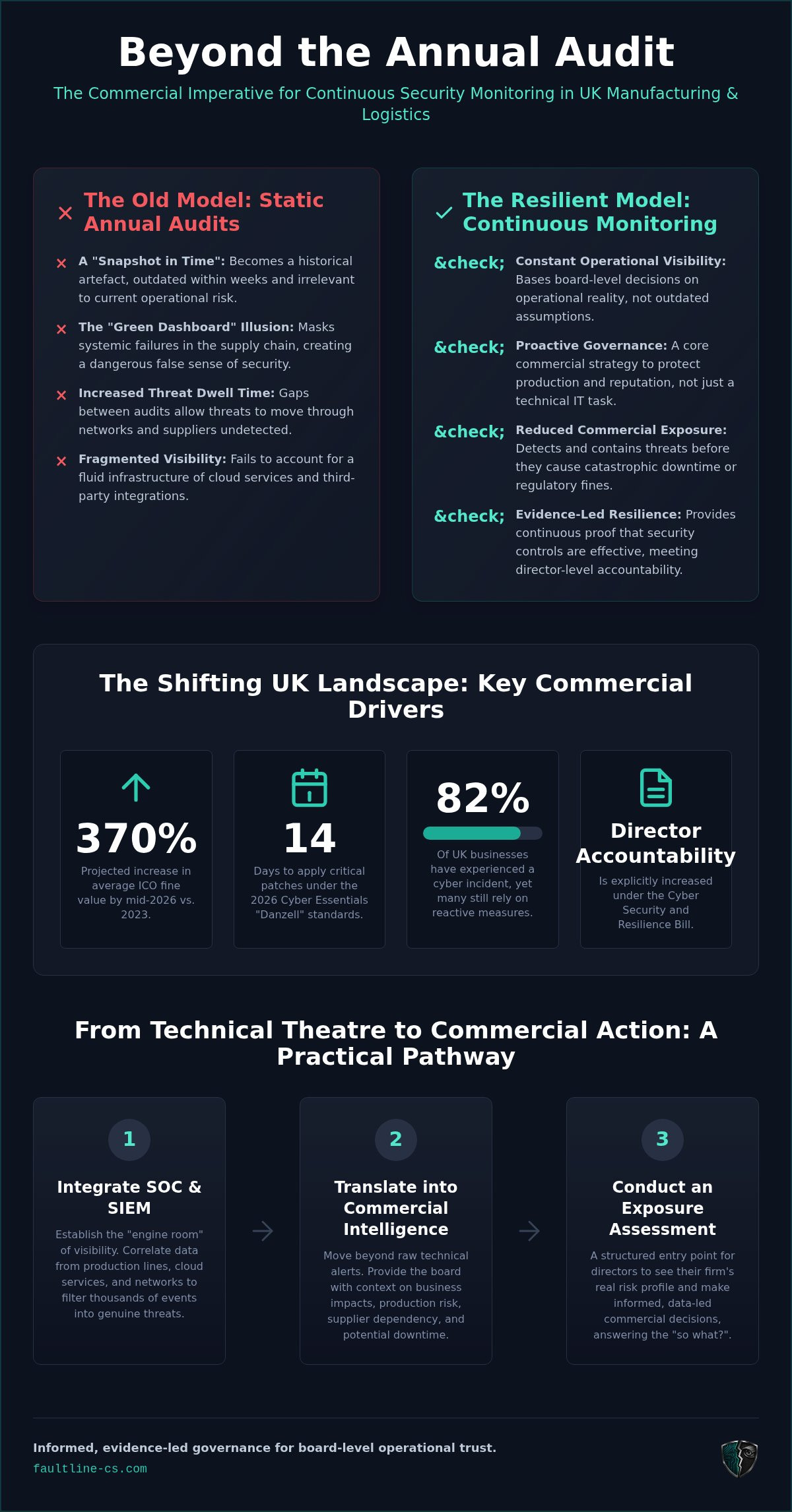
Annual audits have become historical artefacts. In an environment where critical patches must be applied within 14 days to meet the 2026 Cyber Essentials “Danzell” standards, a report from six months ago is effectively a work of fiction. Adopting Continuous Monitoring as a core governance strategy is no longer a technical choice; it’s a commercial necessity. For directors in manufacturing and logistics, the risk isn’t just data loss. It’s the total cessation of production caused by a vulnerability that was ignored because the next audit wasn’t due for months.
The “snapshot in time” model fails because it assumes a static environment. Modern infrastructure is fluid, with cloud services and third-party integrations changing daily. If your oversight is periodic, your visibility is fragmented. This gap between assessments creates a “dwell time” where threats can move laterally through your supply chain undetected. Transitioning to continuous security monitoring UK ensures that your board-level decisions are based on operational reality rather than outdated assumptions.
The Limitations of Static Compliance
Traditional compliance often creates a “green dashboard” illusion. This false confidence suggests that because you passed a point-in-time check, your perimeter is secure. It isn’t. Sophisticated actors now exploit the gaps between these checks, targeting your operational resilience rather than just your servers. When a new critical vulnerability emerges, you don’t have weeks to react; you have hours. Measuring real-world resilience requires a shift from checking boxes to a model of constant, evidence-led verification.
The 2026 UK Threat Landscape
The UK threat landscape has fundamentally shifted. By mid-2026, the average ICO fine has surged by 370% compared to 2023, reflecting a regulatory environment that prioritises demonstrable resilience over paper-based promises. In regions like Belfast and across the wider UK, logistics hubs and manufacturing plants are being targeted through their supply chains. These aren’t just technical glitches. They are strategic disruptions designed to halt your operations.
Current trends show that 82% of UK businesses have experienced a cyber incident, yet many still rely on reactive measures. The commercial cost of late detection is no longer just a line item in an IT budget; it’s a threat to your firm’s survival. With the Cyber Security and Resilience Bill placing explicit accountability on executive management, the “so what?” for directors is clear. If you cannot prove your security controls are effective today, you are carrying a level of commercial exposure that no annual audit can mitigate.
The Anatomy of a Resilient Monitoring Strategy
Technical tools are frequently mistaken for strategy. A resilient monitoring posture is not a collection of disconnected software licenses but a structured architecture that translates technical signals into commercial intelligence. For directors, the goal is to move beyond the noise of daily alerts to a state of informed oversight. Achieving this level of continuous security monitoring UK requires a deliberate integration of human expertise and data correlation that reflects the operational reality of your business.
SOC and SIEM: The Engine Room of Visibility
Visibility is only useful if it’s actionable. A Security Information and Event Management (SIEM) system acts as the central nervous system, correlating data from your production lines, cloud services, and office networks. However, data without context is just noise. This is where a Security Operations Centre (SOC) becomes vital. By filtering thousands of events to identify the handful of genuine threats, a SOC provides the human oversight necessary to prevent operational paralysis. When evaluating MSSP services, ensure they provide context rather than just passing on raw technical alerts.
Monitoring must also extend to identity and credential exposure. With the 2026 Cyber Essentials “Danzell” update mandating MFA for all cloud services, compromised credentials remain a primary entry point for attackers. Continuous oversight of credential exposure ensures that stolen logins don’t become the key that unlocks your entire supply chain. It’s about recognising that human behaviour is often the weakest link in a sophisticated technical chain.
The Role of IntelSensus in Cyber Readiness
Effective governance is built on evidence, not assumptions. Our FaultLine Cyber Readiness Assessment, powered by IntelSensus, provides a data-led framework to quantify your current security maturity. This process aligns with NCSC risk management guidance by identifying systemic gaps before they are exploited. In a manufacturing context, this approach moves the conversation from vague cyber risk to specific production downtime. By mapping technical vulnerabilities to operational dependencies, you can see exactly which part of the factory floor is exposed.
The final component is communication. Senior leadership doesn’t need to understand the mechanics of a SQL injection; they need to know if production is at risk. Plain-English reporting bridges the gap between the server room and the boardroom, turning technical data into strategic clarity. If you’re unsure how your current setup translates to business risk, you can speak with our consultants to refine your reporting structure and move from technical theatre to practical resilience.
Beyond the Dashboard: Addressing the Green Dashboard Illusion
Dashboards are often comfort blankets for the uninformed. A row of green lights suggests control, but it frequently only reflects the status of specific IT assets whilst ignoring the systemic gaps in your operational logic. True continuous security monitoring UK requires looking past the interface to understand where real exposure lies. As highlighted in our insight on Moving Beyond the Green Dashboard Illusion, relying on automated signals without human context is a recipe for strategic failure. Evidence of safety is not the same as the absence of risk.
Governance is built on evidence. An ISACA guide to continuous monitoring emphasises that these programmes must align with business objectives rather than just technical metrics. For a manufacturing director, a “green” signal on a firewall means nothing if a third-party maintenance contractor has unfettered access to the PLC network via an unmonitored laptop. Monitoring must be broad enough to capture these operational realities, moving beyond the server room to the factory floor and the distribution hub.
Supplier and Third-Party Dependencies
Operational trust is a vulnerability. Most logistics and manufacturing firms grant external partners deep access to their systems to facilitate efficiency. However, these pathways are rarely monitored with the same rigour as internal accounts. FaultLine analyses the hidden gaps where incidents frequently begin, often finding that the “green” status of the primary firm is rendered irrelevant by the poor hygiene of a critical supplier. Monitoring must encompass the entire ecosystem. You cannot claim operational resilience if your visibility ends at your own perimeter.
Physical-to-Cyber Crossover Risks
Digital security does not exist in a vacuum. Physical access is a cyber vulnerability that dashboards frequently ignore. If an unauthorised person can enter your facility or a server room, your digital perimeters are effectively bypassed. Monitoring the movement of people is as critical as monitoring the movement of data. A pragmatic sentinel looks at the intersection of these risks, recognising that a physical breach is often the precursor to a digital catastrophe.
Consider the risk of a physical breach leading to a digital fallout. A lost access card or a tailgating incident at a distribution centre provides a direct route to the hardware that runs your operations. Effective resilience requires a unified view of risk where physical security protocols are integrated into your broader monitoring framework. This ensures that a breach in the physical world is detected and countered before it translates into a production-halting event. Relying on software alone to protect a physical environment is a dangerous assumption that directors can no longer afford to make.
Implementing Continuous Visibility in UK Infrastructure
Implementation is the point where strategic intent meets operational reality. Many firms fail because they treat monitoring as a siloed IT project rather than a business continuity requirement. Effective continuous security monitoring UK requires a focus on the processes that drive your revenue, ensuring that visibility is concentrated where an outage would be most catastrophic. By defining scope through the lens of operational sensitivity, directors can ensure that resources are allocated to protecting the firm’s actual value rather than just its hardware assets.
Governance must extend beyond the initial setup of tools. High-level oversight is only effective if there are clear escalation routes that translate technical anomalies into commercial decisions. When a threat is detected, the response shouldn’t be confined to a server room; it must involve operational leaders who understand the impact on production schedules and supplier commitments. This structured approach is detailed further in our Managed Security Service Provider UK: Director’s Guide, which outlines how to bridge the gap between technical alerts and board-level action.
Defining Scope for Operationally Sensitive Firms
Identifying your “Crown Jewel” processes is the first step toward resilient oversight. In manufacturing and logistics, these are the data flows and automated systems that, if halted, would stop production or block the supply chain. Mapping these dependencies allows for a prioritised monitoring strategy. You don’t need to monitor every non-critical asset with the same intensity. Instead, focus your visibility on the areas where the financial impact of downtime is highest, ensuring that continuous security monitoring UK provides a genuine safety net for your core operations.
Aligning with UK Regulatory Standards
The UK’s regulatory environment is becoming increasingly rigorous for infrastructure and supply chain participants. The Cyber Security and Resilience Bill, introduced to strengthen the UK’s framework, places explicit accountability on executive management to oversee cybersecurity measures. This shift mirrors the principles of the EU’s NIS2 directive, requiring organisations to prove that their security controls are active and effective. Aligning your monitoring with these standards isn’t just about avoiding penalties; it’s about meeting the heightened expectations of cyber insurers and corporate partners who now demand evidence of resilience.
Public-facing manufacturing sites must also consider the implications of Martyn’s Law, where security monitoring plays a vital role in public safety and site resilience. Maintaining ISO/IEC 27001 certification similarly requires a commitment to continual improvement cycles. Monitoring provides the data needed to prove that your controls aren’t just present on paper but are functioning in the real world. This evidence-led approach ensures that your governance framework remains robust enough to withstand both regulatory scrutiny and the evolving tactics of sophisticated actors.
FaultLine Cyber & Security Ltd: Board-Level Operational Trust
Resilience is not a product you buy; it’s a state you maintain through evidence-led governance. At FaultLine Cyber & Security Ltd, we act as a pragmatic sentinel for directors who are sceptical of technical theatre and industry hype. Our approach to continuous security monitoring UK is built on the understanding that security is an operational logic problem, not just an IT one. We provide the clarity needed to align your technical defences with your commercial objectives, ensuring that your production and reputation remain secure whilst avoiding the pitfalls of over-engineered solutions.
The £5,000 Exposure Assessment
Meaningful oversight begins with an accurate baseline. Our fixed-price Exposure Assessment at £5,000 serves as the logical entry point for directors who need to see their real risk profile without committing to expensive, unproven toolsets. This service provides a comprehensive deconstruction of your current posture, resulting in a board-level report that avoids jargon in favour of a realistic attack-path narrative. We identify the specific gaps where a breach could halt your production or disrupt your supply chain, offering a clear-eyed perspective on reality before you invest in further operational resilience services. This assessment allows you to move beyond the “snapshot” audit model discussed earlier, providing a foundation for ongoing visibility.
Practical Resilience for Senior Leadership
We focus on “Pilot 0 thinking” to answer the “so what” for leadership teams in Belfast and across the UK. Our methodology connects the dots between cyber vulnerabilities, physical security gaps, and governance failures into a single, coherent picture. This integrated view allows you to manage risk as a board-level responsibility rather than a siloed technical issue. We prioritise factual accuracy and transparency, ensuring that every insight we provide is based on verifiable evidence rather than speculation or alarmism. By identifying where operational trust assumptions fail, we help you avoid wasted spend on irrelevant technical controls.
Our partnership model is designed for long-term resilience. We move seamlessly from identifying systemic vulnerabilities to outlining a structured path forward, acting as a steady hand in complex environments. Whether you are navigating the requirements of the Cyber Security and Resilience Bill or seeking to reduce threat dwell time, FaultLine Cyber & Security Ltd provides the sophisticated guidance required for modern corporate governance. You can reach out to Paddy Hearty or Cris Martlew for a confidential discussion regarding your current exposure and how to transition toward a model of constant visibility.
Securing Operational Continuity through Evidence-Led Governance
The transition from periodic compliance to persistent oversight is no longer a matter of technical preference but one of corporate survival. Relying on annual snapshots leaves your production and reputation exposed to vulnerabilities that evolve in hours, not months. Implementing continuous security monitoring UK ensures that your board-level decisions are based on the current reality of your supply chain and internal infrastructure.
True resilience is achieved when you move beyond the “green dashboard” illusion to address systemic gaps in operational logic. By utilising IntelSensus-powered readiness frameworks, you can quantify your maturity and prioritise visibility where the financial impact of downtime is highest. Our Belfast-based team of experts provides the sober, technical guidance needed to navigate this complexity without the distraction of industry hype.
The first step toward this model is clarity. Our fixed-price £5,000 Exposure Assessment offers a transparent deconstruction of your real-world risks, providing a narrative that translates technical exposure into commercial impact. This evidence-led approach allows you to build a foundation of trust and operational readiness that survives regulatory scrutiny and sophisticated threats.
Building a resilient organisation is a methodical process. We’re here to provide the steady hand and strategic insight required to secure your future.
Frequently Asked Questions
What is continuous security monitoring in a UK business context?
It’s an ongoing governance process that provides constant visibility into your digital and physical perimeters. Unlike reactive IT support, continuous security monitoring UK focuses on identifying threats in real-time before they impact production or supply chains. This approach aligns with the Cyber Security and Resilience Bill requirements for proactive risk management. It ensures that firms in regions like Belfast and Lisburn maintain operational continuity despite evolving external threats.
How does continuous monitoring differ from an annual security audit?
An annual audit is a point-in-time snapshot that becomes outdated within weeks. Continuous monitoring provides a persistent stream of evidence-led insights into your current risk profile. Whilst an audit checks for past compliance, monitoring identifies active vulnerabilities such as missed patches or credential exposure. For directors, this means moving from historical reports to live operational readiness, reducing the dwell time that allows attackers to disrupt logistics or manufacturing processes.
Is continuous monitoring required for NIS2 or ISO 27001 compliance?
Whilst not always explicitly named as a single tool, it’s a fundamental requirement for meeting modern resilience standards. The EU’s NIS2 directive and the UK’s 2025 Cyber Security and Resilience Bill mandate strict incident reporting timelines, such as initial warnings within 24 hours. ISO 27001 also requires continual improvement and performance evaluation. You cannot meet these reporting obligations or demonstrate effective control without a system of ongoing, evidence-based oversight across your infrastructure.
Can continuous monitoring help reduce our cyber insurance premiums?
Yes, insurers increasingly prioritise firms that can demonstrate active risk management over those with static certifications. Providing evidence of 24/7 monitoring and rapid incident response reduces your perceived risk profile. By documenting that critical patches are applied within the 14-day window required by the 2026 Cyber Essentials standards, continuous security monitoring UK presents a stronger case during policy renewals. This proactive posture often leads to more favourable terms and lower premiums for UK infrastructure firms.
How does FaultLine handle the physical security aspect of monitoring?
We treat physical access as a primary cyber vulnerability. Our monitoring strategy includes identifying crossover risks where a breach of office or factory floor security provides a direct path to digital assets. We analyse how the movement of people interacts with the movement of data, ensuring that unmonitored physical entry points don’t bypass your digital firewalls. This holistic view is essential for protecting sensitive operations in industrial hubs like Newtownabbey and Craigavon.
What is the “Green Dashboard Illusion” in cybersecurity?
This is the false sense of security created when automated tools show green status whilst ignoring systemic operational gaps. Your dashboard might report that your firewall is active, but it won’t show that a critical supplier has unmonitored access to your PLC network. We look beyond these surface-level metrics to identify hidden exposures in your governance and supply chain that software alone cannot detect, ensuring your visibility matches reality.
How much does a professional exposure assessment cost?
FaultLine provides a fixed-price Exposure Assessment at £5,000. This flagship entry-level service is designed for directors who need a clear, board-level report on their real risk profile without the complexity of a full audit. It includes an analysis of external visibility, credential exposure, and supplier dependencies. For firms in Belfast and Derry/Londonderry, this provides a realistic attack-path narrative that informs strategic decisions before heavy investment in technical tools or software.
Does continuous monitoring require hiring a large internal IT team?
No, most operationally-focused firms find that a managed service model is more efficient than building an internal team. By partnering with a Managed Security Service Provider (MSSP), you gain access to 24/7 SOC and SIEM capabilities without the overhead of specialist recruitment. This allows your existing team to focus on core production whilst we act as a pragmatic sentinel, providing the expert oversight and plain-English reporting required for effective board governance.

Article by
Alex J Morgan
Alex Morgan writes and develops content for FaultLine Cyber & Security Ltd. Alex has worked across web development, organic SEO, digital marketing and content creation since 2009, with a particular focus on making complex subjects clear, useful and easy to navigate.
Leave a Reply