


Most security dashboards are designed to impress technical teams whilst leaving directors in the dark about actual business resilience. It’s a common frustration for senior leadership to see rising security spends that fail to translate into clear risk reduction. You’re often presented with a wall of jargon and green lights that do little to explain what happens if a key supplier goes offline or a production line halts. Learning how to choose an MSSP in the UK shouldn’t feel like a gamble on which provider has the flashiest software. It’s a strategic decision that must be rooted in your specific operational logic.
We understand that justifying security investment to the board is difficult when the outcomes feel abstract. This guide provides a commercially grounded framework to help you select a Managed Security Service Provider that closes the gap between technical monitoring and real business exposure. We’ll move beyond the industry hype to examine how you can identify a partner that prioritises evidence over assumptions. By the end of this article, you’ll have a clear path to align your 2026 security strategy with the practical realities of your manufacturing or logistics operations.
Key Takeaways
- Identify why technical green dashboards often obscure real business exposure and how to align security reporting with board-level governance.
- Distinguish between MSSP, SOC, and SIEM services to ensure your outsourced partner understands the operational logic of your specific industry.
- Follow a practical framework on how to choose an MSSP in the UK that begins with a baseline exposure assessment rather than a tool-first approach.
- Analyse the commercial reality of the UK security skills gap to determine if an in-house 24/7 function is actually viable for your organisation.
- Recognise why technical monitoring is ineffective without a foundation of cyber readiness and how to bridge this gap for long-term resilience.
Managed Security Service Provider UK: Moving Beyond the Green Dashboard
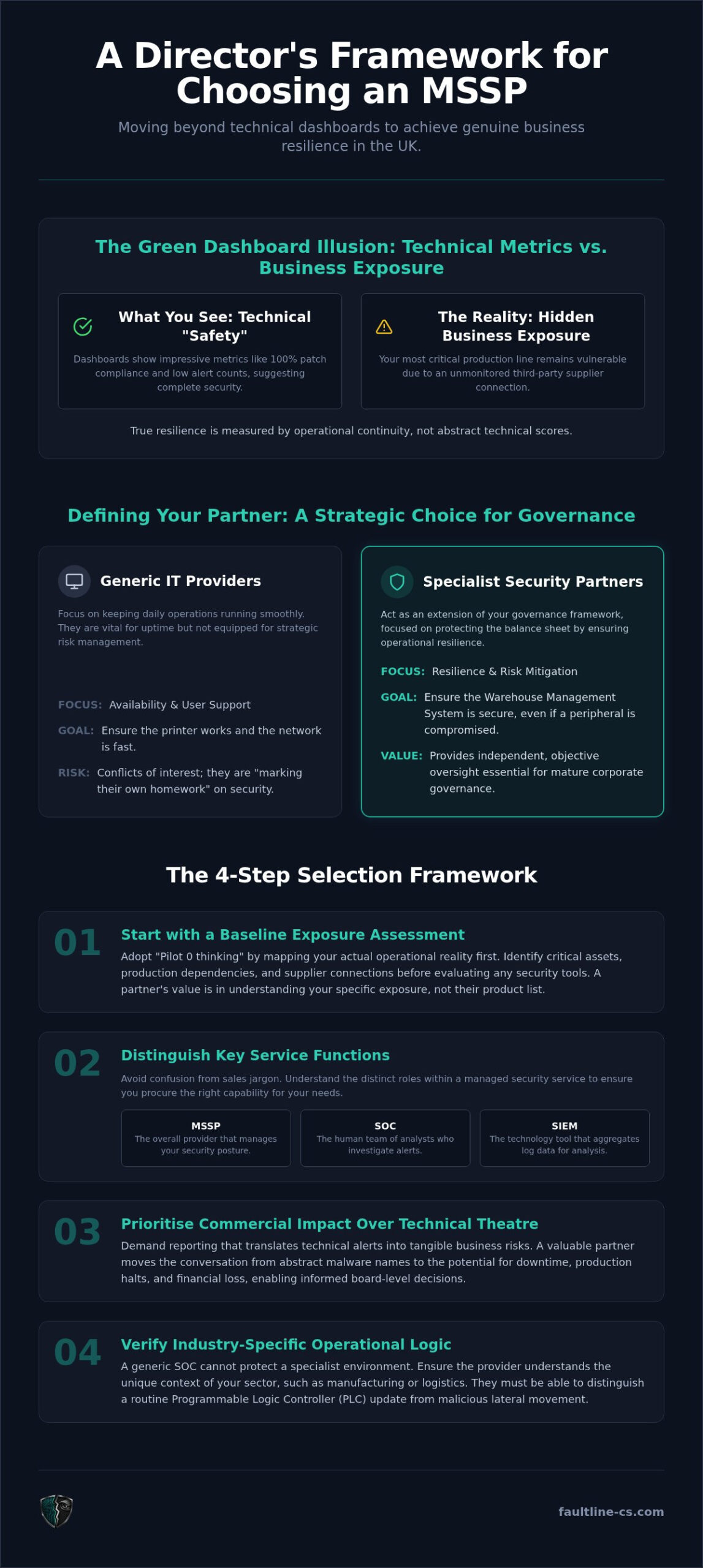
Managed security is often misunderstood as a purely technical procurement. In reality, a Managed Security Service Provider (MSSP) functions as a vital component of a UK corporate governance framework. Its role is to protect the integrity of the balance sheet by ensuring operational continuity. However, many directors are lulled into a false sense of security by the green dashboard illusion. These interfaces often display impressive technical metrics that bear little relation to actual business exposure. You might see 100% patch compliance on paper whilst your most critical production line remains vulnerable due to an unmonitored supplier connection.
Understanding how to choose an MSSP in the UK requires a shift in perspective. We advocate for Pilot 0 thinking, a methodology where your security strategy begins with your operational reality rather than a vendor’s product list. There is a fundamental difference between a generalist and a specialist:
- Generic IT Providers: Focus on availability and user support. They want the printer to work and the network to be fast.
- Specialist Security Partners: Focus on resilience and risk. They ensure that even if a peripheral device is compromised, your warehouse management system remains secure.
This distinction is the difference between simple maintenance and strategic protection.
The Reality of Modern Cyber Exposure
Traditional perimeter defences are no longer sufficient for UK firms operating complex supply chains. Modern exposure exists at the intersection of cyber, physical, and supplier risk. For a logistics firm, a breach in a third-party tracking portal can be as devastating as a direct attack on their internal servers. We define exposure as the gap between your technical monitoring and the reality of where an incident actually begins. Closing this gap requires visibility into systemic vulnerabilities that technical tools alone often miss.
Commercial Impact vs Technical Theatre
Security reporting should focus on commercial outcomes rather than technical theatre. Directors don’t need to know the names of specific malware variants; they need to know the potential for downtime and the impact on production risk. When deciding how to choose an MSSP in the UK, prioritise providers who can align security spend with these business outcomes. A partner providing specialist security services should be able to translate technical alerts into business impacts, allowing you to make informed decisions about where to allocate resources for maximum resilience.
Defining the Scope: MSSP vs Outsourced SOC UK
Directors are often confronted with an alphabet soup of technical acronyms that obscure the underlying commercial reality. To make an informed decision on how to choose an MSSP in the UK, you must first understand the functional differences between these services. An MSSP is the broad service provider that manages your security posture. Within that, a Security Operations Centre (SOC) is the team of analysts who provide the human intelligence needed to interpret alerts. They utilise a SIEM (Security Information and Event Management) tool to aggregate data from across your network. Whilst these terms are often used interchangeably by sales teams, their roles in your governance framework are distinct.
The strategic value of these services lies in their ability to provide visibility into distributed environments. For manufacturing and logistics leaders, a generic approach is rarely sufficient. Your provider must understand the specific operational logic of your sector. If a SOC analyst cannot distinguish between a routine maintenance update on a PLC (Programmable Logic Controller) and a malicious lateral movement, the service adds little value. This industry-specific insight is what separates a basic monitoring service from a true resilience partner.
Managed Security vs Managed IT
It’s a common mistake to assume your general IT provider has security covered. Whilst they are vital for uptime and user support, asking them to manage your security creates a situation where they are effectively marking their own homework. Independent security oversight is a strategic necessity for directors who value objective risk reporting. Specialist security partners provide a “Pilot 0” perspective, focusing on identifying systemic gaps that a generalist might overlook in favour of operational convenience. This separation of duties is a hallmark of mature corporate governance.
The Value of an Outsourced SOC UK
An outsourced SOC UK model offers continuous threat detection without the prohibitive costs of building a 24/7 internal function. In the logistics sector, where operations never truly sleep, 24/7 monitoring is not a luxury; it’s a requirement for maintaining supplier trust. Rapid detection significantly reduces dwell time, preventing a minor intrusion from becoming a catastrophic production halt. These managed services also provide the structured evidence required to support compliance with standards like ISO 27001. If you are evaluating your current operational exposure, you can contact our consultants for a clear-eyed assessment of your needs.
Outsourced SOC vs In-House: A Strategic UK Comparison
Internal security functions are often more fragile than they appear. Whilst building an in-house Security Operations Centre (SOC) is frequently viewed as the gold standard for control, the commercial reality for most UK firms is starkly different. Maintaining a 24/7 technical function requires a level of investment and management oversight that can quickly become a distraction from core business objectives. The decision on how to choose an MSSP in the UK should be framed by a realistic assessment of your ability to sustain this capability over the long term.
Co-managed security offers a strategic middle ground for organisations with existing IT teams. This model allows you to retain visibility and final decision-making authority whilst outsourcing the heavy lifting of continuous monitoring to a specialist. It ensures you maintain control over your operational logic without the burden of 24/7 execution. By partnering with an external provider, you gain a steady hand that provides clarity without the overhead of a full internal department.
Recruitment and Retention Challenges
The UK security skills gap is a systemic risk that recruitment cannot solve alone. Finding qualified analysts is difficult, but keeping them is often the greater challenge. Internal teams frequently suffer from stagnation and alert fatigue because they are limited to the traffic patterns of a single organisation. An MSSP provides a strategic advantage here, as their analysts benefit from broader threat intelligence gathered across multiple clients. This diversity of experience ensures they are better equipped to recognise emerging patterns before they impact your production environment.
Financial Realities for UK Directors
Comparing capital expenditure (CapEx) against operational expenditure (OpEx) reveals the true cost of an internal SOC. Building a 24/7 function involves significant upfront investment in tooling and a high recurring cost for staffing multiple shifts. There are also hidden costs associated with recruitment fees, ongoing specialist training, and software maintenance. In many cases, the total cost of employing just one experienced security analyst is comparable to the annual fee for a full managed security service that provides round-the-clock coverage. Moving to a managed model provides the board with a predictable and scalable cost structure that aligns directly with business outcomes.
The Selection Framework: How to Choose an MSSP in the UK
Procurement often fails when it prioritises technology over risk alignment. To avoid this, your selection process should follow a structured, commercially grounded framework. Knowing how to choose an MSSP in the UK requires moving beyond a simple comparison of features to an evaluation of strategic fit. This process begins with understanding your own environment before inviting a partner to manage it. A steady hand is only effective if it knows exactly what it is protecting.
- Step 1: Conduct an Exposure Assessment. You cannot protect what you have not quantified. Define your baseline exposure to identify systemic gaps before investing in monitoring tools.
- Step 2: Evaluate Sector Understanding. A partner must understand the operational logic of UK manufacturing or logistics. They should know how a delay in your supply chain impacts your bottom line.
- Step 3: Review Reporting Style. Demand board-ready insights in plain English. If their reports are filled with technical jargon rather than business risk, they are failing their primary duty to leadership.
- Step 4: Check UK-Specific Knowledge. Ensure they are aligned with UK regulatory requirements and standards like ISO 27001. Local knowledge of the UK threat landscape is a strategic necessity.
- Step 5: Test Response Capability. Move beyond automated alerts. Ask for evidence of how they handle complex incidents that cross the boundary between cyber and physical systems.
Critical Questions for Potential Partners
Engagement should start with challenging questions that expose a provider’s true depth. Ask how they translate technical threats into business risk for your board. Inquire about their specific experience with UK supply chain dependencies and how they manage the physical to cyber crossover gap. A partner who values evidence over assumptions will provide clear, logical answers rather than vague assurances. This transparency is the foundation of a long-term resilience partnership.
Red Flags to Avoid During Procurement
Be wary of providers who lead with tool names rather than risk conversations. This is often a sign of technical theatre. Vague promises of 100% security or unbreakable systems are hallmark traits of an immature provider. Finally, a lack of transparency regarding their own third-party risks is a significant warning sign. If they don’t manage their own exposure, they cannot be trusted with yours. Focus on finding a partner that prioritises clarity and operational logic over flashy dashboards.
Closing the Gap: The Cyber Readiness Approach
Monitoring is an empty exercise if it isn’t built on a foundation of cyber readiness. Many organisations invest heavily in an outsourced SOC only to find that they’re paying for a team to watch a fire they haven’t tried to prevent. A technical alert is just noise if you haven’t defined what constitutes a business-critical event within your specific operational logic. This is why the process of how to choose an MSSP in the UK must start with an honest evaluation of your current posture rather than a procurement of tools. You cannot monitor your way out of systemic vulnerability.
The FaultLine Cyber Readiness Assessment, powered by IntelSensus, is designed to provide this necessary clarity. We move beyond the technical theatre of green dashboards to identify the actual exposure gaps that threaten your production and logistics. By starting with our fixed-price £5,000 Exposure Assessment, you gain a commercially grounded baseline that dictates exactly what needs monitoring and why. This approach shifts your organisation from reactive firefighting to proactive exposure management, ensuring your security spend is an investment in resilience rather than a sunk cost.
Establishing an Evidence-Led Strategy
Effective security requires visibility into how an attacker sees your organisation from the outside. We use OSINT (Open Source Intelligence) and external visibility signals to map potential attack paths before they can be exploited. This evidence-led strategy is then refined through board-level workshops where we define your specific risk appetite. It’s about ensuring that your security partner understands the difference between a minor IT glitch and a catastrophic supply chain failure. For a deeper look at this strategic alignment, see our Managed Security Service Provider UK: Director’s Guide.
Next Steps for Senior Leadership
Moving forward requires a controlled wake-up call for your organisation. Directors must move away from the assumption that security is a technical problem handled by the IT department. It’s a governance issue that requires a steady hand and a clear-eyed perspective on reality. Whether you are preparing for ISO 27001 or aiming for Cyber Essentials Plus, our managed support provides the structured evidence needed for compliance and operational trust. When deciding how to choose an MSSP in the UK, look for a partner that values transparency and logic over hype. Your long-term resilience depends on a partner that is more interested in your business outcomes than their own software stack.
Contact FaultLine to discuss your Exposure Assessment
Aligning Security Strategy with Operational Reality
Securing your organisation in 2026 requires a fundamental shift from technical monitoring to strategic resilience. Directors must look past the illusion of green dashboards to find partners who understand the specific production risks inherent in UK manufacturing and logistics. By prioritising evidence over assumptions, you can effectively close the gap between your digital defences and real-world exposure.
Learning how to choose an MSSP in the UK is ultimately about finding a strategic guide capable of providing board-level reporting in plain English. We provide a fixed-price £5,000 Exposure Assessment to establish this baseline; this ensures your investment is grounded in operational logic with no hidden costs. Moving from reactive firefighting to proactive management is the only way to maintain long-term trust with your suppliers and customers. This approach ensures that every pound spent on security is a pound spent on protecting your commercial viability.
Take the first step towards a more resilient and transparent security posture that serves your business goals.
Frequently Asked Questions
What is the average cost of an outsourced SOC in the UK?
Cost varies based on the complexity of your network and the level of monitoring required. It is influenced by log volumes, the number of users, and whether you require 24/7 human analysis. Rather than looking for a generic industry average, directors should focus on the value of protecting their specific production lines. Starting with a fixed-price £5,000 Exposure Assessment allows you to define your requirements before committing to a long-term service contract.
How does an MSSP differ from a standard managed service provider (MSP)?
An MSP ensures your technology is available and functional, focusing on tasks like patching and helpdesk support. An MSSP focuses on protecting your organisation from exposure and systemic risk. Whilst an MSP wants your printers to work, an MSSP ensures that a compromised printer cannot be used as a gateway to your core operational data. This independent oversight is vital for mature corporate governance and objective risk management.
Do I still need an MSSP if we have Cyber Essentials Plus?
Cyber Essentials Plus is a valuable baseline certification, but it represents a point-in-time snapshot of your technical controls. It doesn’t provide the continuous monitoring or active threat hunting needed to detect a live intrusion. An MSSP provides the 24/7 visibility required to respond to incidents as they happen. For manufacturing firms with complex supply chains, relying solely on a yearly audit leaves significant gaps in your daily operational resilience.
Can an MSSP help with NIS2 or ISO 27001 compliance?
Managed security services are essential for maintaining the continuous evidence required by NIS2 and ISO 27001. These frameworks demand more than just policies; they require proof of active risk management and incident response capabilities. An MSSP provides the technical logs and board-level reporting that demonstrate your compliance to auditors and partners. This alignment ensures that your security posture meets the high standards expected in modern logistics and manufacturing sectors.
What should be included in a managed security service contract?
A robust contract must clearly define service level agreements for detection and response times rather than just uptime. It should specify data ownership, transparency regarding the provider’s own third-party risks, and the frequency of board-level reporting. When considering how to choose an MSSP in the UK, ensure the contract includes provisions for regular exposure assessments. This ensures the service evolves alongside your business rather than becoming a static technical expense.
How do I measure the return on investment (ROI) for an MSSP?
ROI in managed security is measured by the avoidance of catastrophic operational failure and production downtime. Calculate the cost of a single day of halted logistics or manufacturing to understand the value of prevention. Effective security also protects your commercial reputation and supplier trust, which are difficult to rebuild once lost. By moving from reactive firefighting to proactive exposure management, you ensure that security spend directly supports long-term business continuity.
Is an outsourced SOC suitable for a small to medium-sized UK business?
Small and medium-sized organisations often benefit the most from an outsourced model because they cannot justify the cost of an internal 24/7 team. Building an in-house function requires significant recruitment and retention effort in a competitive UK market. An outsourced SOC provides access to specialist analysts and enterprise-grade tools at a predictable operational cost. This allows smaller firms to compete for contracts that require high levels of proven security and resilience.
How often should my MSSP provide reports to the board?
Strategic reports should be delivered to the board at least quarterly, whilst operational leaders may require monthly updates. These reports must move beyond technical metrics to explain risk in plain English. They should focus on changes in your exposure baseline and the effectiveness of your current resilience measures. Regular communication ensures the board remains informed about systemic vulnerabilities and can make evidence-led decisions regarding how to choose an MSSP in the UK for future expansion.

Article by
Alex J Morgan
Alex Morgan writes and develops content for FaultLine Cyber & Security Ltd. Alex has worked across web development, organic SEO, digital marketing and content creation since 2009, with a particular focus on making complex subjects clear, useful and easy to navigate.
Leave a Reply